
For the first time ever, an exceptionally powerful tsunami has been observed from space in stunning detail. The feat, made possible by a satellite that wasn’t even designed for this purpose, has revealed wave behavior that challenges one of the core principles of tsunami science.
Launched in 2022 by NASA and France’s CNES space agency, the SWOT (Surface Water and Ocean Topography) satellite was originally built to map variations in water height and track low-intensity ocean currents. But on July 29, 2025, something extraordinary happened: an 8.8-magnitude earthquake struck the Kuril–Kamchatka subduction zone off Russia’s Pacific coast — just as SWOT was passing overhead.
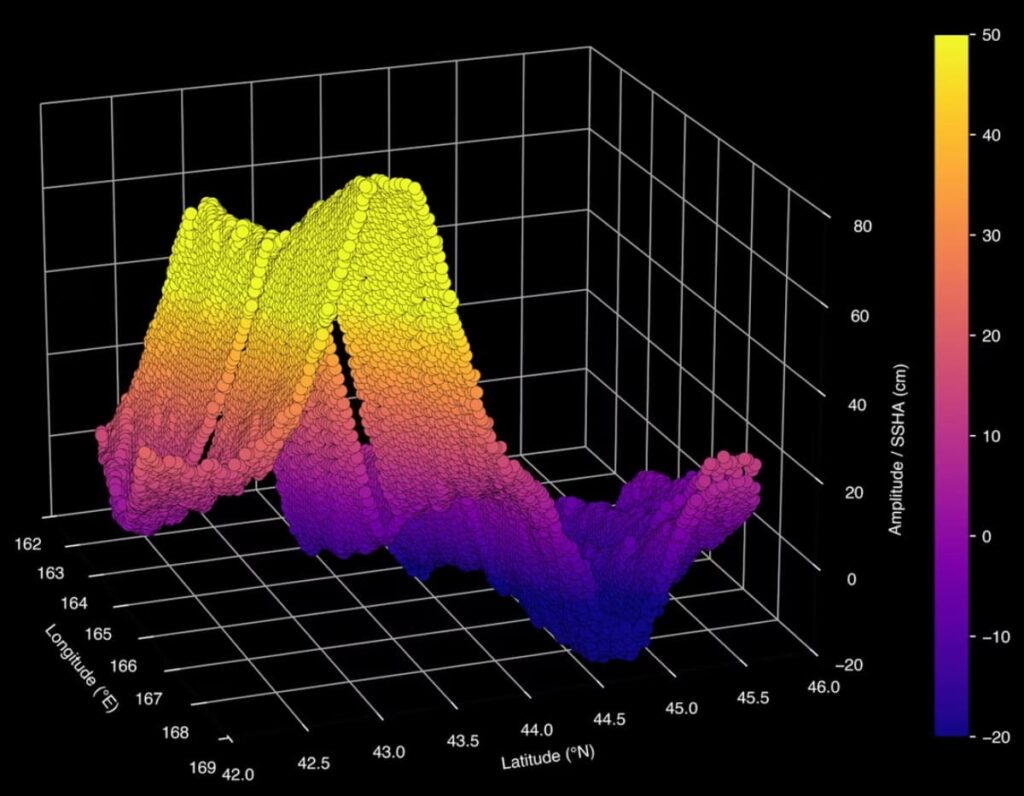
Visualization of the tsunami front using sea surface height measurements captured by SWOT. © NASA/JPL-Caltech
A satellite’s view of a living wave
For the first time, scientists were able to follow a tsunami from its birth to its full expansion across the ocean. SWOT’s unprecedented resolution, combined with data from three DART (Deep-ocean Assessment and Reporting of Tsunamis) buoys, offered a complete picture of the wave’s evolution from start to finish.
A surprisingly complex pattern
Until now, models suggested that large tsunamis behave as single, coherent waves that move across the ocean without breaking apart. But SWOT’s readings told a different story.
The data showed the wave splitting into several parts — a massive front wave followed by a train of smaller ones. This intricate structure, captured across a swath nearly 120 kilometers wide, was something no earlier satellite could have detected. Previous systems offered only isolated data points or narrow cross-sections.
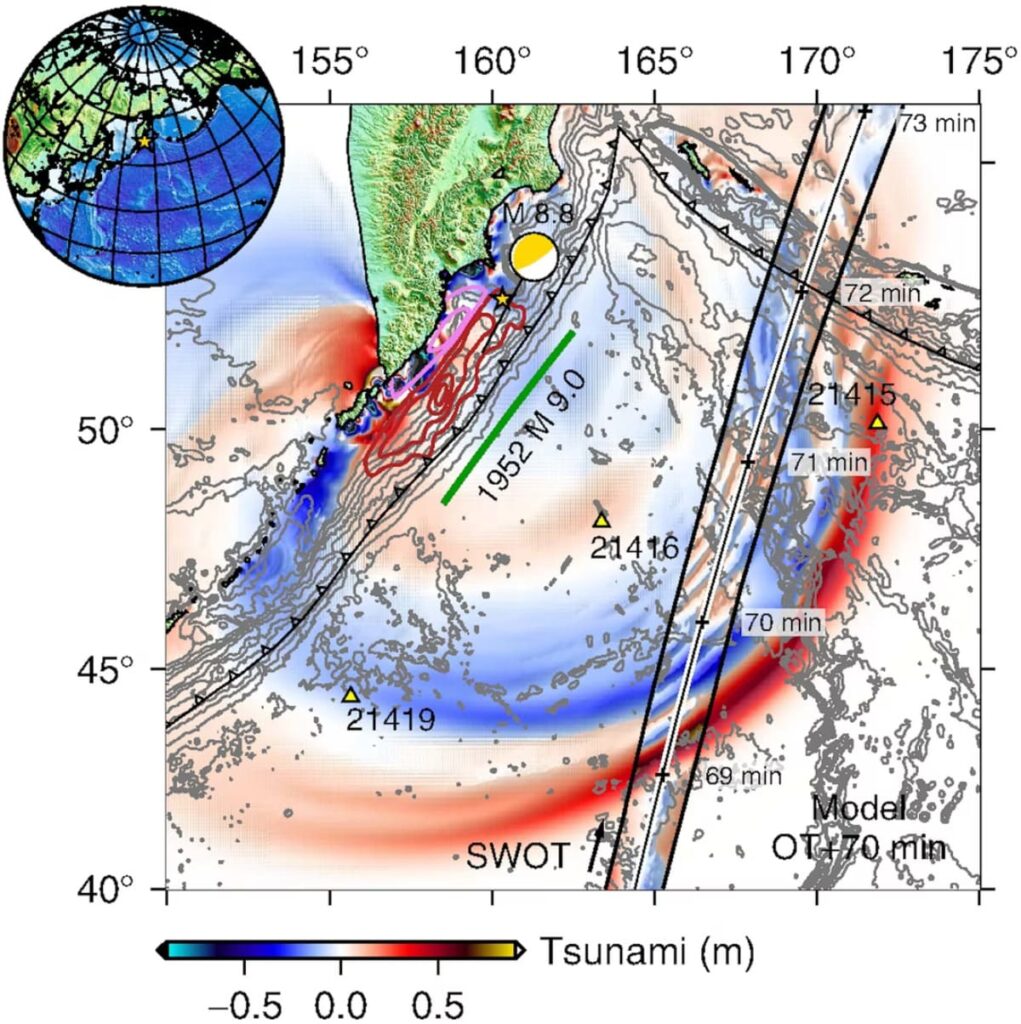
Tsunami SWOT data: the star marks the hypocenter. The first wave, in red, exceeded 45 cm in height. © Ruiz-Angulo et al., TSR, 2025
“I see SWOT data as a new pair of glasses,” said Angel Ruiz-Angulo, an oceanographer at the University of Iceland and lead author of the study. “DART systems gave us point readings. Earlier satellites could, at best, cut across the wave along a thin line.”
A breakthrough for future tsunami alerts
The implications go far beyond a single event. With measurements like these, SWOT could become a vital early-warning tool, helping scientists detect tsunamis as soon as they form and track their paths in real time.
By refining propagation models, researchers hope to give coastal communities precious minutes of advance warning — time that can mean the difference between safety and disaster.
The study, published in The Seismic Record, marks a turning point in how we understand and monitor these colossal forces of nature. With SWOT’s “new eyes,” scientists are now seeing the ocean’s hidden dynamics like never before — and rewriting what we thought we knew about waves themselves.

Cécile Breton
Journalist
Since childhood, books, photography, and travel have been part of my world. Fascinated by life, by the stars, by landscapes that tell stories without a single word, I quickly realized that I needed to express what I saw and felt.
Passionate about the world around me, I first pursued a degree in History at university, driven by my fascination with the stories of the past and the great civilizations that shaped our world. But over the years, another truth became clear: I didn’t want to spend my life in archives or research. I wanted to be out in the field, behind a camera or in front of a microphone, sharing what I learned.
So, I took a new path. I chose journalism, to learn how to tell stories differently—with rigor and clarity. I learned how to write, to interview, to edit, to capture both attention and emotion.
Giving meaning and sharing what matters
Since then, I’ve worked across different media: print, web, radio, television, and video. All of this has allowed me to bring to life topics that matter deeply to me: nature, animals, space, and the major environmental and human issues of our time.
Today, I continue my journey as a journalist at Futura. As part of the editorial team, I strive to share knowledge with curiosity, clarity, and passion. My guiding thread? To make visible what deserves to be seen, understood, and shared—and to keep my sense of wonder alive.