
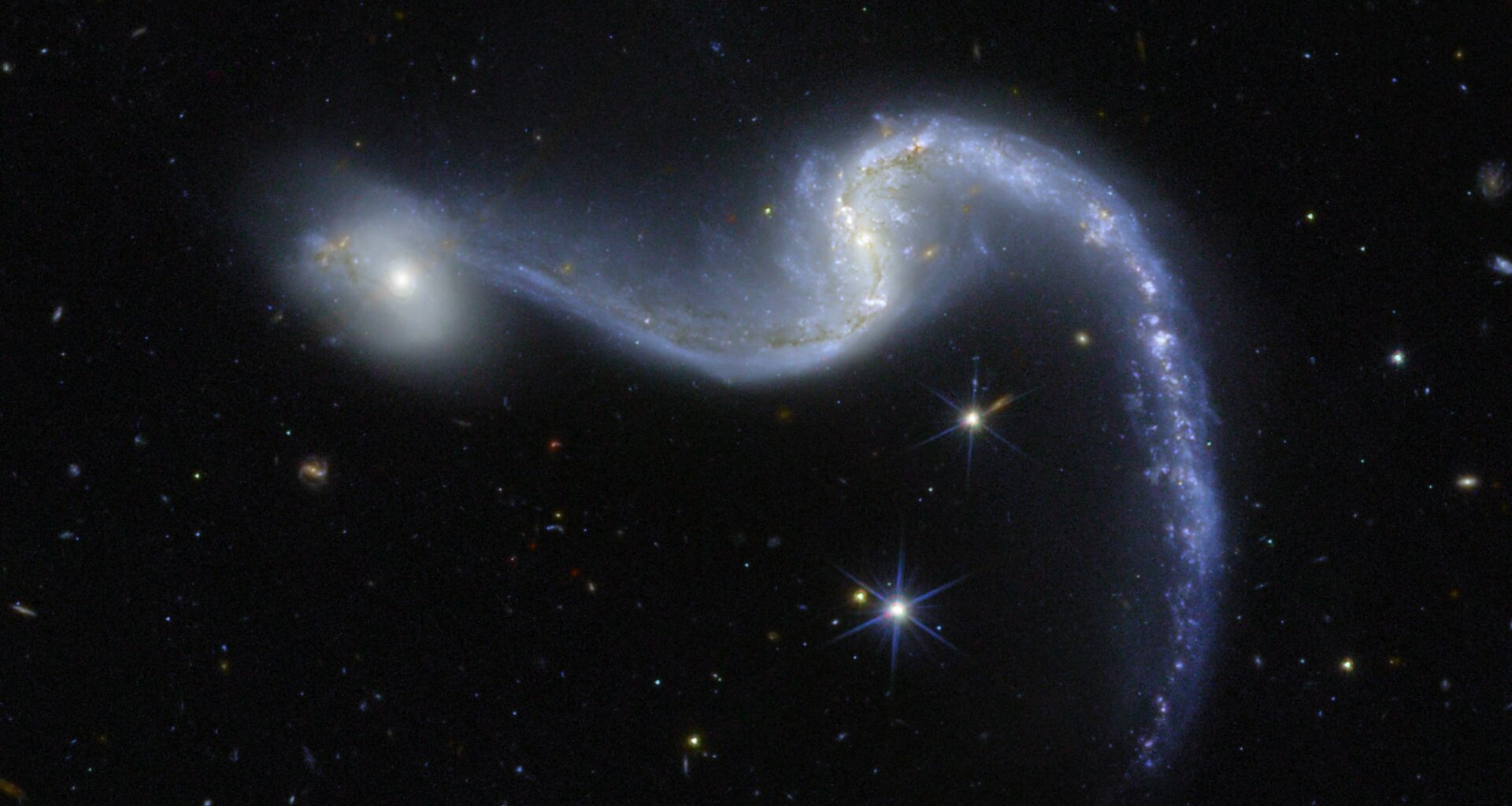
Today’s Image of the Day from the European Space Agency features the galaxy NGC 646 sparkling like a cosmic holiday garland.
At first glance, it looks like a simple twinkling jewel, but this barred spiral galaxy holds a story that spans hundreds of millions of years.
NGC 646 offers astronomers a window into the evolution of galaxies across the universe.
A galaxy in motion
Located in the constellation Hydrus, NGC 646 was discovered in 1834 by the British astronomer John Herschel.
The galaxy is racing away from us at roughly 5,062 miles per second, and its light takes around 392 million years to reach Earth. That means the image we see today is a snapshot of a galaxy as it existed long before humans walked the Earth.
The new observation comes from ESA’s Euclid space telescope, a mission designed to map the universe with unprecedented precision.
While NGC 646 may feel distant, it is relatively close compared to the billions of galaxies Euclid will study over the next six years.
By the end of 2026, ESA and the Euclid Consortium plan to release their first year of survey data, covering about 1,900 square degrees of sky – roughly 14% of the total mission area.
These images are expected to reveal hundreds of thousands of galaxies, helping scientists trace how cosmic structures form, evolve, and cluster together.
The barred spiral design
Barred spiral galaxies like NGC 646 are distinguished by a bright central bar of stars that extends across the galaxy’s core, with spiral arms unfurling outward.
In this image, the arms glow in soft shades of blue and white, highlighting regions of active star formation.
Bars are thought to play a key role in funneling gas toward the center of a galaxy, fueling the birth of new stars.
Over cosmic time, astronomers have found that barred galaxies become increasingly common, offering clues to the processes that shape galactic evolution.
Galaxies that look like neighbors
Interestingly, NGC 646 appears near a smaller, round galaxy called PGC 6014. To the eye, they seem like neighbors, but they are separated by about 45 million light-years.
PGC 6014 sits at a distance of 347 million light-years from Earth, so any gravitational interaction between the two galaxies is weak and brief, if it occurs at all.
Their apparent proximity is a reminder that our perception of space can be deceptive – galaxies that appear side by side in the sky can be light-years apart.
Exploring the dark side of the universe
The Euclid telescope is designed to explore the dark side of the universe. By mapping the distribution of galaxies across vast cosmic distances, it will help scientists better understand dark matter and dark energy – the mysterious forces that dominate the cosmos.
These surveys also provide a detailed census of galaxies at different stages of life, giving astronomers the ability to track structural changes over billions of years.
Images like this one of NGC 646 are just a taste of what’s to come. They not only showcase the beauty of the universe but also offer insights into fundamental questions about its history and composition.
As the Euclid mission continues, researchers anticipate that their observations will illuminate why certain galaxy types, such as barred spirals, become more common as the universe ages.
Diverse galaxies beyond the Milky Way
For amateur astronomers and stargazers, NGC 646 offers a striking example of the complexity and diversity of galaxies beyond the Milky Way.
Its sweeping spiral arms and luminous core demonstrate the ongoing processes that shape the cosmos: the birth of stars, the gravitational tug of neighboring galaxies, and the slow evolution of galactic structures over millions of years.
Even a small, faint companion like PGC 6014 adds context, reminding us that galaxies rarely exist in isolation. Each interaction, however subtle, contributes to the larger tapestry of cosmic history.
By studying these galaxies in detail, scientists are piecing together a narrative that stretches from the birth of the first stars to the sprawling universe we see today.
Euclid’s observations will continue to refine our understanding, offering both stunning imagery and crucial scientific data.
Image Credit: European Space Agency
—–
Like what you read? Subscribe to our newsletter for engaging articles, exclusive content, and the latest updates.
Check us out on EarthSnap, a free app brought to you by Eric Ralls and Earth.com.
—–