
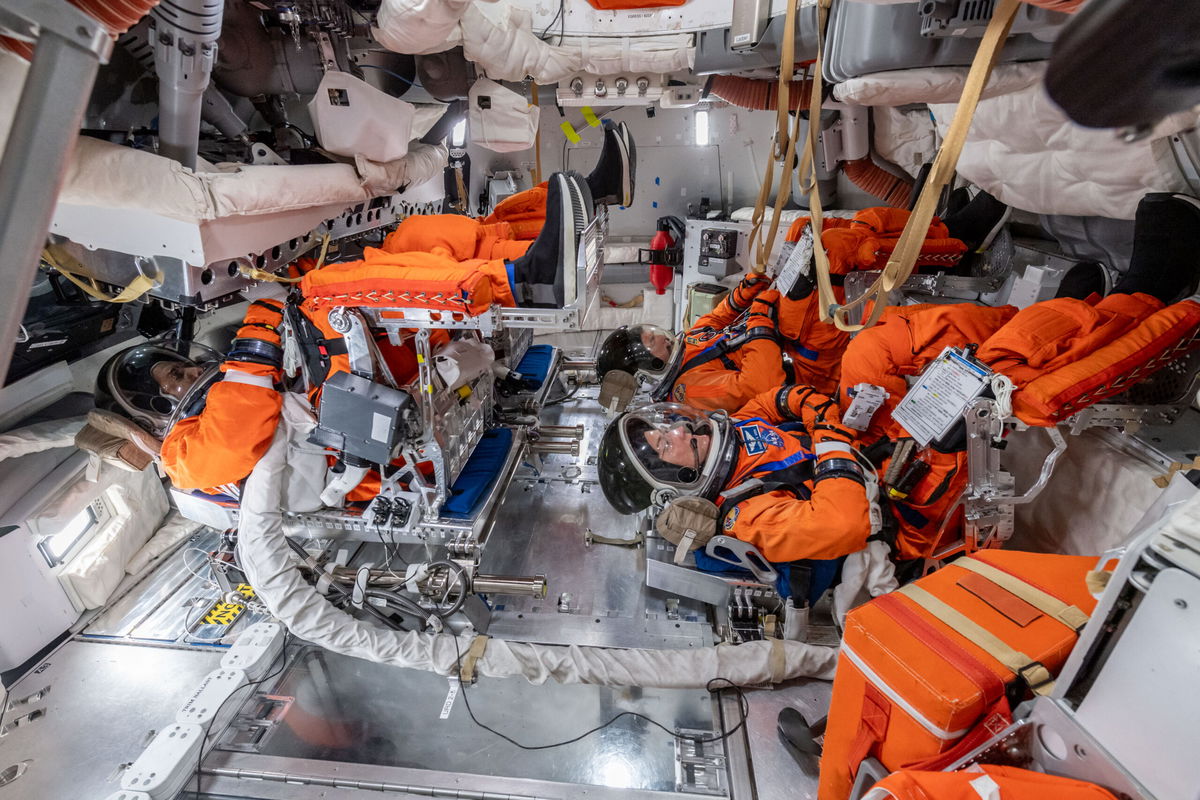
The crew practiced getting the Orion spacecraft configured once in orbit, how to make it habitable, and suited up in their entry pressure suits to prepare for their return from the Moon. Credit: NASA/Mark Sowa/Wikipedia CC
For the first time since the Apollo programme, NASA astronauts are set to travel around the Moon on a crewed mission. The Artemis II mission, scheduled to launch no earlier than February 2026, represents a major milestone in human space exploration. As part of their final preparations, the four astronauts conducted a full dress rehearsal, donning their Orion Crew Survival System suits at Kennedy Space Center in Florida.
The rehearsal allowed the astronauts to practise launch-day procedures in full, from pre-suit preparations to entering the Orion spacecraft. Every step of the countdown was timed and coordinated with ground control and engineering teams, ensuring that both crew and technical systems are ready for the mission. NASA officials emphasised that these exercises are essential for the safety and success of the flight.
Suits, systems and survival
Technical preparation and life support
The Orion Crew Survival System suits are central to the mission. Each suit provides oxygen, communications, thermal protection and mobility, allowing astronauts to operate spacecraft controls while remaining safe in the harsh environment of space. The suits are custom-fitted to each astronaut, and wearing them during the rehearsal helps the crew adjust to the constraints and demands of the mission.
Most Read on Euro Weekly News
According to NASA, the dress rehearsal represents the final major pre-launch training exercise for Artemis II. The astronauts successfully completed all tasks, demonstrating that both human and technical systems can function as expected. Engineers will now analyse data from the rehearsal to fine-tune procedures and ensure that every aspect of the mission is optimised.
Human and mission significance
Astronauts experience and mission context
Beyond the technical preparation, the rehearsal highlights the human aspect of deep space exploration. For the astronauts, suiting up and entering the spacecraft for the first time as a full crew is a moment of both excitement and responsibility. NASA has emphasised that Artemis II is a test mission, intended to validate life support and spacecraft systems in real conditions, while also inspiring future generations to pursue science and exploration.
“The rehearsal went smoothly and gave us confidence in our training and procedures,” a NASA spokesperson said. “It allows the crew to experience the full launch-day sequence in realistic conditions, which is critical before embarking on a journey around the Moon.”
The mission will orbit the Moon and return to Earth without landing, but its importance extends beyond the immediate flight. The Artemis II mission will provide crucial data for future lunar landings, including the Artemis III mission, which aims to put astronauts on the Moon’s surface. Completing these rehearsals ensures that every stage of the mission, from launch to orbit and re-entry, can be executed safely.
Artemis II mission highlights
Crew conducted full dress rehearsal in Orion suits at Kennedy Space Center.
Countdown and launch-day procedures were practised in realistic conditions.
Artemis II will orbit the Moon, marking the first crewed lunar mission since Apollo.
The mission tests life support and spacecraft systems for future landings.
Data from rehearsals will inform final adjustments before launch.
Looking ahead
Mission readiness and broader significance
NASA’s Artemis II mission demonstrates the careful preparation required for human space exploration. By successfully completing their suiting-up exercise and countdown rehearsal, the astronauts have confirmed that both crew and technical systems are ready for the journey. The rehearsal provides confidence that when the mission launches, the crew will operate safely and efficiently, paving the way for the next era of lunar exploration.
As the launch date approaches, NASA continues to emphasise the combination of human skill, technical precision and careful planning that will make Artemis II a historic moment in space travel. The mission will not only test spacecraft systems but also inspire a renewed sense of curiosity about humanity’s place beyond Earth.