
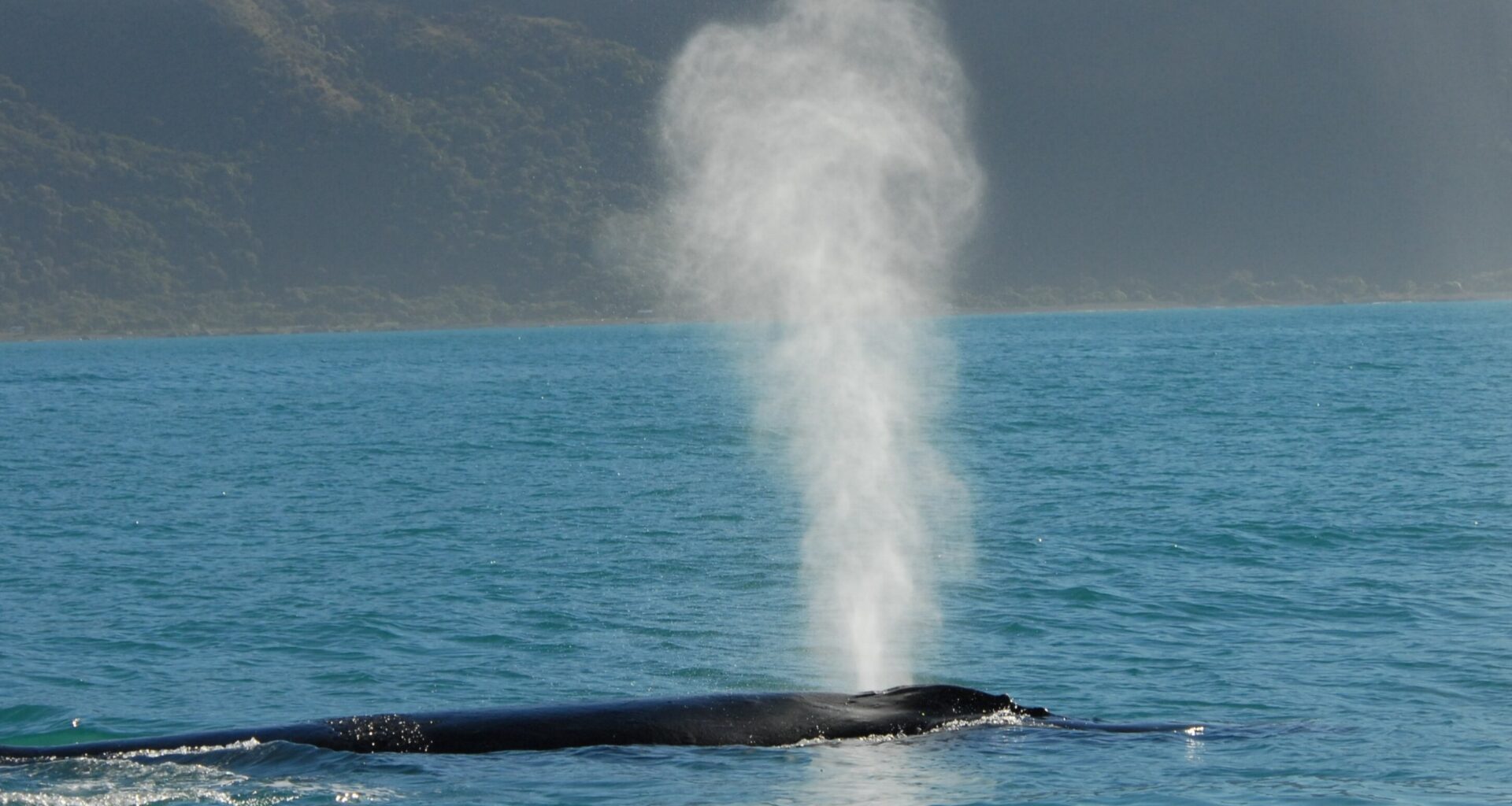
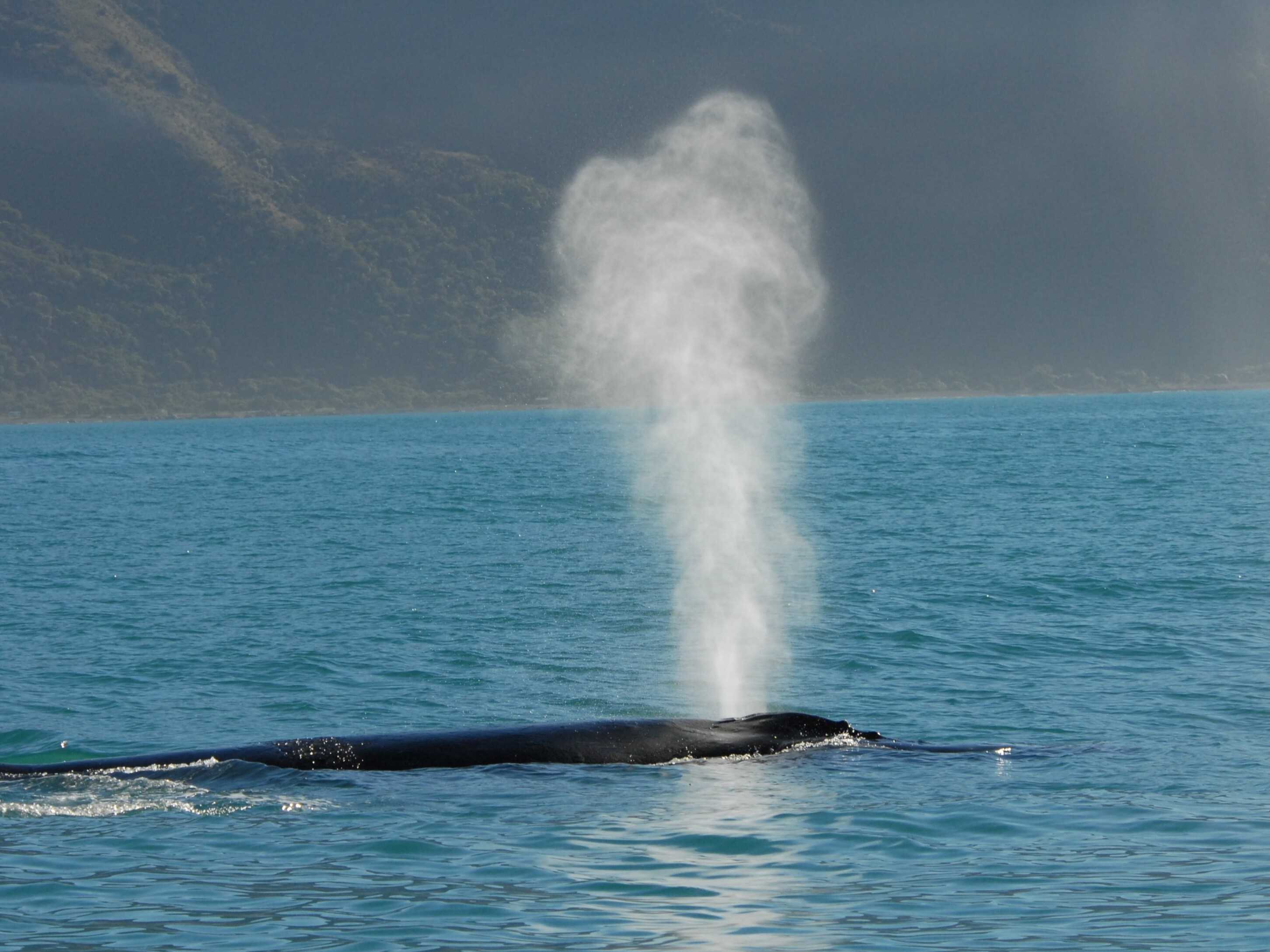
A humpback whale exhales out of its blowhole. Scientists are now using drones to study these exhalations and identify when whales are sick. Image: Dr. Mridula Srinivasan/NOAA
Why scientists are catching whale breaths….with drones
Scientists in the Arctic are catching the exhaled breaths of whales to better understand their health. How? Drones.
“Drones have really revolutionized our ability to get a biological sample from a wild whale,” says Amy Apprill, a marine microbial ecologist from Woods Hole Oceanographic Institution.
Typically, scientists collect samples from wild whales by getting close to them in a boat, and then shooting a dart gun to snag a small skin sample. Otherwise Apprill, who was not involved in the current study looking at whale microbial infections, says most samples come from whales that are dead.
To collect the breaths, researchers flew a drone over surfacing whales, which they operated from a nearby boat. Whales breathe through their blowholes, which are the equivalent of nostrils on their heads. Using live camera footage, the scientists hovered the drone over a whale that looked like it was about to blow. They captured the exhales on petri dishes attached to the drone.
Lead author of the study, Helena Costa says collecting the samples is both stressful and fun.
“Of course, in the moment it’s like a lot of people just screaming ‘Fly lower’ or ‘Go right’ and ‘The whale is coming.’ So it’s a lot of chaos on the boat. But of course, once you look back and you see the results and you see how well the method works, that’s a lot of fun.”
By studying respiratory whale microbes, scientists hope to piece together how deadly diseases spread in whale populations. And although there aren’t protocols to treat a sick whale, managers can help the large mammals by reducing their stress during illness by, for example, temporarily altering shipping lanes to avoid them. Or, if a whale is carrying a disease that can spread to humans, governments can limit whale-people interactions.
Based on blow samples collected from 2022 to 2025 in the Arctic waters around Norway and Iceland, the team detected cetacean morbillivirus in a couple groups of whales. This virus can cause immunosuppression and severe disease in cetaceans–whales, dolphins and porpoises–and has caused several mass die-offs in these animals. The researchers also detected herpes virus, which is often asymptomatic but can cause severe or fatal disease in immunocompromised animals.
The team didn’t detect avian influenza virus or the bacteria brucella, which can both infect humans.
Costa says she’s most interested in what the long term data will reveal, “because obviously four years of data is interesting, but if we have 30 years of data we can understand better the dynamics of the circulation of these pathogens…how some stressors, for example, pollutants or climate change, are affecting these dynamics of these diseases.”
Listen to how scientists are decoding whale clicks with AI here
Read the full research article here
Interested in more science on charismatic megafauna? Email us your question at [email protected].
Listen to every episode of Short Wave sponsor-free and support our work at NPR by signing up for Short Wave+ at plus.npr.org/shortwave.
Listen to Short Wave on Spotify and Apple Podcasts.
This episode was produced by Rachel Carlson and Kai McNamee. It was edited by Patrick Jarenwattananon. Tyler Jones checked the facts. The audio engineers were Maggie Luthar and Peter Ellena.