
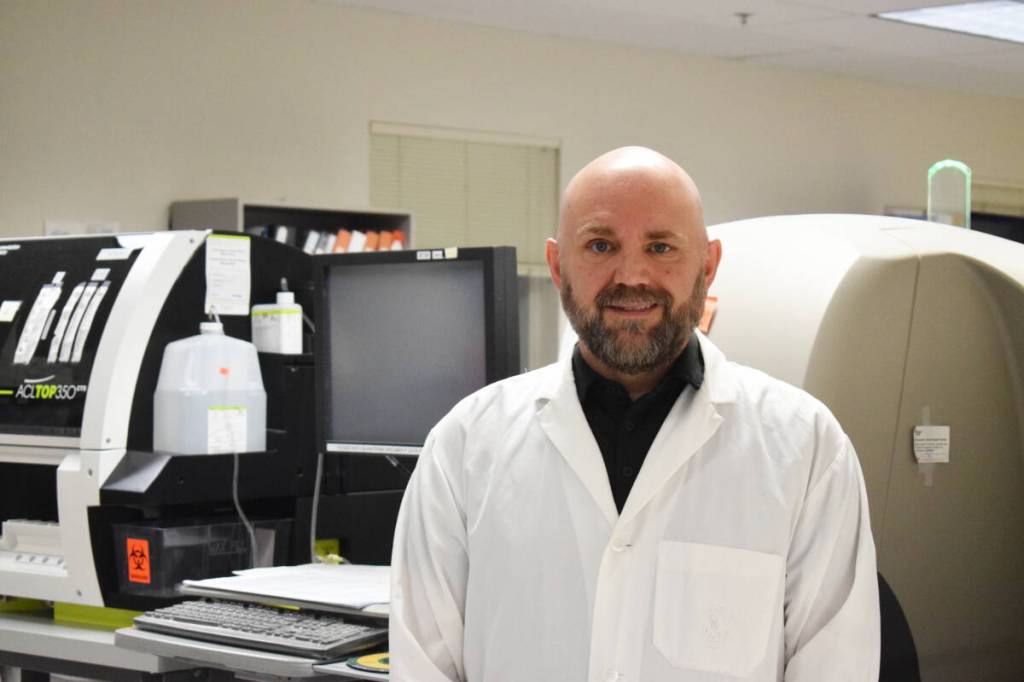
The Whitehorse General Hospital’s lab is on track to establish the first robotic or automated laboratory north of 60 in Canada using funds raised through the Yukon Hospital Foundation’s festive fundraiser, according to spokespeople behind the lab automation project.
Yukoners can expect shorter wait times, less tests sent out of the territory, and more health-care staff coming and staying in the Yukon, thanks to the modern upgrades coming to the Whitehorse General Hospital, as noted by those involved.
Karen Forward is president of the Yukon Hospital Foundation, which is made of one staffer and a volunteer board of directors. The foundation’s overarching goal is to improve health care at Yukon hospitals by providing better equipment, support and services that wouldn’t necessarily be expected in a remote location.
With a $500,000 fundraising goal, the hospital foundation’s Love Our Lab campaign focuses on bolstering the lab’s capacity to carry out more tests to keep up with a growing, aging population in the Yukon.
“We’re doing that by purchasing a robotic arm and track system for the hospital lab,” Forward said.
“It’s a part of our hospital that touches just about every Yukoner’s health journey while they’re in the territory, be it, you know, for things like cancer treatments or simple blood tests to identify potential health concerns.”
Forward said the foundation works closely with the hospital corporation to identify areas where there’s an opportunity to go “above and beyond” what the government would normally fund in the hospital.
The lab is currently stretched thin with the number of tests it can manually perform as the number of people needing care in the territory continues going up, per Forward. The robotic and automated upgrades will allow people working in the lab to focus on the higher scope of their job as opposed to menial tasks such as moving specimens around.
“It’ll allow them to produce more test results faster here in the territory,” Forward said. She added that includes repatriating some tests that are currently being sent down South.
Automating the lab
Greg Shaw is director of diagnostic and therapeutic services at the Yukon Hospital Corporation. His background over the past quarter of a century has been medical laboratories.
Shaw said the Whitehorse lab has grown about five to eight per cent a year. That means the lab has more samples coming through than in previous years.
Furthermore, lab work contributes to about 70 per cent of clinical decisions involving treatment and diagnoses, according to Shaw.
“It’s involved in almost every aspect of care,” he said.
Shaw described the procedure for modernizing the Yukon hospital lab, which involves replacing some older, smaller equipment with newer, bigger tools as well as doing renovations to make way for larger gear and, finally, introducing the robotic arms and automation.
“Things that will help move samples around the lab from an automated perspective, rather than having a person necessarily do it,” Shaw said.
“It kind of decreases those repetitive tasks that are done by people.”
The lab itself will look and feel different after the changes are done, per Shaw.
The automation is intended to help with basic tasks like opening tubes, putting barcode labels on them and pouring specimens from one tube into another, according to Shaw. A sample can be taken from one physical location to another instrument located about 12 to 15 metres away using automation.
“It is not necessarily here to replace people. It’s here to help augment and give them the tools that they need to be able to do their job, and to help allow them to actually work at the top of their scope,” Shaw said.
“There is a human health resource crisis that’s happening inside of health care, particularly in the lab. It’s very difficult to recruit medical laboratory technologists. So modernizing our lab and having new pieces of equipment and having people kind of do the more interesting work will hopefully yield higher levels of recruitment into the territory.”
Without automation, each specimen that gets stored is handled about 25 times, Shaw explained. With automation, the number of human touches drops to five.
“It’s scalable and sustainable into the future,” he said.
Automating laboratories in Canada’s southern provinces has been common since these concepts were developed in the 1980s and 90s, Shaw said. He suggested these concepts were likely originally devised for larger-scale labs.
“But with advancements in automation and the technology itself, it’s allowed it to be kind of delivered on a bit more of a smaller scale, so that smaller labs can actually reap the benefits,” Shaw said.
He said the hospital corporation collects about 300,000 specimens in the territory per year.
About 70 per cent of specimens collected get tested in Whitehorse while the remaining 30 per cent go to Vancouver for testing.
“Having larger pieces of equipment and more kind of automated tasks inside of the lab will allow us to bring some of that testing home,” Shaw said.
“There are 10s of 1000s of tests out there. So it doesn’t make sense for us to do everything here in Whitehorse, but we’re looking at bringing back some of those tests where it makes sense.”
Overhauling the local lab is a $3-million project, according to Shaw. The automation piece of the work is anticipated for completion in 2027-28.
Shaw said the hospital corporation is projecting system savings to the tune of half-a-million dollars a year once the system is up and running, which means the timeline for the return on investment for this initiative is about three to four years.
Freeing up spending dollars
This year’s Northwestel Festival of Trees and associated events include an online 50/50 raffle, a silent auction, a seniors’ soiree, a cocktail party, breakfast with Santa and a grand ball to raise money for the initiative.
Forward offered thanks to the generosity of everyone involved, from major sponsors, such as Air North, Alkan Air and Save On Foods, to individuals involved in the 2025 fundraising efforts and over the years.
Past Yukon Hospital Foundation campaigns raised money for the Whitehorse hospital’s new mental health unit and a maternity ward. Fundraising efforts also contributed to bringing a magnetic resonance imaging, or MRI, scanner to the hospital.
Yukon Health and Social Services Minister Brad Cathers personally and professionally supports the work the foundation does.
He donates every year. He noted the foundation has collectively raised $10 million over the years.
Since Cathers was just sworn in as health minister on Nov. 22, he said one of the first things he did on the job was tour the hospital. He said he spoke with front line staff and hospital administration.
The automated lab initiative is part of a larger effort, he noted, including to help process more tests “at home” in the Yukon and make the workplace more efficient from a staffing perspective.
Cathers commented on the “considerable pressure” the hospital is currently under. He suggested this initiative will help free up spending dollars.
“If there are areas such as this where we’re able to reduce the costs in certain programs through purchasing new equipment, it will help us use those dollars for other needs within the healthcare system, and help us increase services and meet the rising demand that our hospitals are really seeing due to factors including an aging demographic and a higher population,” he said.
Contact Dana Hatherly at dana.hatherly@yukon-news.com