
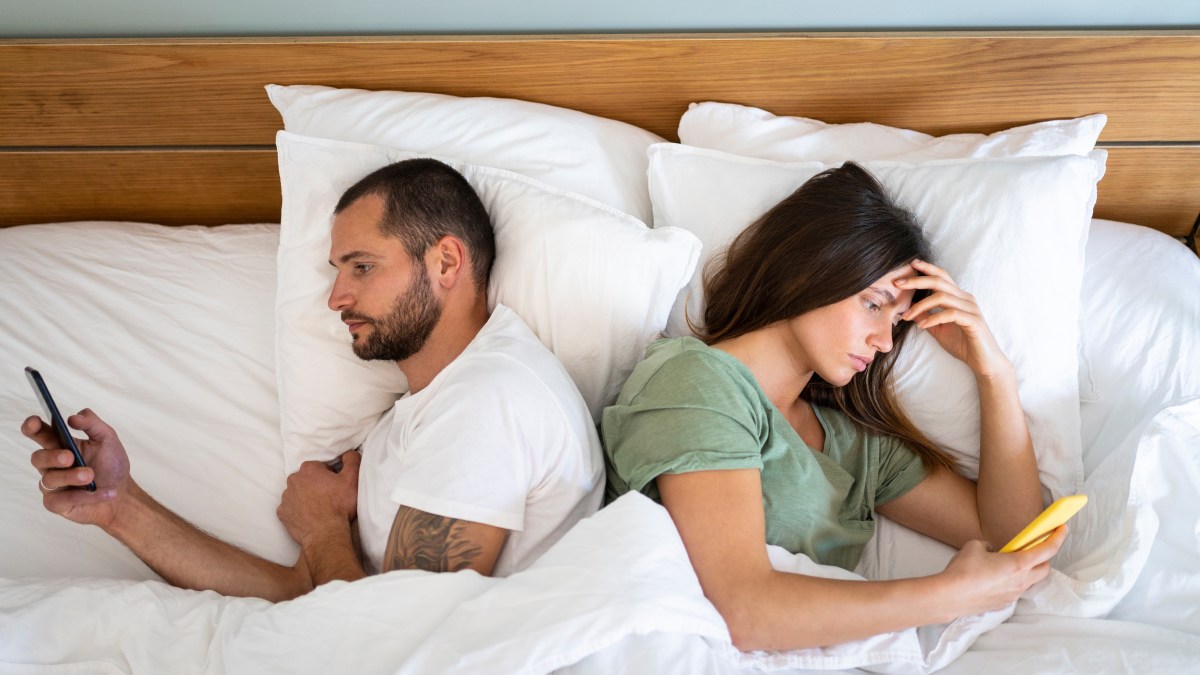
Phones are by our bed when we wake up, at our side as we work and on the sofa with us while we relax — a blight on our lives and social interactions. But we know already that any new year’s resolutions to cut down on screen time will probably fail. But all is not lost, say experts. It is time to frame our phone use in a different way.
Waging war on an abstract concept of “screen time” is not “helpful”, says Peter Etchells, professor of psychology and science communication at Bath Spa University and author of Unlocked: The Real Science of Screen Time, because it fosters a climate of fear and panic. Tech is not going away, he says. But there is a world of difference between using your device to facetime a relative abroad and spending three hours scrolling TikTok. The challenge now, Etchells says, is not to endlessly try and still fail to ditch our devices, but to alter our relationship with them, so “we keep the good stuff and minimise the stuff we’re not happy with”. While he concedes this can be “hard work”, it is doable. Here’s how to change your phone use for the better.
• Doomscrolling, texting at dinner… Have we reached peak phone?
Spend only half an hour a week on Instagram
The concept of connecting with people on social media is not inherently bad. But adverts and posts from influencers now take priority over pictures of friends and family on our feeds, which leads to less connection and more mindless scrolling. Last year a meta-analysis in the Journal of Computer-Mediated Communication found passive viewing on social media sites “was associated with worse emotional outcomes” than if we were to actively comment on others’ posts. Marcantonio Spada, emeritus professor of addictive behaviours and mental health at London South Bank University and chief clinical officer at the mental healthcare company Onebright, says “fundamentally voyeuristic” sites such as Instagram and Facebook are worse than platforms such as LinkedIn and Reddit that “centre more on ideas exchange and skills”. If you must use Instagram, focus on active engagement with accounts that interest you and pay attention to how you feel afterwards, he says. Unfollow accounts that prompt negative emotions. Make an agreement with yourself as to how much time you are willing to waste scrolling, write it down and track it (iPhones break down your screen time into specific app usage in settings). Spada pledges not to spend more than half an hour a week in “voyeuristic activity” across all platforms.
Swap TikTok for podcasts and YouTube
Encourage teens to watch longer content on YouTube, rather than short videos on TikTok
ALAMY
TikTok videos and Instagram Reels, which often last as little as 7-15 seconds, are particularly harmful on social media. More cognitively stimulating than a picture, they deliver rapid spikes of the neurotransmitter dopamine, associated with learning and reward, “neurobiologically and attentively locking us in”, says Dr Rayyan Zafar, research fellow at Imperial College London’s department of brain sciences. According to documents released by TikTok as part of a lawsuit against the company, it takes just 260 videos to form a habit. These videos are particularly damaging to young brains because they are not fully developed — a concern, given Ofcom research has found that 45 per cent of girls and 41 per cent of boys aged 3 to 17 have a TikTok account. “Short-form video apps like TikTok should not be used under the age of 18,” Zafar says. He suggests parents encourage their teens to watch and listen to longer content on YouTube and podcasts that generally prompt a more sustained dopamine release. Spada advises we spell out to our children exactly how the short-form video format has been cynically designed by tech titans to hook us. “Explain that they are outsourcing their brains to California,” he says. “That’s how I explained it to my children.”
Ask yourself why you’re picking up your phone
Pledge to cut out “non goal-directed” phone use, Etchells says. All phone pick-ups are not equal. Checking to see if a friend has replied to a text message “facilitates social connection”, Etchells says, but scrolling Instagram while driving is obviously “disastrously bad” and problematic phone use stems from “how often you engage in it in what we call a non goal-directed way”. Before you reach for your phone without intent, he suggests asking yourself, “What’s led to this point? What relief or release am I trying to create?” When Etchells realised he had started scrolling comedy Instagram Reels in search of light relief after a bad day, but that it wasn’t making him feel any better, he switched to reading a book instead. Seeking distraction after a busy day is OK, to a point, Spada says, but trying to regulate your emotions because you are depressed or anxious is not. “We know through the literature [scrolling] will exacerbate negative emotions.”
• How to stop your child from scrolling — the doctor’s guide
Believe that you can change your bad phone habits
Saying we are addicted to our phones is “tremendously disempowering”, Etchells believes, because it implies a lack of control. He maintains it’s more helpful for us to view heavy smartphone use as a habit that we have within us to change. “The first step is to notice what you’re doing.” He cites his own habit of doing the crossword on his phone while trying to get his children to sleep as babies. When it stopped being a “lifeline” and became a bad habit that stopped him going back to sleep, he deleted the app and started sleeping better again. He doesn’t dispute that getting rid of an app or curtailing time spent on one is “really hard” and requires “resilience and strength” but says, “If you keep trying, you will get there.”
• How I was cured of my smartphone addiction — for four minutes
Mark out weekly windows of time away from your phone
While you can’t ditch it altogether, regular breaks can reduce your smartphone’s appeal. Recent research in the journal Computers in Human Behavior found 72 hours of restricted access to smartphones decreased activity in brain regions, including the middle frontal gyrus and the superior parietal lobule, that are involved in various functions including attention, visual processing and motor control, suggesting smartphones might become less stimulating. “Our study suggests that even a short break from smartphone use can lead to changes in brain activity, particularly in regions associated with reward and self-control,” said the study author Robert Christian Wolf, deputy director of the department of general psychiatry at Heidelberg University Hospital. Spada spends eight hours away from his smartphone every Sunday — a habit that has an “unbelievable effect” on his desire to scroll the rest of the week — and picks up his phone after 7pm every evening only if it rings.
• I’m a smug digital minimalist — here’s how you can be one too
Remove yourself from non-essential WhatsApp groups
Consider how you are using WhatsApp: “being bombarded by irrelevant messages is not [helpful”
ALAMY
Yes, WhatsApp groups are helpful when you’re not sure what time the bus leaves or whose turn it is to host the coffee morning, but being bombarded by irrelevant messages is not. There is a presumption among many in messaging groups that they’re a dumping ground for random thoughts and we would do well to be upfront about the rules of engagement, Etchells says. In WhatsApp, these can be pinned to the group’s mast. “Thinking about how we change our attitudes to those sorts of groups is an important thing we’re not discussing,” he says. Spada is stricter still, removing himself from any WhatsApp groups that aren’t “entirely functional. Anything that has to do with discussions or opinions I see as a waste of life because the interaction is digital.”
• Read more social media stories from our experts
Keep your phone 2m away from your bed
We are forever being told to keep our phones out of our bedroom, but research “doesn’t support” their mere presence leading to poor sleep, Etchells says. There is no definitive proof the blue light smartphones emit has a “massive impact” on production of the hormone melatonin, which regulates our sleep. “From my read of the literature I don’t think it’s a problem,” he says. Nor does turning your iPhone onto Night Shift mode to reduce blue light have any “appreciable effects” on sleep. “My phone is my alarm clock on my bedside table,” he says. It is the temptation our smartphones offer that interrupts sleep, he says, especially among teenagers because there is a “social expectation” that they are available late at night and may not be able to resist the lure of messaging friends when their device is in sight. Encourage them to leave their phone in another room overnight. Spada recommends adults also use a “traditional alarm so the phone is not nearby to mindlessly engage” and that if the smartphone has to be used, it is kept a minimum of 2m away to “reduce the trigger to engage”.

It is the temptation that smartphones offer that interrupts sleep
ALAMY
Download apps that enhance your brain
Although enjoying a game with a friend in person can boost levels of the bonding hormone oxytocin, sudoku and chess played on our smartphones are just as beneficial for cognitive function as those conducted in the flesh, Spada says, while educational apps such as the language platform Duolingo, which offers points and badges for achievements, “gamify the dopamine response but allow your attentional networks to engage in something productive”, Zafar says. He recommends a games app for kids called MentalUP and the CogniFit games app for adults, which “harness neuroplasticity to improve brain function”. He believes a healthy relationship with our smartphone is “about mastering our biology in view of developments of technology”. Can it be done? He is optimistic. “It is being done.”
• Dial-A-Poem, the phone addiction that’s actually good for the soul
For childrenDon’t ban your child’s phone — it will only make them want it more
“Create a situation where children feel supported in their tech use,” Etchells says. “What do they want out of their phone use? Where are the boundaries you can both agree on? Co-design that.” He cites research that found regardless of whether parents lay down rules authoritatively or collaboratively, kids will break them “because that’s what teenagers do”, but if they are scared of breaking them, they will be more likely to hide their tech use from their parents, with potentially disastrous results. Tell them, he suggests, “These are the rules, but I want to make it clear that if something goes wrong, I don’t care about the rule any more. I care about the thing that’s happened.” Zafar says teaching teens they have “agency” in what they consume is key, along with “the ability to understand that this beast that’s been created can be used for good and for bad. Parents could try to drive it in a direction which is useful.”

Set boundaries that you and your child agree on
GETTY IMAGES
Talk to your children about graphic content
Horrific content is compulsive viewing — and it is ubiquitous. Graphic and violent videos such as the shooting of the political activist Charlie Kirk go viral not because we — or, more worryingly, our teens — enjoy watching them, but because they prompt a significant brain response, Zafar says. “We know from brain-imaging studies the reward circuits respond to unpleasurable things in the same vein as pleasurable things,” he says. The dopamine released is our brain’s way of trying to learn from what we see. “It’s a survival mechanism. Our brain’s thinking, what can I learn that might protect me? We’re being played to feel more under threat than we are.” If your teen tells you they’ve seen something disturbing, avoid the temptation to shout at them and see it as a positive sign they have confided in you, Etchells says, because “continuous conversations about intentional use” are the most effective antidote to harmful smartphone habits. Talk about how the video has made them feel and where it’s come from, he adds. Often content is spread through their messaging groups. “Does that mean a conversation with a school, or parents?”
• What happened when I made my sons and their friends go without smartphones
Stop blaming your child’s smartphone for all their problems
It is too simplistic to say smartphones alone are responsible for a decline in teens’ mental health, Etchells says. “It’s not how the world works.” Ask yourself exactly what is being affected by your teen’s use. Are their grades suffering? Is their sleep worse? Are they feeling isolated? The chances are no matter what the problem, other factors are at play. “There’s a 90 per cent overlap between online and offline bullying,” Etchells says, by way of example. He believes we should use our concerns about our children’s smartphone use “as an opportunity to open up a conversation about what’s going on in other aspects of their lives”.
Discuss your own phone use with your children
Keeping secret our messaging marathons or LinkedIn dependency out of shame keeps us stuck in online silos and lets unhealthy smartphone behaviour fester, Etchells says. Being more open about our smartphone use can foster connection with family and friends and remove feelings of guilt. He fell into this trap when his daughter was a toddler and asked what he was doing when he was checking his email. He said, “Nothing,” and hastily hid his phone. “It took me time to realise this was one of the worst things I could have done, because from her point of view I’m on this magic box we don’t talk about.” Now he is transparent. If getting a GP appointment means logging on to the surgery app at 8am while she’s having breakfast, for example, he tells her exactly what he’s doing. “I think she’s a bit bored with me doing this now, but in a way that’s kind of the goal.”