
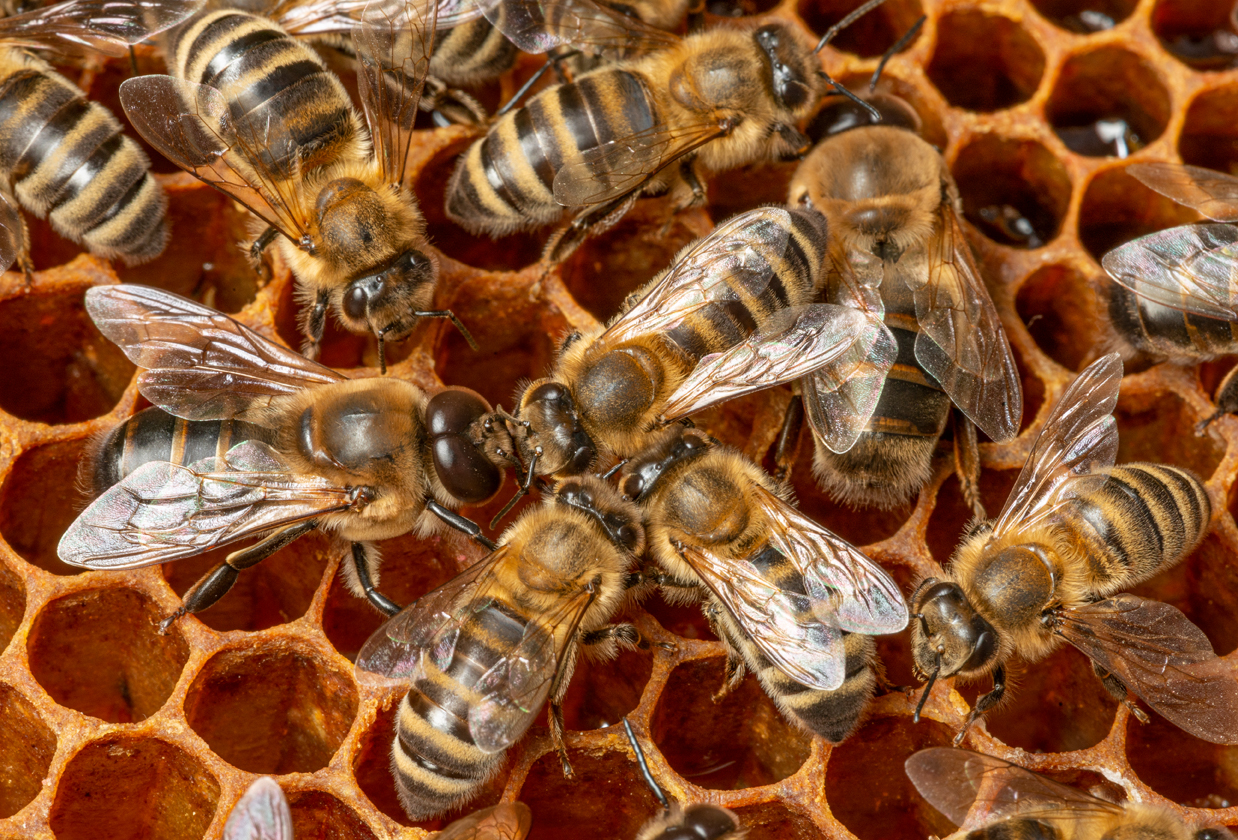
A gene called fruitless controls about 1,800 brain cells that allow male honeybees to beg worker bees for food inside the hive, according to new research.
The study comes from Heinrich Heine University Düsseldorf (HHU) in Germany, and the results help explain how a hive keeps males fed.

Inside a hive, food handoffs depend on careful timing between hungry males and the workers that feed them.
The research was led by Professor Martin Beye, who studies how genes guide brain development and social choices in insects, with honeybees as a main focus.
Why drone bees need help
Male bees of the species Apis mellifera, known as drones, eat little pollen. Instead, worker bees digest it and feed the drones protein-rich secretions from glands in their heads.
This dependence means males must seek out workers and request food, rather than collecting their own protein outside the hive.
If the request fails, drones can starve even while the colony stores plenty of pollen and nectar nearby.
The begging sequence
Drones begin by tapping workers with their antennae, then continue begging until a worker opens her mouth to share food.
This exchange, called trophallaxis, involves mouth-to-mouth transfer of liquid food and also spreads chemical signals within the colony.
“In our research, we ask ourselves what is required to orchestrate this interaction,” said Professor Beye.
How the fruitless gene works
One reason the fruitless gene matters is that it acts as a transcription factor, a protein that controls when other genes turn on.
During male development, this kind of regulator can alter which neurons connect, by changing the proteins cells build at key stages.
The team found the fruitless gene active mainly in male nervous-system cells, hinting that a sex-specific program shapes the begging sequence.
Marking active brain cells
At HHU, the researchers added a gene that makes a green fluorescent marker wherever the fruitless gene turns on.
The marker lit up clusters of neurons involved in sensing and integrating information, including touch and taste pathways that guide close contact.
Because the method labels living tissue without stopping the fruitless gene, it gave a map for later tests that disabled it.
Where those signals meet
Several fruitless-gene-marked neurons sit in the mushroom bodies, bee brain regions that combine sensory inputs for learning.
Other marked cells appear in odor and vision centers, suggesting the gene touches many routes that can guide a social approach.
The pattern fits an idea that begging depends on evaluating several senses at once, not on a single cue.
Removing the gene
The researchers created a knockout mutant, an animal engineered to lack a working gene, for the fruitless gene in drones.
Without the fruitless protein during development, the same bee still forms a brain, but some circuits no longer drive the right choices.
This design let the researchers test whether the fruitless gene controls the start and stopping points of begging, rather than muscle movements.
Tracking bees in colonies
To follow each male in a crowded hive, the researchers attached tiny two-dimensional barcodes and recorded the colony with cameras.
Software then traced who approached whom and how long contact lasted, turning messy movement into clean behavioral counts.
Because the setup ran inside experimental colonies, it captured begging in the context workers and drones normally experience.
Changes in begging behavior
When the fruitless gene was missing, mutant drones approached nestmates less often, which cut chances to start the feeding sequence.
Begging and mouth-to-mouth transfers fell by about twofold, so many males received less worker-made food during the day.
The pattern points to a decision problem, where males fail to commit to social contact long enough for a worker to respond.
What stayed surprisingly normal
Many basic actions stayed normal, including walking, resting, and self-cleaning, even when the fruitless gene could not function.
Mutant drones still performed the same body movements during begging, but they began those bouts less often and ended sooner.
That narrow change argues against a simple weakness or injury, and instead ties the fruitless gene to motivation and persistence.
Detection versus decision
The bees also kept their cuticular hydrocarbons (CHCs), waxy skin chemicals that carry identity cues, so workers had no new smell to avoid.
Brain scans showed the first smell-processing region looked intact, and neural responses to key odors stayed strong.
These checks suggest the fruitless gene affects how sensory input guides social decisions, not whether the senses detect those cues.
Responses to queen scent
Outside the hive, drones chase queens using pheromones, chemical signals that influence behavior in bees. The fruitless gene plays a part.
In lab tests, normal males reacted strongly to the queen’s scent, while mutants showed much less movement.
Responses to light, unpleasant smells, and basic touch were unchanged, showing that the gene’s effects were limited.
Over evolutionary time, a gene program can take on new jobs, and the fruitless gene now guides within-hive cooperation.
Male-only activity in the fruitless gene helped create a neural control system that starts and sustains begging when cues match.
Because evolution may tweak many downstream genes, pinpointing the fruitless gene is only the first step toward a full map.
Taken together, the work links a defined set of brain cells to a social exchange that keeps drones alive.
Future studies can trace fruitless-gene targets in those neurons, while testing how nutrition and colony stress tune the behavior.
The study is published in the journal Nature Communications.
—–
Like what you read? Subscribe to our newsletter for engaging articles, exclusive content, and the latest updates.
Check us out on EarthSnap, a free app brought to you by Eric Ralls and Earth.com.
—–