
Astronomers have proposed a radical idea: dark matter—the mysterious substance making up most of the universe’s mass, might not be composed of unknown particles but of pieces of giant exotic objects. A new study, shared in the open-access server arXiv, outlines an observational path that could soon test this unconventional theory.
Rethinking The Nature Of Dark Matter
For decades, dark matter has remained one of the greatest puzzles in astrophysics. The most accepted models suggest that it consists of weakly interacting massive particles, or WIMPs, which barely interact with ordinary matter. Despite vast searches, these particles have never been directly detected. The new research, published in the open-access server arXiv, challenges this traditional view by exploring the possibility that dark matter could instead be composed of macroscopic entities, vast clusters of exotic material formed in the universe’s earliest moments.
These hypothetical objects, sometimes called macros, might vary widely in size and mass from something as small as a grain of sand to as large as an asteroid. Unlike subatomic particles, macros would behave more like celestial debris drifting through space. According to the authors, their presence could subtly alter the brightness or motion of background stars as they pass between observers and distant galaxies.
Detecting The Undetectable
The study suggests that new astronomical surveys could detect these elusive objects by searching for telltale gravitational effects. Instruments like the Vera C. Rubin Observatory and the Nancy Grace Roman Space Telescope are capable of observing transient phenomena across vast areas of the sky. If macros exist, their passage could briefly dim or distort starlight, producing a distinct optical signature.
This method relies on the principle of gravitational microlensing, where a massive object bends the light from a background source. Astronomers have already used this effect to detect exoplanets and black holes, but spotting macros would require long-term observation and high-precision data analysis. Detecting even one such object would dramatically reshape our understanding of both dark matter and cosmic evolution.
Cosmic Clues Hidden In The Early Universe
The theory also connects to early-universe physics. The researchers propose that these exotic objects might have formed during phase transitions shortly after the Big Bang, when fundamental forces were separating and cooling. Under the right conditions, clumps of strange quark matter or other exotic states could have condensed into dense, stable structures that survived until today.
These primordial remnants could explain the gravitational effects attributed to dark matter without the need for undiscovered particles. If confirmed, it would mean that the building blocks of dark matter have been hiding in plain sight massive, ancient objects drifting quietly through galaxies.
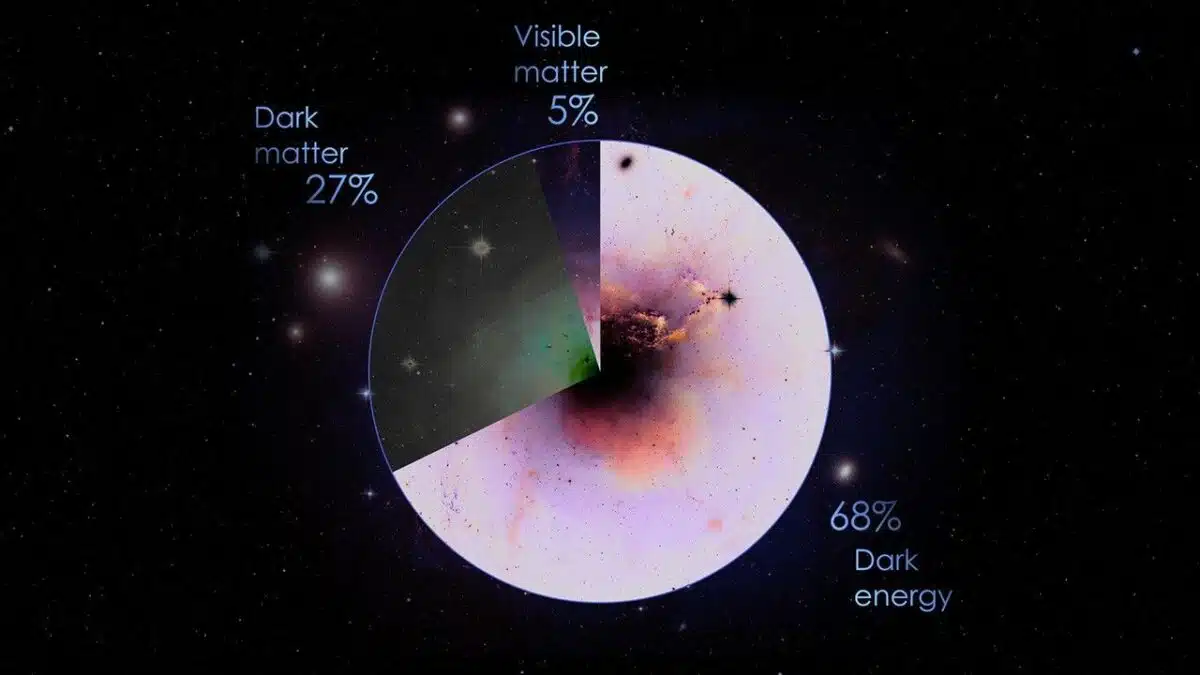 The universe is made up of three components: normal or visible matter (5%), dark matter (27%), and dark energy (68%).
NASA’s Goddard Space Flight Center
The Path Ahead For Observations
Future missions are expected to shed more light on this possibility. With instruments capable of surveying billions of stars, even rare events could soon be within reach. Teams analyzing archival data from observatories like Gaia and Pan-STARRS are also re-examining subtle light variations that might hint at macro encounters.
The paper’s authors stress that this approach does not dismiss existing dark matter models but expands the range of possibilities. The study published in the open-access server arXiv emphasizes that progress in astrophysics often comes from testing bold, alternative ideas, and that every new observation helps refine our picture of the cosmos.