
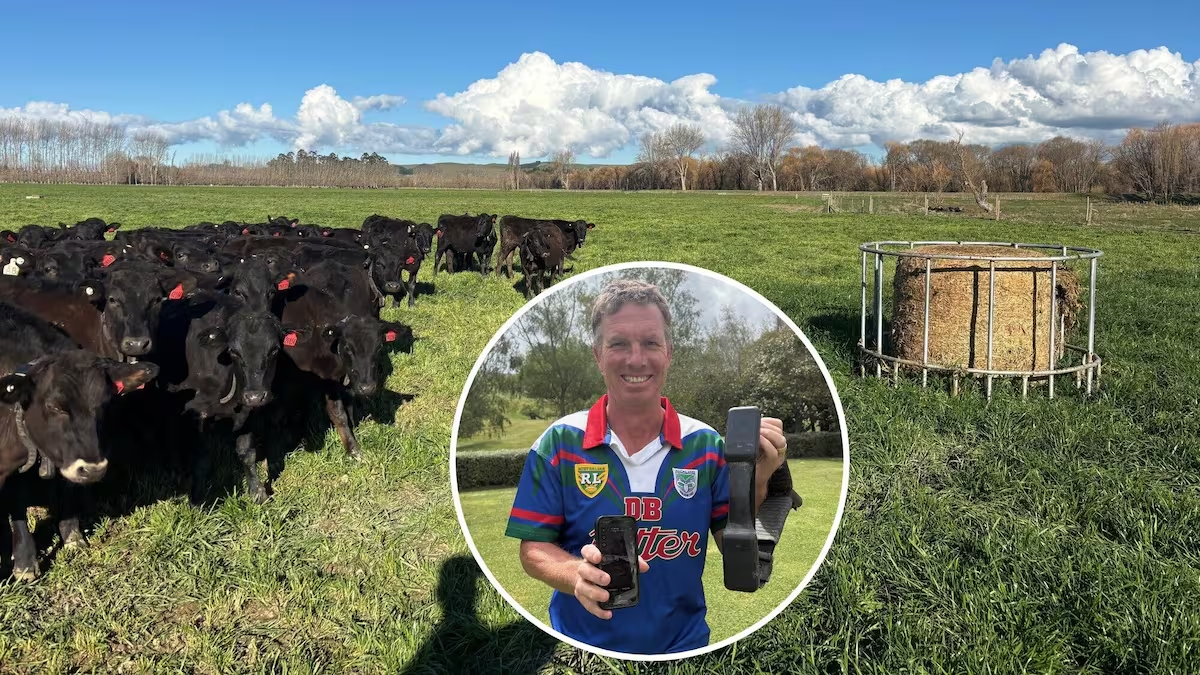
“It’s the whole cliché of leaving it in a better place, and it’s all a bit woke, but it’s 100% correct; each generation improves it in their own way.”
He said his search for improvement led him to technology called Halter collars, used as a virtual fencing option for cattle and operated via network towers and a phone app.
“It brings the fun back to farming,” Peacock said.
“It takes a lot of the stress out for all the obvious reasons that they are not breaking wires and chewing and getting into different paddocks.”
Marcus Peacock is fully embracing the use of AI on his farm with at least 300 cattle and more planned to wear Halter collars for virtual fencing and health benefits.
Peacock said it was during a field day in Takapau in 2024 on a dairy farm when he realised he could use the technology to make his life and farming practices easier.
“It was just one of those light bulb moments like ‘holy s*** I need this’.
“I say to people I have learnt more in the last six months of farming with Halter than I have in the previous 20 years.”
Halter collars create a virtual fencing system and send health data via an app for farmers to make informed decisions, increasing production. Photo / Halter
Peacock said the collars could show him live health data for each animal, which enabled him to refine his feed allocations.
“They have never looked so good. I look a lot at my rumination and grazing time on it to try and get a correlation to live weight gain – so it takes out a lot of the guesswork and assumptions.”
He said his decisions were now made on fact, his mental load was lessened, and he was free to carry out other tasks.
“It’s AI at its best.
“It’s going to lift production on farm hugely, so it’s a paradigm shift.”
Tom Collier, Halter beef territory manager for Hawke’s Bay, said there had been a “significant uptake” of farmers interested in and converting to Halter.
“We are signing farms every week … it’s almost overwhelming.”
Tom Collier said more and more farmers in the region are interested and converting to Halter. Photo / Halter
“Once someone gets it in a district, the neighbour gets it, and their neighbour gets it, and so it starts to have this spider web effect.”
He said the New Zealand company had an estimated half a million collars on farms around the world, including Australia and America.
Collier said the collars worked by creating an incentive, with speakers attached to solar panels that sat on the top of the cow’s neck that let off a gentle vibration to alert the cow to a new break, and a tone to steer the animal.
“They feel it through the collar, and that tells them that they have a new break opened up to them, and we can also guide them directionally with the left and right speakers.
“There is some really clever animal science that has gone into this development around animal incentive – it’s more of a carrot approach now, the incentive is that a new, fresh allocation of feed has been opened up to them.
Cattle wearing Halter collars can be shifted via an app on a phone. Photo / Halter
He said the technology enabled farmers to micro-manage from their phones and move the cattle with their natural rumen cycle.
“The ideal is to be able to do two shifts a day and by doing that you are keeping the animal’s stomach really efficient … and what it leads to is a really high feed conversion efficiency.
“For every kilogram of pasture or dry matter they consume, they convert more into meat than they previously did under traditional systems.”
He said the collars provided flexibility, created better grazing pressure, and could reduce the costs and maintenance needed for conventional fences.
“It’s super exciting, just seeing the gains that these extensive farms and even the more intensive ones … are making by harvesting more grass more efficiently.”
Michaela Gower joined Hawke’s Bay Today in 2023 and is based out of the Hastings newsroom. She covers Dannevirke and Hawke’s Bay news and loves sharing stories about farming and rural communities.