
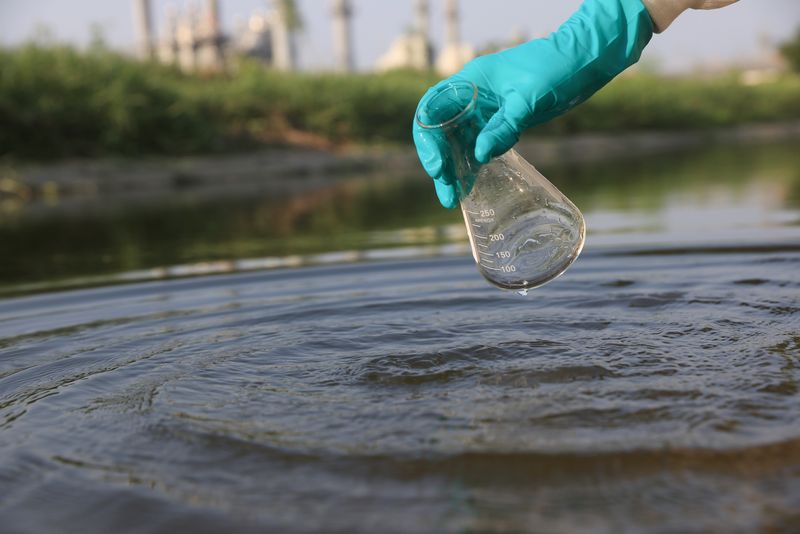
The Sirsa river, a major tributary of the Sutlej that cuts through Himachal Pradesh’s industrial heartland, is now emerging as one of North India’s most critically polluted water bodies. A series of recent scientific studies and government monitoring reports have confirmed the presence of pharmaceutical compounds, toxic heavy metals, volatile chemicals and organic industrial waste in the river much of it traced to the Baddi-Barotiwala-Nalagarh (BBN) industrial cluster.
The sources told The Tribune now the solid waste, including plastic bottles coming in the river was bothering even the irrigation authorities of Punjab. The irrigation authorities have proposed to build a floating barrier near Ropar headworks to check the flow of solid waste as plastic bottles further downstream into Sutlej and canal systems of the state.
Executive engineer, Punjab Pollution Control Board (PPCB), Vipin Kumar Jindal, when contacted said that they were planning to carry out drone survey in Sirsa river to check the sources of pollution which mostly are industries located in Solan district of Himachal.
A 2024 study titled ‘Ecological and Human Health Risk Assessment of Pharmaceutical Compounds in the Sirsa River of Indian Himalayas’ authored by Arohi Dixit, Himanshu Pandey, Renu Lata and others, reviewed research identifies concentrations of pharmaceutical compounds such as ciprofloxacin, norfloxacin, cetirizine and citalopram at levels significantly above ecological safety parameters. These compounds, found in quantities ranging between 50–150 micrograms per litre, are known to promote antimicrobial resistance (AMR) when continuously released into natural water sources. The study confirms that for several aquatic organisms, especially algae that form the base of the river’s food chain, the contamination level exceeds the risk quotient threshold making the compounds biologically dangerous.
Another major study, conducted by S K Bhardwaj, Reetika Sharma and R K Aggarwal, examined metal toxicity and found worrying levels of mercury (Hg), chromium (Cr), cadmium (Cd), lead (Pb) and even thallium (Tl) in parts of the river. These metals, often originating from metal processing, chemical, dyeing and textile units, are non-biodegradable and continue to accumulate in sediments and the food chain.
The research concludes that stretches of the Sirsa downstream of Baddi have crossed several pollution safety benchmarks, indicating continuous industrial discharge rather than sporadic contamination.
An ecological survey by Bhagat Singh, Ram Naresh Tyagi and Anil Jindal, which reported extremely high Biochemical Oxygen Demand (BOD) and Chemical Oxygen Demand (COD) reaching 328 mg/L and 672 mg/L, respectively in some stretches. These values are several times higher than permissible limits and suggest near-terminal levels of organic and chemical pollution. Many sites showed dissolved oxygen falling to 1.2 mg/L, nearly at suffocation level for aquatic life.
Col (retd) Jasjit Singh Gill, an environmentalist activist from Ludhiana, while talking to The Tribune said that the Central Pollution Control Board (CPCB) have repeatedly flagged the Sirsa as a Priority I/II Polluted Stretch, meaning immediate intervention is required. If no action was taken, it could render useless the World Bank project to supply drinking water to Ludhiana city from Sutlej as pollution levels in river exceed permissible levels, he said.
The Sirsa merges with the Sutlej near Tallewal in Ropar district of Punjab, spreading the contamination downstream Sutlej and through irrigation networks and reservoir systems.