
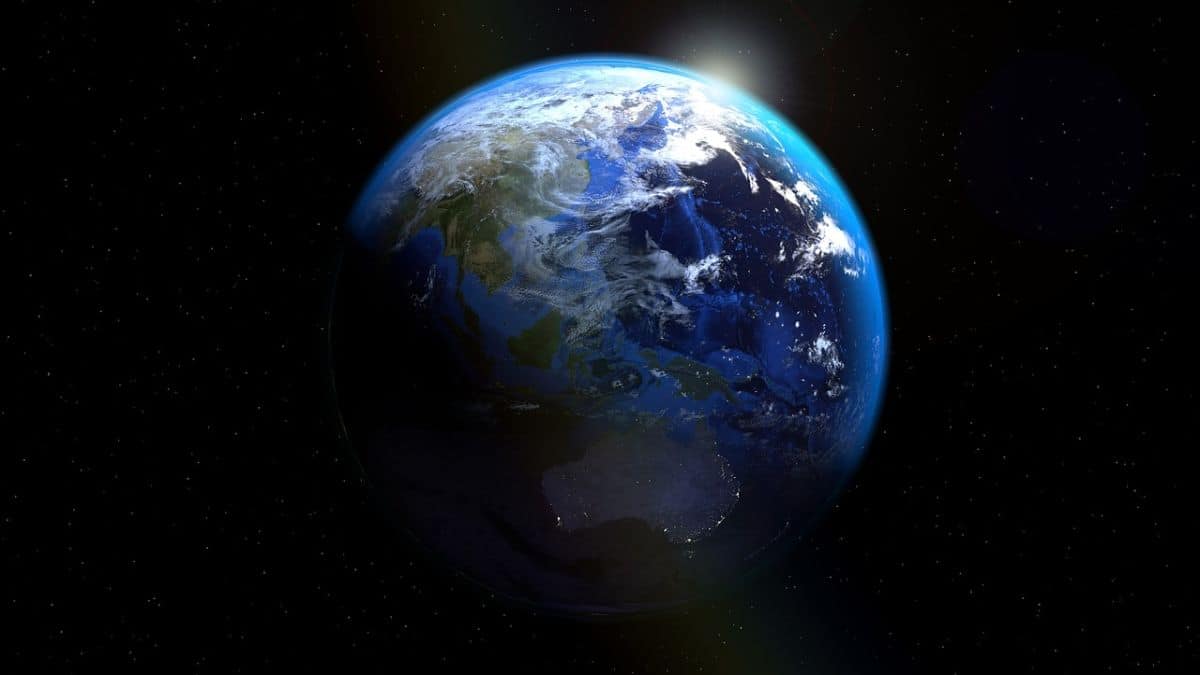
Our 24-hour day measures Earth’s rotation relative to the Sun, known as a solar day. This is slightly longer than Earth’s rotation relative to distant stars (a sidereal day), because Earth is also moving along its orbit around the Sun. But could there be 25-hour days in the future?
Will Earth soon have a 25-hour day?
Everyone knows there are 24 hours in a day. This is based on the rotation of the Earth relative to the position of the Sun. But did you know that there could one day be 25-hour days? I While it may sound like science fiction, it’s not. Scientists say it could happen millions of years from now.
But what do we know? How would it happen?
STORY CONTINUES BELOW THIS AD
Let’s take a closer look.
Earth’s 24-hour dayFirst, let’s examine the Earth’s 24-hour day.
“The origin of our time system of 24 hours in a day, with each hour subdivided into 60 minutes and then 60 seconds, is complex and interesting,” Dr Nick Lomb, consultant curator of astronomy at the Sydney Observatory, told ABC.
The idea comes from the ancient Egyptians, who used sundials.
They divided the day into 10 hours, with a twilight period at the beginning and
another at the end, and the night into 12 hours.
A visitor sits near a limestone fragment dating to the reign of the ancient Egyptian 19th dynasty king Merneptah (1213-1203 BC) on display at the Grand Egyptian Museum in Giza. AFP
“Night-time was divided into 12 hours, based on the observations of stars. The Egyptians had a system of 36 star groups called ‘decans’ — chosen so that on any night one decan rose 40 minutes after the previous one,” Lomb added.
“Tables were produced to help people determine the time at night by observing the decans. Amazingly, such tables have been found inside the lids of coffins, presumably so that the dead could also tell the time.”
Later, the ancient Babylonians divided hours and minutes into 60 units each, using the sexagesimal (base-60) system they inherited from the Sumerians. This structure was eventually locked in by the first mechanical clocks, which emerged in Europe towards the end of
the 16th century. It remains the system we use today.
STORY CONTINUES BELOW THIS AD
This measures Earth’s rotation relative to the Sun — known as a solar day. However, Earth is also rotating on its axis while orbiting the Sun, which is why a solar day is slightly longer than a sidereal day (a full rotation relative to distant stars).
How would it become 25 hours?Because the Earth’s rotation is slowing — albeit extremely slowly.
This happens due to the pull of the Moon’s gravity on Earth. The Moon creates tidal bulges in the oceans, and because these bulges are not perfectly aligned with the Moon, they exert a small braking force on Earth’s rotation.
NASA explains that the Moon’s gravitational pull “causes the oceans to bulge slightly, and this interaction acts like a brake, slowing Earth’s rotation over time”.
Earth’s spin is also affected, to a much lesser extent, by melting glaciers, shifting ocean mass, and movements within the planet’s core and mantle.
The change itself is tiny. It doesn’t add seconds to the clock, but milliseconds — roughly 1.7 milliseconds per century. But when measured across hundreds of millions or even billions of years, these tiny changes add up.
STORY CONTINUES BELOW THIS ADScientists estimate that Earth could experience a 25-hour day in roughly 200 million years, give or take.
This, however, is nothing new.
Earth’s rotation has been changing throughout its history.
The Moon creates tidal bulges in the oceans, and because these bulges are not perfectly aligned with the Moon, they exert a small braking force on Earth’s rotation. AFP
As Sarah Millholland, an assistant professor of physics at MIT, told Live Science, “The Earth has experienced days that were both shorter and longer than it is now at different points in history.”
“About a billion years ago, the length of a day was only about 19 hours,” she added.
In fact, geological evidence from ancient coral growth rings and tidal sediments suggests that hundreds of millions of years ago, Earth experienced more than 400 days per year, with each day lasting just over 21 hours.
Shortly after Earth formed, a day may have lasted less than 10 hours. There have also been periods when days were longer than 24 hours — though not for long.
Should we be worried?
Probably not.
Konstantin Batygin, a professor of planetary science at Caltech, told Live Science, “The change in Earth’s spin rate is happening gradually enough that evolutionary processes can adapt to the changes over time.”
STORY CONTINUES BELOW THIS AD
“The relative change in orbital speed would not be noticeable in daily life,” Batygin added.
Even today, Earth’s rotation is not perfectly steady. Because of small variations, scientists occasionally add “leap seconds” to atomic clocks to keep our timekeeping in sync with Earth’s rotation. As the International Earth Rotation and Reference Systems Service (IERS) notes, leap seconds are added when Earth’s rotation drifts by more than 0.9 seconds from atomic time.
In short, a 25-hour day isn’t a sign of impending planetary upheaval — just a reminder that even something as constant as time is not immune from cosmic forces.