
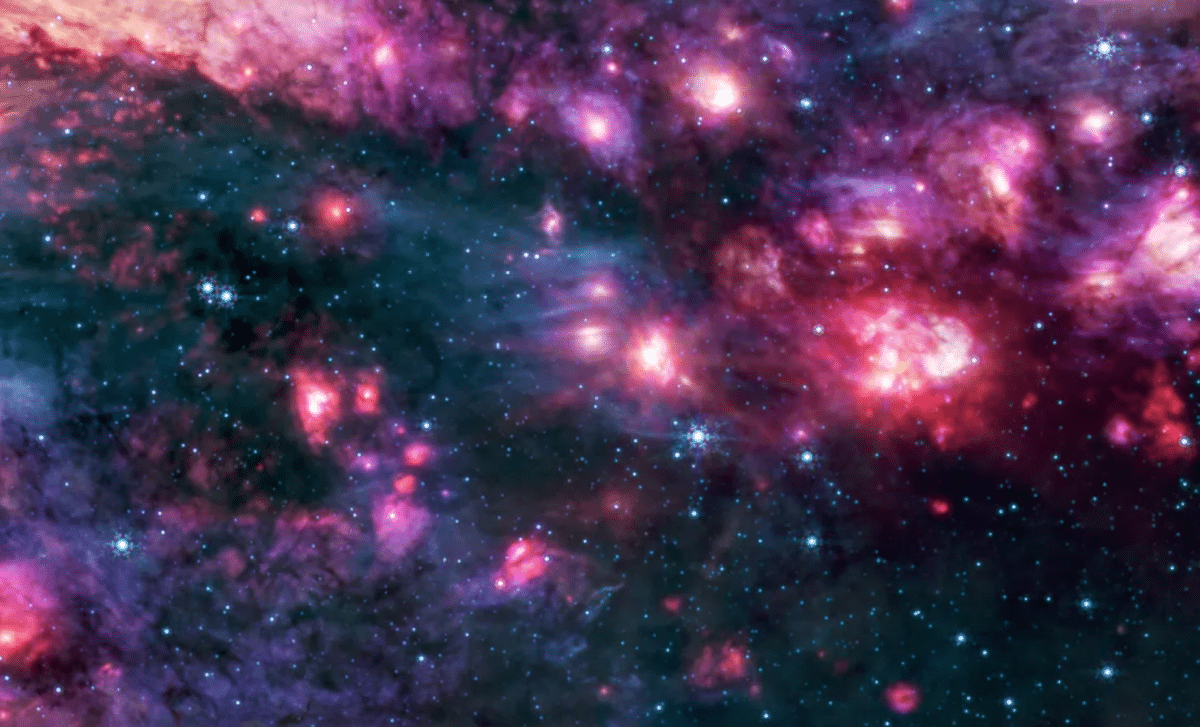
The James Webb Space Telescope (JWST) has captured a stunning and scientifically puzzling image of Sagittarius B2 (Sgr B2), a massive molecular cloud near the Milky Way’s galactic center. While visually striking in infrared, the structure’s true mystery lies in its unusual star formation efficiency, producing half the stars in the area with only a tenth of the available gas. This revelation, recently highlighted by NASA in a dedicated feature article, adds a compelling piece to the puzzle of galactic evolution.
A Monster Cloud With a Stellar Secret
Located approximately 26,000 light-years from Earth in the direction of the constellation Sagittarius, Sgr B2 is one of the largest and densest molecular clouds in the Milky Way. The region is a known stellar nursery, but what astonishes scientists is its efficiency: it has produced 50% of the stars in the galactic core despite holding only 10% of its molecular gas.
Using JWST’s Mid-Infrared Instrument (MIRI) and Near-Infrared Camera (NIRCam), astronomers were able to peer into its dense structure, where clumps of dust and gas are glowing in red, pink, and purple hues. This contrast highlights not only active star-forming regions but also areas so dense that even JWST’s powerful infrared capabilities cannot penetrate them. These impenetrable zones could be hiding proto-stars in their earliest evolutionary stages, waiting to be uncovered.
A Chemically Complex Stellar Factory
The most intriguing discovery lies in the redder clumps on the right side of the cloud complex, as seen in the mid-infrared image captured by MIRI. These areas are among the most chemically rich ever observed in our galaxy. Prior data from ALMA, Herschel, and other observatories had already indicated unusual chemical complexity, but JWST now gives unprecedented detail.
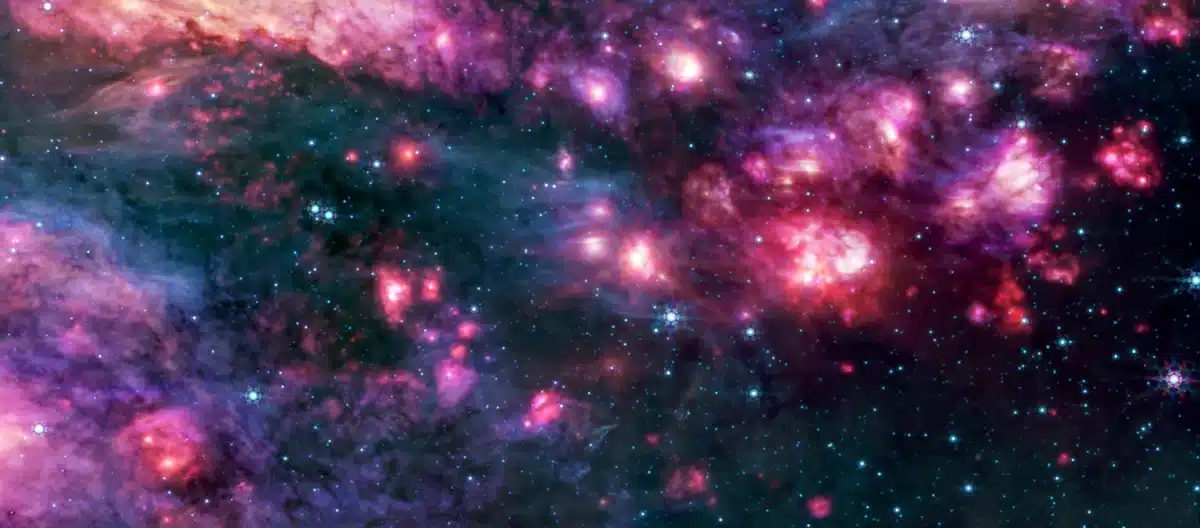 JWST’s view of the Sagittarius B2 region in near-infrared light. (Image credit: NASA, ESA, CSA, STScI, Adam Ginsburg (University of Florida), Nazar Budaiev (University of Florida), Taehwa Yoo (University of Florida); Image Processing: Alyssa Pagan (STScI))
These red regions likely hold important clues to why Sgr B2 is so proficient at forming stars. Current theories suggest that a combination of turbulence, magnetic fields, and temperature gradients might be driving more efficient gravitational collapse, but no single model fully explains the phenomenon yet. These data help redefine our understanding of how gas becomes stars, particularly in extreme environments like the galactic center, which is subject to intense radiation and gravitational forces.
NASA’s New Imagery Reveals A Hidden Heartbeat
The full-resolution image released by NASA and detailed in their December 2025 study paints a visually rich yet scientifically dense portrait of this “super-efficient stellar nursery.” The photo reveals more than just color: it maps temperature, density, and chemical composition through infrared emissions. What appears to be “dark” in the photo isn’t empty. It’s light blocked by thick curtains of dust, hiding early star formation processes from even the most advanced instruments.
The study notes that understanding these processes could help astronomers build more accurate models of galaxy formation and evolution, particularly in crowded, turbulent cores like that of the Milky Way. The NASA team, including scientists from the University of Florida and STScI, worked in collaboration to process and interpret the image. Their findings hint at the presence of multiple generations of star formation, coexisting within the same cloud. That arrangement could explain both the density and efficiency of the region.
Searching For Answers In Infrared Light
What JWST brings to the table is layered visibility. Different instruments highlight different physical characteristics of the same object. The near-infrared view from NIRCam shows a sky rich with stars, since stars emit strongly in that spectrum. In contrast, the mid-infrared image reveals the warm dust and gas, which are key ingredients of star birth. It’s in this band that JWST uncovers the structure and chemistry of the molecular cloud, helping astronomers infer the age, mass, and distribution of the embedded stars. This dual view is critical for astrophysical modeling. While optical telescopes would be completely blinded by the dust, JWST sees through the veil and provides data on how stars are forming in real time, what chemical reactions fuel the process, and how environmental conditions like radiation pressure affect stellar evolution.
What Sagittarius B2 Means For Galactic Evolution
The discovery of such an efficient stellar nursery in Sagittarius B2 raises important questions about star formation theory. If such high-efficiency zones are more common than previously thought, especially in galactic centers, then current models of star formation, which rely on fixed efficiency rates, may need revision. Furthermore, these insights might help explain why some galaxies evolve faster than others, particularly those with active or turbulent centers.
The data suggest that dense molecular clouds are not just passive structures waiting to collapse. They are dynamic systems influenced by shock waves, magnetic activity, and chemical feedback loops. Future observations of similar regions will help astronomers determine whether Sgr B2 is an outlier or the rule.