
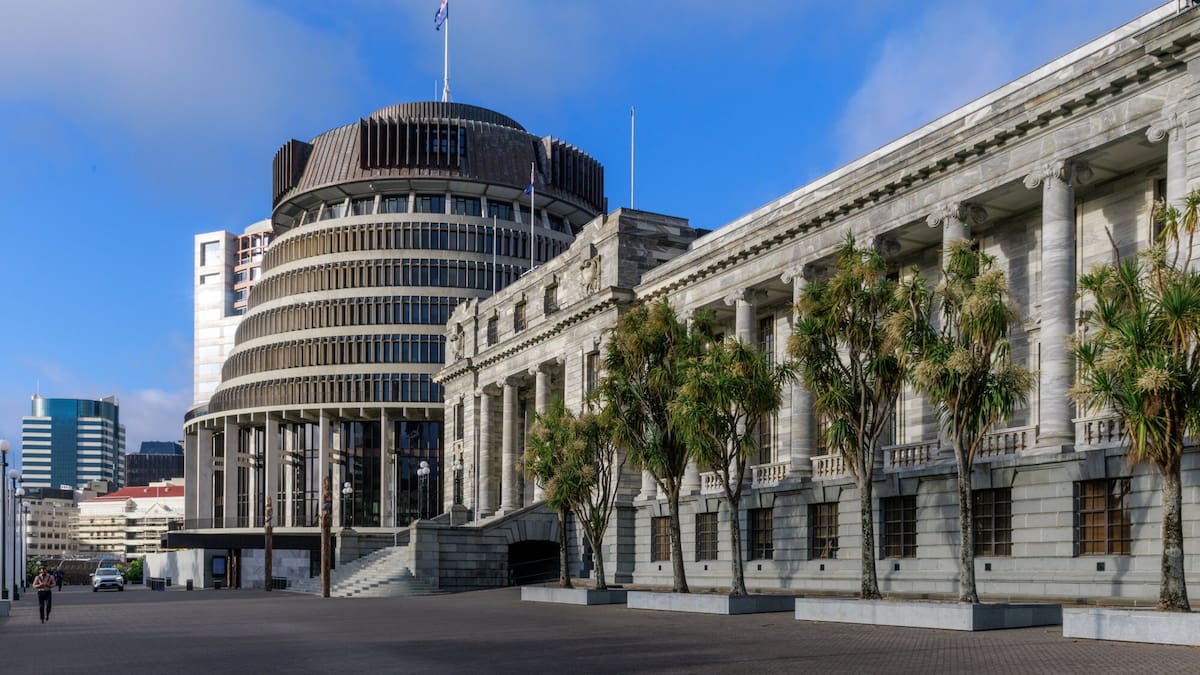
Claims of censorship overshadowed this year’s Youth Parliament.
One representative said at the time that criticisms of the present Government’s policy and legislation had been cut because it didn’t fit what they believed the ministry was looking for. Another rejected these claims, arguing the Youth MPs could say what they wanted.
Labour leader Chris Hipkins said censoring political debate undermined the point of the Youth Parliament event. Youth Minister James Meager said the purpose of reviewing the speeches was to ensure there were no legal risks.
While elected MPs have protections in the House from the likes of defamation – called parliamentary privilege – this doesn’t extend to Youth MPs.
Youth Minister James Meager said the review was about protecting the Youth MPs. Photo / Mark Mitchell
Issues identified in speeches
In response to an Official Information Act (OIA) request, the Herald received a summary of the feedback the Youth MPs were emailed by MYD officials after providing their draft speeches for review.
The document shows most Youth MPs received no feedback or minor feedback, like suggestions to include a sensitive content warning for comments on self-harm, or to reduce the length of the speech.
Thirty-one received tailored emails with a subject line saying, “changes required”. Despite the inclusion of “required”, the ministry has maintained these were only recommendations.
The emails said officials “have had to make some changes to ensure that your speech” is politically neutral, doesn’t breach laws, doesn’t name, blame or shame others, and doesn’t make false assertions not supported by facts”.
“Please find your speech attached with some minor changes to the wording,” the emails said before explaining why the changes had been “recommended”.
The summary document said where speeches “included serious accusations against MPs, agencies and organisations outside of government, Youth MPs were advised that without strong evidence of wrongdoing, they may be accused of defamation”.
“Risks of defamation were identified in four speeches and potential privacy breaches were identified in two,” the document said.
Feedback to this type of content included the officials suggesting the Youth MPs use a more general statement, reference sources, and remove a direct reference to an individual.
Some content in the speeches could have breached laws, ministry officials said. Photo / Tatiana Epifanova
There were 10 instances where changes were suggested to avoid “naming, blaming or shaming”.
Officials suggested focusing on “young people’s experiences” rather than accusations, using general language “broadening the pool of accountability”, and “softening this language without editing the content or context of your speech”.
Eleven cases where speeches made or could be interpreted as making “false assertions or claims” not backed up by facts were found.
Officials said some language was meant to speak to personal observations and opinions, but was instead stated as fact.
One statement targeted multinational corporations as “solely responsible and that they rule the world, which is not a statement of fact”. Officials suggested softening that language “to say that they wield financial, social and political power or say that it sometimes feels to you like they rule the world”.
Two speeches took the form of a poem where “artistic licence, emotional imagery and opinion were presented as facts”. They also contained “false assertions and breaches of copyright, including the use of a Large Language Model AI to write elements of the speech”.
The Youth MPs were asked to rewrite their speech to ensure it focused on conveying facts, policy problems and solutions “without any artistic embellishment”.
There were 22 instances of speeches not aligning with guidance for Youth Parliament to be non-partisan because they criticised or endorsed the Government and its policies, referenced an MP, criticised the previous Government, or referenced government slogans.
The Government’s changes to the pay equity regime and the defeated Treaty Principles Bill were mentioned in some speeches. Officials said because these had been before Parliament, making statements on them “would not be considered politically neutral”.
“Focusing on the parties’ positions can distract your audience from the strong message that you are trying to get across and does not follow the no blaming/shaming principles,” some feedback said.
“We have provided politically neutral alternatives which retain your analysis of the issues and your proposed solutions without talking directly to current policies or criticising particular politicians or parties’ stances.”
‘Pastoral care’
The MYD said all participants in Youth Parliament were “told in advance of the event that their speeches would be reviewed”.
“Participants were informed that this review was not about changing the content of their speech, but to protect them from any risk in the contents of their speech which they may not be aware of,” general manager youth John Robertson told the Herald.
Robertson gave two examples that led to edits being suggested. One where there was an “implication that MPs were accepting bribes or promotions in exchange for supporting certain policies”, and another in which there were “accusations that funding was misappropriated”.
“Ensuring participants are protected from any potential liability if the contents of their speech breached defamation, copyright, privacy, or contempt of court laws, or broadcasting standards, is an important part of our pastoral care role for the Youth MPs involved, who were aged between 16 and 18 years.”
Parliament hosts Youth Parliament once a term. Photo / Mark Mitchell
The Herald was provided with correspondence Youth MPs received about their roles in the months leading up to Youth Parliament in July. Some of this is related to expectations around the speeches.
For example, in May, Youth MPs received online modules to complete. A module on the general debate speeches said Parliament is “based on the principle of freedom of speech”, but parliamentary privilege “does not apply in Youth Parliament”.
In submitting their draft speeches, an online form said contributions should be “non-partisan, respectful and not directly criticise any/or insult any individual or organisation”.
A June 16 email explained why the speeches were being reviewed, with officials again noting the lack of parliamentary privilege.
“Within this context we review speeches before they are spoken in the House to look for any aspects that might need adjustment and why you might not be aware of. This review is not about changing the content of your speech”.
Officials warned against content that could be defamatory, breach copyright laws, or intrude on someone’s privacy. Speeches also shouldn’t include “accusations/allegations against others” or “misleading statements”.
An email from 2022 – when the last Youth Parliament was held – includes almost identical information about why speeches were being reviewed.
Any Youth MPs who followed up on their feedback were sent a generic email from the MYD that said it was their “choice how you use that feedback”.
“You are the one stepping up to speak and we fully respect your right to shape your speech in the way that feels right to you. We simply ask that you consider the feedback in the spirit it is intended, which is to support you.”
Robertson told the Herald MYD acknowledged some correspondence “could have been clearer and more consistent in our language when providing these suggestions and recommended changes to speeches”.
An evaluation of the Youth Parliament is now underway and is expected to be made public early next year.
Minister Meager told the Herald the top priority had been to keep “all participants safe and protected as much as possible” and he believed MYD had “participants’ best interests at heart”.
“As the documents show, there were instances of some Youth MPs’ draft speeches containing potential defamatory remarks, breach of individuals’ privacy, false claims or other breaches of the Youth Parliament Code of Conduct.”
He said the feedback “focused on how to best express their views without falling foul of the law, the standing orders, and to try to protect them from horrible trolling which can occur online”.
“No one was stopped from participating and no one was stopped from delivering any part of their speech, question or report. Many, if not most, Youth MPs were grateful for the support and guidance provided by the ministry and made excellent, robust and challenging contributions to the debate.”
The Herald asked whether it was appropriate for the Youth MPs to be asked to keep their speeches non-partisan, considering the environment they were being made in.
Meager said “robust and challenging debate” was encouraged and “exactly what we saw”.
“Youth Parliament is a non-partisan opportunity for young people to reflect their community’s views, understand how decisions are made and contribute to the ongoing dialogue of how we make New Zealand the best country in the world to work, play and raise a family.”
Jamie Ensor is a senior political reporter in the NZ Herald press gallery team based at Parliament. He was previously a TV reporter and digital producer in the Newshub press gallery office. He was a finalist this year for Political Journalist of the Year at the Voyager Media Awards.
Tags:
- AI
- assertions
- before
- breaches
- cases
- Censorship
- claims
- comments
- contained
- Content
- controversial
- copyright
- defamatory
- delivery
- draft
- during
- earlier
- found
- Headlines
- mps
- News
- of
- officials
- overshadowed
- Parliament
- potentially
- privacy
- remarks
- review
- reviewing
- say
- several
- speeches
- tasked
- them
- this
- Top News
- Top Stories
- TopNews
- TopStories
- unsupported
- were
- with
- year
- youth