

Henry Gibbons, 30, and Holly Baker, 29, cannot quite believe their new parallel universe. At this time of year the two former NHS doctors would usually be passing like ships in the night in their two-bed, £2,000-a-month rented flat in Battersea, southwest London, as they slogged through the winter gloom-cycle of increasingly sick and flu-ridden patients.
But today it is 30C and they are feeling fresh. They have just finished an afternoon of surfing on North Stradbroke Island off the sunny coast of Queensland, Australia, and the back-to-work dread doesn’t hit in the same way now they know they will escape work on time (that means 5pm after a ten-hour shift as emergency doctors).
They are excited about work tomorrow because it is Fun Scrubs Friday, meaning the whole emergency department dresses up in silly patterned uniforms, a weekly mood boost that feels emblematic of what has been a happier culture since they arrived in Brisbane three months ago.
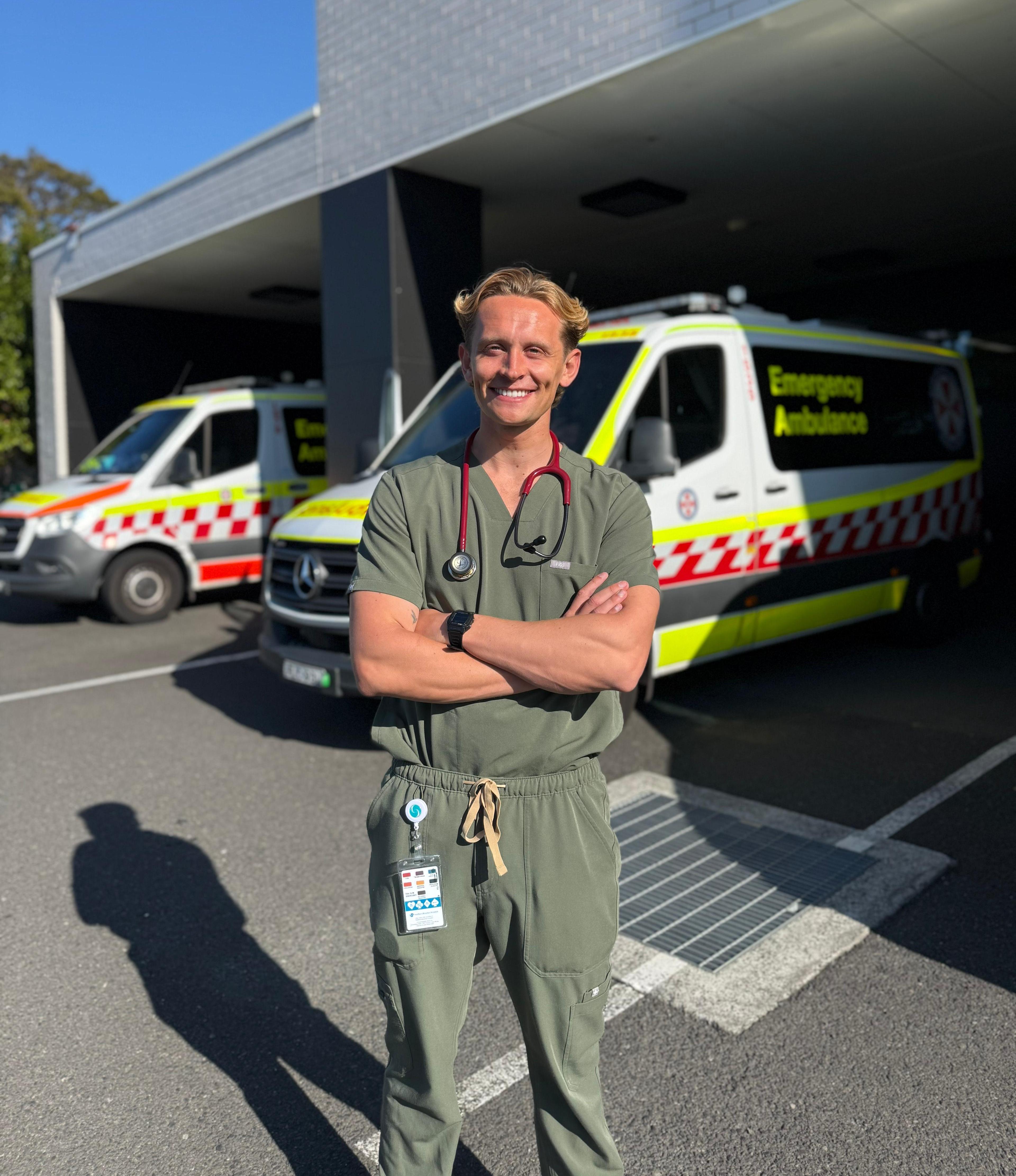
Tom Kydd-Coutts, 28, at work in Sydney. He moved from training hospitals in northwest London last September
COURTESY OF TOM KYDD-COUTTS
“Our stress levels have dropped,” says Baker, who is four years into the job as a resident doctor. She puts it down to better hours and a warmer, more outdoor-focused lifestyle that allows them to swim before work. “We have a 50m outdoor pool across the road and a rooftop pool in our apartment block,” she says.
Their new two-bedroom flat with a balcony, access to a sauna, steam room and gym (as well as that rooftop pool) costs “the same rent we were paying in the UK. It’s pure heaven,” she says. They have been working for only three months in Brisbane, but already have saved more than £4,500, roughly 50 per cent more than they managed while in the UK.
That is largely down to the pay. Just how much doctors earn in Australia varies from state to state. F1 (newly qualified, foundation year 1) doctors are paid the equivalent of £37,000 in New South Wales and £45,000 in Queensland, for example. In the UK, the F1 starting salary is about £32,000.
• Fifth of NHS doctors are sick of working in the UK
Then there is extra pay for weekend and night shifts. Doctors in Australia receive time and a half on Saturdays and double pay on Sundays. Consultants, meanwhile, can earn at least double the salary of their UK counterparts — all of which is for a 40-hour working week, not the 48 hours they would be expected to do in the NHS.
Baker and Gibbons met at medical school in Birmingham seven years ago and had been working at hospitals in London and Surrey. “It was quite hellish at times,” Baker says of the 13-hour shifts she would do with three doctors per 100 patients, desperately trying to meet unrealistic demands. “I’d do these ward rounds feeling delirious, wishing I could take annual leave but not being able to because we could only take it when we were on day shifts, which we didn’t get many of. Family and friends always used to comment that I looked so tired and sad and I kept crying for no reason. I spent a lot of the time wondering, was this going to be it for my entire career?”
You only have to take a quick glance at the UK headlines for a growing list of push-factors for a young person to want to leave the UK — tax hikes, rental hikes and the highest unemployment rate in a decade. But there is an added malaise for medics. A report by the academic and surgeon Lord Darzi into the state of the NHS last year warned that the health service was in a “critical condition”, with A&E departments at breaking point, long waiting lists “normalised” and “no progress whatsoever” in diagnosing cancer.
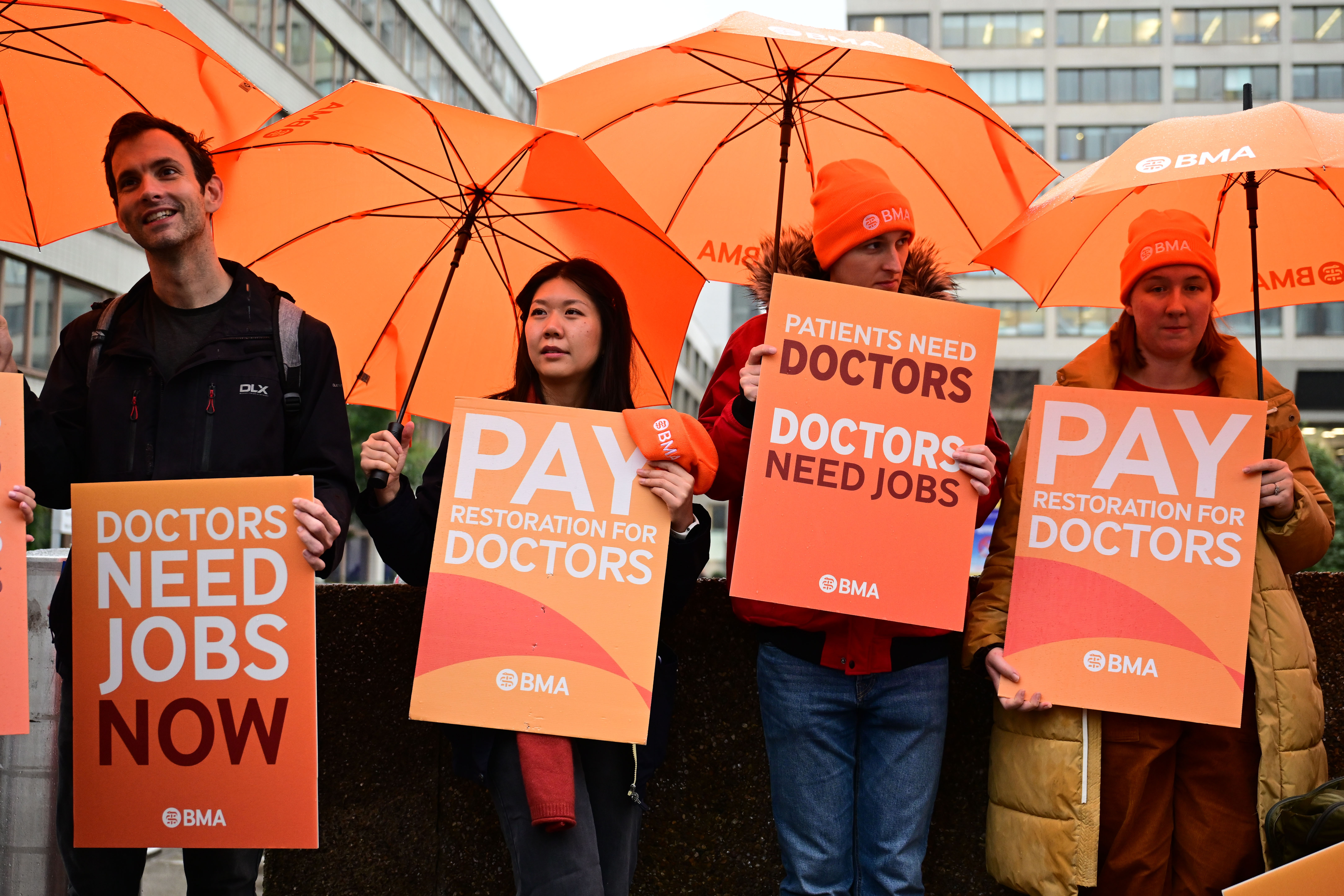
Resident doctors striking in London in November
GETTY IMAGES
“It definitely doesn’t fill me with excitement, the thought of going back to the pressures and the news and the waiting times and the reduced resources,” says Gibbons, a newly qualified GP, who points to the junior doctor strikes — 14 since March 2023 — as an example of low morale. Gibbons wouldn’t have been able to join this month’s strikes himself as he is no longer a resident doctor, but he is fully supportive of them — as is Baker, who says she would be on the picket line if she were in the UK right now.
The couple had watched dozens of British medic friends make the move to cities such as Sydney and Melbourne, but waited until Baker had completed her two foundation training years before marrying in front of 170 guests in Suffolk in the summer and then bidding them goodbye a month later, on a one-way flight to Australia.
• Doctor exodus: tens of thousands planning to move abroad, NHS warned
They certainly fit a pattern of twenty and thirtysomething doctors whom I have seen relocate to Sydney since I came here as a freelance writer 15 months ago, to join my British partner. Ever since I landed, another friend or friend of a friend has stepped off the plane almost every week, many of them medics and on Temporary Skill Shortage visas (also available to the plus-one of a sponsored healthcare worker).
According to the General Medical Council, more than 4,000 doctors left the UK to practise abroad in 2024 — the highest annual total in a decade — with Australia the most popular destination, luring at least 20 per cent of them. (While not pertaining to Australia, the Department of Health and Social Care says that overall NHS resident doctor leaver rates have fallen from their peak in 2022, according to NHS England.)
The numbers are stark when you consider it costs £392,000 to put a doctor through medical school and a foundation training programme, according to the Personal Social Services Research Unit (PSSRU) at the University of Kent. The vast majority of that is funded by the UK government — while tuition fees and student loans are paid back by the doctor.

Henry Gibbons and Holly Baker: “Our stress levels have dropped,” Baker says
GLENN HUNT FOR THE TIMES MAGAZINE
Ministers say they are concerned about a one-way “brain drain” among young talented medics and the BMA is warning that the NHS is “leaking doctors at an unsustainable rate” and facing a “workforce crisis” — hardly helped by British doctors complaining they are then stranded in the southern hemisphere, thanks to bureaucratic barriers. While Australia and New Zealand automatically recognise the medical qualifications of doctors from Britain, the UK will not do it the other way round, even though the training is almost identical. This means senior doctors who completed their specialist training abroad are unable to return home and apply for permanent NHS roles at the same level.
Chris Grayston, 32, was close to quitting medicine altogether in Britain when in 2020 he moved from Devon to Australia.
“I was feeling quite lost and burnt out, struggling with the intensity of the job and feeling very jealous of friends working in tech, start-ups or finance who seemed like they had better lives and were earning more,” he says of his two foundation years across Cornwall and Devon when he was one of four on-call staff expected to look after 400 patients. “I’d drive into work feeling so helpless, like I wasn’t really good enough and like medicine was a silly career choice.”
The breaking point came when he had to tell a family that their father was being moved to end-of-life care, a decision normally left for a consultant on a day shift, not a junior doctor such as Grayston working nights.
“That moment has always stayed with me,” he says. “I felt so unsupported and out of my depth.”
It was a friend from medical school who encouraged him to consider Australia and after his first year working in an emergency department in Brisbane, he quickly realised it wasn’t the job that didn’t suit him, just the NHS. He was not alone in his thinking. “In one emergency department [in Brisbane], around 80 per cent of doctors were British,” he says.
He now works for an agency as a locum, which usually means flying to an emergency department in a rural town and working eight-and-a-half-hour shifts every morning or evening for seven days in a row.
Locuming is lucrative if you are happy to live out of a suitcase and embrace the lack of consistency. As a locum junior medical officer in Australia you can expect to earn £60-£150 an hour, Grayston says, although you miss out on sick pay and holiday pay.

Chris Grayston’s posts on Instagram
@DOCTORCHRISG/INSTAGRAM

He spends his time between jobs travelling, exercising outdoors and making videos for his 80,000 Instagram followers under the handle @doctorchrisg. “For the first time in years, I actually enjoy the job”, “Now I still work healthcare, just not in the crying-in-the-mop-closet kind of way” and “If you’ve survived the NHS, Australia feels like a paid holiday” are among the lines from his most popular videos.
On social media, there are thousands of videos like his. #Medtok is awash with tales of British doctors tripling their salaries, earning £10,000 more a month and being able to afford a decent lifestyle in a way they never could in the UK.
The Australian government frequently describes its healthcare system as “one of the best in the world”, pointing to a hybrid model of public care and private insurance. At its core is Medicare, a government-funded universal insurance scheme that provides free and subsidised treatment.
Yet it is not all a sunkissed fairytale. “There are still waiting times, staffing issues and difficult rota patterns. It’s still medicine. You still have to work hard,” says Tom Kydd-Coutts, 28, who moved to Sydney from training hospitals in northwest London with his fiancée, Holly, a dentist, in September 2024. He began work in an emergency department, a job that paid £54,000, compared with his £32,000 salary in the UK.
“Yes, waiting times were lower, patients generally presented with symptoms much earlier and, as a doctor, I felt so much more respected by patients — not to mention that Australians seemed to (wrongly) attribute my British accent with good clinical practice and credibility,” he says. “In Australia, arriving to an empty waiting room is normal and it’s a bad day if a patient is waiting longer than six hours.” In London, he once saw that a patient had been waiting 19 hours. “It would almost have been quicker for them to fly to Australia,” he says.
The rota, however, is arguably harder in Australia, he says. In the NHS, doctors can work a maximum of four night shifts in a row. In Australia it is not unusual to have to work seven. The same goes for weekend shifts. “I’ve often worked every other weekend here in Australia,” he says. “In the UK, it would be a maximum of one in four.”

Tom Kydd-Coutts with his fiancée, Holly
COURTESY OF TOM KYDD-COUTTS
There is also the fact that moving to Australia as a Brit does not automatically land you in affluent cities such as Sydney, Brisbane, Melbourne or Perth. Out in rural Australia, medicine is a whole different ball game. Healthcare facilities are often three hours from the nearest hospital, there are fewer staff and drug and alcohol cases are often disproportionately high.
“Resources are limited, resuscitations never stop and co-ordinating helicopter retrievals can be stressful,” says Kydd-Coutts, who, after a year in Australia, switched to better paid locum work and recalls a recent rural case where he was on his own with a stabbing victim, waiting four to five hours for a helicopter.
He has found rural work like this exhilarating most of the time and he has certainly racked up his fair share of stories, such as the patient who brought in a deadly octopus in a bucket, or the one who dislocated his shoulder lifting a dead kangaroo onto a van.
But it is not for everyone. “Right now, I’m living on my own in a holiday park four hours from Sydney, where my girlfriend, Holly, and all our friends are based,” he says on a sweltering 40C day in rural New South Wales. “It can be quite isolating at times, but the upside is I’m probably earning three times as much as I would locuming in the UK, with less clinical stress.” Neither he nor Holly says they have felt burnt out since they arrived.
Kirsty Maskell, 36, a mental health nurse with 46,000 followers on TikTok, who posts about her job in Oz, moved from Glasgow to Perth in September 2024. She and her partner, who works on wind farms, love their new lifestyle and want to stay permanently, if they can, almost solely for work-life balance reasons. Maskell says she burnt out in the NHS and didn’t feel comfortable asking for mental health days. “Taking a mental health day off is completely accepted here,” she says. “The irony is I’ve not needed one.”
Her pay also rose with the move, from £37,000 to £55,000 — she has saved £10,000 so far — and she is already being encouraged to apply for a promotion. Even her mum stopped pleading with them to come home once she flew out and saw their new beachside life in Perth for herself. “Going home would feel like a step back now, because you know you’ll go back to being paid not that well and probably struggling more than you were out here,” she says.
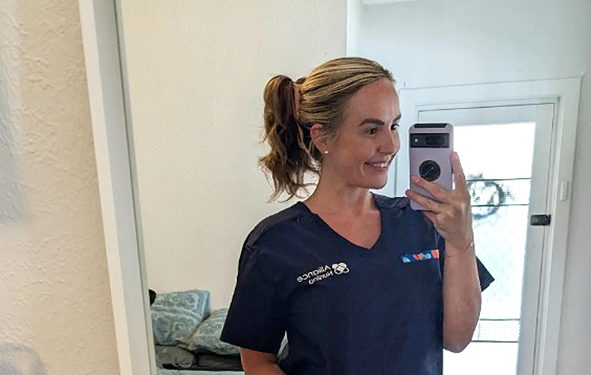
Mental health nurse Kirsty Maskell relocated from Glasgow to Perth
TIKTOK.COM/@NURSEK200
Data on how many medics end up returning from Australia to the NHS is not available, but anecdotally plenty of Brits seem to return home eventually. Baker and Gibbons estimate about 70 to 80 per cent of the medics they’ve met in Australia have gone back.
They too are planning to return to the UK later this year. “We keep saying, if we could pick up our friends and family, staying in Australia would be an easy decision,” Baker says. But they want to be around family if and when they have one of their own and Baker hopes to go into dermatology, one of the most competitive specialisms for which it helps to have contacts. They’ll head home after a stint of travelling, she says.
“But we would definitely consider moving back,” she says, noting they will struggle to afford a property in London big enough to raise a family on their current salaries.
Kydd-Coutts plans to return to London in June for the next stage of his training to be an anaesthetist. He is adamant that the UK is a country of clinical excellence and has some of the best doctors in the world. But he also believes any doctor can benefit from experiencing another country’s healthcare system, whether it is facing new medical scenarios such as snake bites or being more exposed to hands-on procedures.
Being close to family tipped the balance in the end. When his parents — South Africans who moved to the UK for a better life in 1997 — visited them in Sydney, they admitted a part of them wished they had moved to Australia instead of the UK. “My dad, a retired GP, says he could hardly blame us if we wanted to stay,” he says. “If we were five years younger or already had children, staying in Australia would be a no-brainer.”
For Grayston, the move down under is looking permanent now he is engaged to an Australian. He visits loved ones in the UK once a year — a trip, he says, that tends to reinforce the fact that he has made the right choice.

Henry Gibbons: “It doesn’t fill me with excitement, the thought of going back to the pressures and the waiting times”
GLENN HUNT FOR THE TIMES MAGAZINE
Does he feel guilty to have been trained at a huge expense in the UK, only to take his skills abroad? It’s something he is asked on social media all the time, and he understands the strength of feeling around the issue.
“But I don’t think the answer can be that doctors should accept being unhappy or burnt out for the rest of their lives because the system invested in their training,” he says.
Grayston points out that he paid £15,000 in tuition fees — a lot less than the £47,000 his younger colleagues had to pay after fees tripled — and is still paying off his student loans. Plus he has served his time working in the NHS. “Ultimately, if the system supported junior doctors better, fewer people would feel the need to leave in the first place. Most of us don’t leave lightly. It’s usually after trying very hard to make it work.”
Gibbons and Baker agree. “We’d feel guilty leaving if there were a shortage of doctors,” they say. “But given there is a lack of training posts, increasing doctor unemployment and student debt, often over £80,000, working abroad reflects an exciting opportunity to understand and experience a different healthcare system and does not reflect a lack of commitment to the NHS.”
They accept that UK training is often a classic baptism of fire: being chucked on the wards and managing situations of which you have no experience. “But that baptism of fire does stand you in good stead for a career in medicine.” It’s probably half the reason British doctors are so valued abroad — and why countries such as Australia want them.