
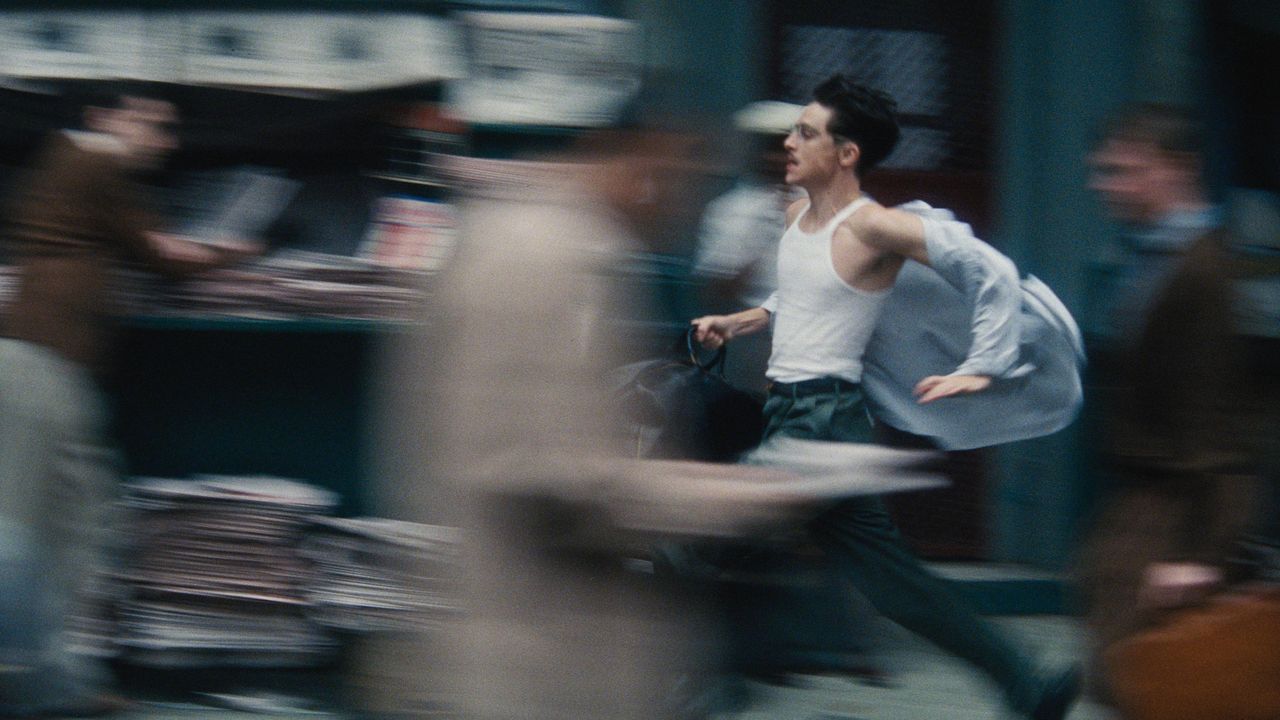
You can see that most clearly in Lawrence’s Table Tennis Club, Marty’s primary social and professional environment. Built from archival references and original blueprints, it’s dense, smoky and kinetic, a room where bodies, money and performance collide. In the film it’s not just a setting but a pressure chamber. The same care extends outward. As reported, the Plaza Hotel in New York was repurposed to stand in for the Ritz in London, with walls repainted to match the exact shade of cream historically used in Ritz interiors, chosen for the way it flatters skin tones and softens light.

Tournament scenes set across Europe and the Middle East were staged inside a vast arena in New Jersey, where crews built tens of thousands of square feet of wooden flooring and custom truss lighting to simulate international venues. London and Tokyo feel less like exotic departures than like extensions of the same visual logic. The world expands, but it doesn’t fracture. Even the ping-pong is treated this way. The matches feel less like sport than like choreography. Rallies are constructed from historical plays, rehearsed with precision and staged around rhythm as much as speed.
All of this feeds into what the film is really interested in, which is visibility itself. Marty doesn’t just want to succeed. He wants that success to be seen. The film’s heightened aesthetic mirrors that desire without fully endorsing it. It watches Marty watching himself, building a version of his life that’s as performative as it is real. In that sense, the marketing doesn’t feel separate from the film so much as continuous with it. It’s the same logic that runs through the film itself, atmosphere first and narrative second.