
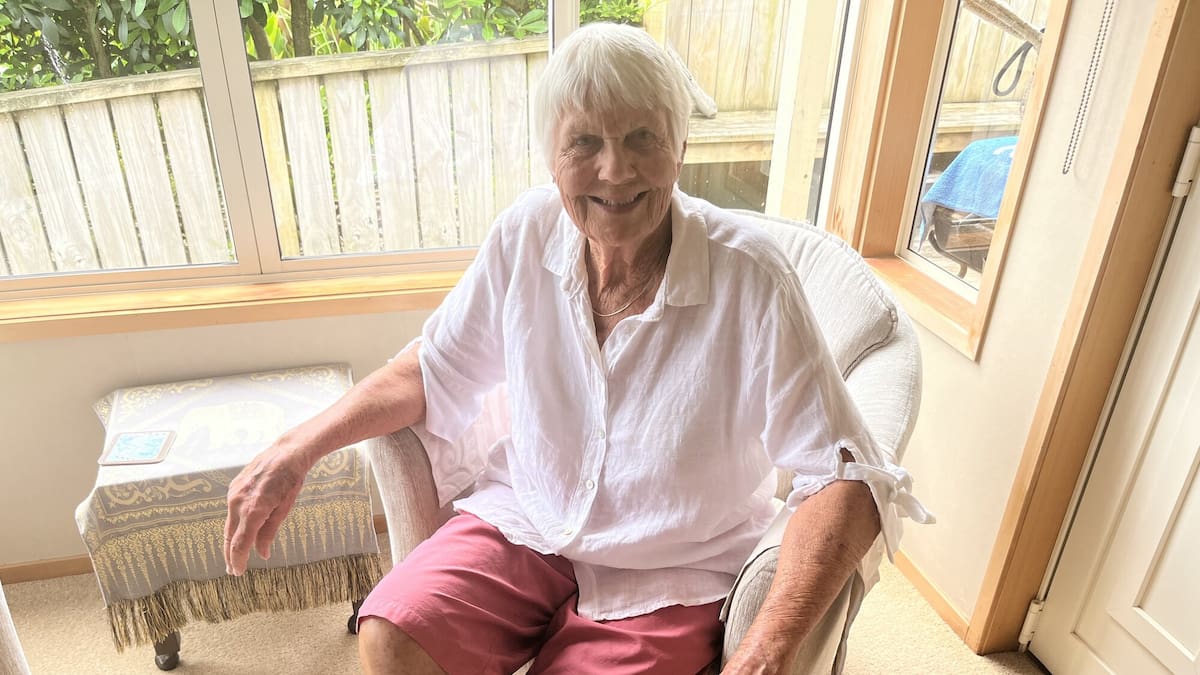
“I was at Auckland Hospital, and I taught clinical pharmacology at med school [the University of Auckland] for decades.”
Women’s health and the work of women in the medical field were core parts of her career, with Briant running evening family planning clinics on Karangahape Rd for a few years and working with the New Zealand Medical Women’s Association.
“We took it on ourselves to meet in Auckland with all the young women who were coming for an interview for med school. A bunch of us would invite them for lunch and then berate them about the difficulties of combining career and motherhood. Just so that they had thought about it before they leapt in.
“The issue for half of the medical students who are women is the never-ending conflict between biology and training. So, when most people want to have a family, and when is it going to be good to do that?”
Although it was possible to train and work part-time in the medical profession, Briant said it was still very challenging to balance with children and family.
“I don’t have any kids of my own. That was a decision too far for me. The way I was brought up with a totally at-home mother who totally looked after everything – I couldn’t quite take myself out of that to be a part-time in both roles. So, I made a non-child choice way back – which is fine. I’m happy about that.”
That did not stop her from saying it was a good career option.
“I would say it’s a most satisfying, interesting career, that has so many opportunities and directions.”
There are few better examples of that than Briant herself, who also spent time volunteering as a doctor for World Vision in Thailand and had stints as chairwoman of the New Zealand Medical Council and the NZ branch of International Physicians for the Prevention of Nuclear War.
She received the New Zealand Suffrage Centennial Medal in 1993 and was appointed a Commander of the Most Excellent Order of the British Empire for services to the medical profession in 1994.
Later, she worked with the international medical relief organisation Médecins Sans Frontières (Doctors Without Borders) and went to Palestine for a year.
“I did that in 2003 and 2004 for a year. Life for Palestinians when I was there was very bad. And we naively thought it couldn’t get any worse. Well, clearly it has with Gaza being now completely annihilated in terms of infrastructure, and [people] still living in horrendous conditions,” Briant said.
She also spent six months helping to run a trauma programme for children in Jenin, in the north of the West Bank.
With Médecins Sans Frontières, she also spent time working in Rarotonga, the Republic of Abkhazia in northwestern Georgia and Pakistan before she eventually returned to Gisborne.
“Because Pātūtahi is my origin, I came back here to retire.
“I’ve got heaps of family here. Yes, my brothers and my many nieces and nephews and great-nieces and nephews. No doctors, a number of nurses and a radiographer.”
Around 2007, she said she returned to work as a physician at Gisborne Hospital because of a “dire need for person power”.
From there, she eventually went to Hospice Tairāwhiti, where she said she had spent a significant amount of time as a locum.
“I did a year as a main clinical staff member after the previous person left rather suddenly without a succession plan.
“I’m not specifically trained in hospice work. I said I’d do it for a year, which I did. I subsequently have been their kind of a fill-in person for gaps and holidays and sickness and things like that.”
She emphasised the important work the hospice does in the community.
“Many Gisborne people have already had interaction with hospice through various family members, neighbours, friends, themselves and everything.
“It’s another of those vital, quiet little services that keeps going and plugs on.”
Briant said the ability to visualise organs and diseases inside the body had “changed immensely” during her time working in medicine.
“We had very well-honed clinical skills to determine more or less what was going on inside the brain. Stroke, brain tumour, Parkinson’s disease, those sorts of things. The descriptions of those diseases and the deficits that they produced were ones that we sought out with our clinical skills, examining the body carefully.
“Now, that kind of comes afterwards. People get whacked through a scanner, and then somebody might go and tap their reflexes afterwards or something.
“To me, it’s a very strange world. So I’d say imaging is the thing that’s changed most dramatically and the ability to determine what’s going on without cutting people open.”