
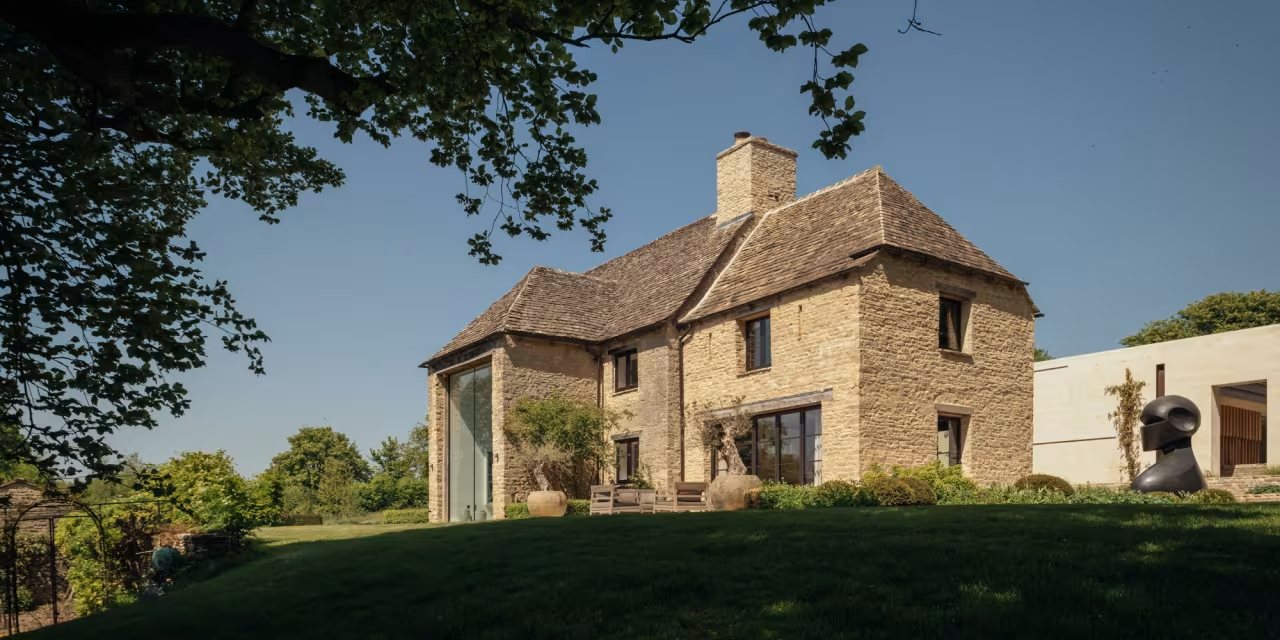
Architectural designer Benjamin Twells got the kind of brief that many in his field dream of when he was tasked with masterminding a contemporary extension on a 19th-century stone threshing barn in England’s Cotswolds.
“The client is a sort of eccentric character with a kind of ‘anything is possible’ attitude, which was the most inspiring relationship to work with,” he said. “His brief was very open. He knew that he wanted the best parts of the country house life, but he didn’t want the dingy, dark, small windows of a traditional Cotswold stone farmhouse, for example. It was very much about, ‘How can we do something different in this pristine valley in the Cotswolds, which is very prestigious to be in? How can we push the boundaries?’”
Twells’s design juxtaposes classical and contemporary, contrasting the simple stone structure of the barn with a sweeping curve of glass, wood and Cotswold stone, which is linked to the barn by a glass tunnel and extends in a gentle arc into the hillside beyond. Twells’s company, SOTA Design, was established in 2019 “really, to facilitate this project,” he said.
Short for State of the Art, the name of his studio embodies his approach, which aims to “draw on what is already in existence and reinterpret that in a contemporary way, to a level where we are pushing boundaries.”
MORE: Burt Reynolds, Jake Paul and Five Finger Death Punch: 10 Celebrity Homes That Wowed in 2025
The client for this career-defining project, the CEO of a global outdoor-media infrastructure company, had a few specifications in terms of his family’s living requirements, but left the structure, appearance and layout of the home to Twells.
Finished in 2024, the new wing of the house features everything one would expect in a classic country house, including four bedrooms, a generous central living space, a playroom, snug, boot room, scullery, pantry, powder room and laundry, but it also contains a multilevel basement sunk into the hillside, containing a private cinema, a barrel-vaulted Cotswold stone wine cellar, a gallery and museum-quality art storage facilities.
The glass-walled central living space is centered on a seven-ton carved granite fireplace that anchors a living area, dining area and curved kitchen. Curving panels of oak on the ceiling echo the wooden cladding on the striking overhang outside, one of many details designed to create an indoor-outdoor feel that unites the interior of the property with the natural landscape beyond.
The main inspiration for the shape of the barn’s sweeping stone-and-glass extension was the natural contours of the land on which the building stands.
“It was essentially an 11,000-square-foot extension on a 2,000-square-foot barn. So we dug 25,000 tons out of the hillside,” Twells said. “Then what you have is a sort of slit that opens up, and then the hillside could roll over the top.”
The family home is a juxtaposition of old and new. Twells began by restoring the barn to its original layout, demolishing a modern extension and stripping away some internal interventions that weren’t in keeping with the historic style, including a large landing with glass balconies that had been added in the 1990s, interrupting the cohesion of the barn’s double-height internal space.
The designer chose to connect the two halves of the property with a simple glass tunnel, surrounded on the exterior by water and enormous chunks of local stone, intended to link it to the local landscape and the site’s agricultural history.
MORE: 230 Interior Plants Are ‘the Lungs’ of This Aussie Wellness House
The choice of materials was key in uniting two such disparate architectural styles, creating a juxtaposition that feels striking but not jarring. “I’ve worked in the Cotswolds for 12 years now, so we’ve got a really good understanding of local materials, how and why things are built the way they are,” he said. “You can get anything from anywhere and put it together and you would still have a lovely house, but it wouldn’t necessarily feel at home where it is.”
From Mansion Global Boutique: How To Create Comfort in Winter’s Dark Months, According to Kendall Wilkinson
In keeping with the clients’ wishes to avoid a structure that felt minimalist or austere, he chose materials not only for their links to the history of the area and their ties to the historic barn, but also for their warmth and tactility and their ability to patinate over time, including stone from local quarries and oak timber felled and cut locally.
“The majority of materials that made the project happen were from a 10-mile radius,” he said. “There was a whole conceptual reasoning behind what materials we should use where.”
The home transitions from raw materials to refined back to raw again, Twells explained. “Big, monolithic blocks of Portland stone” gave way to textured walls made using local stones that had been refined, shaped and dry laid, then to expanses of glazing, then to smooth, local lime plaster, and then back in reverse order “toward its natural state, into the ground.”
MORE: Investors Have Swooped in as Scorched Lots Stack up a Year Since L.A.’s Wildfires
The build ties back visually to the original threshing barn—where workers would strip grain from the chaff—thanks to the extension’s curved facade. “As you move around the plan in each room, you’ve always got a visual connection back to the original barn,” he said.
As well as preserving the barn, the project prioritized the rewilding of the land, as well as a sustainable approach to energy usage. The crescent-shaped extension is built on a southwest orientation to maximize passive solar gain. In the winter, sunshine streams inside to warm the home, while an overhand on the facade offers shade in summer, when the sun is high, preventing overheating. Twells chose to use concrete mixed with fly ash for the bulk of the structure because of its ability to store heat.
“It takes a very long time to heat up, but once it does heat up, it stays warm for a very long time,” he said. “The building is essentially warmed by solar gain.”
The green roof was also a key element in preserving and encouraging biodiversity. “Almost the whole building, we laid a wildflower turf green roof over the top,” he said. The site has been “turned back over to nature,” he added. “You get the voles and the field mice and butterflies and all of the pollinating insects. It’s about improving on what we had.”