
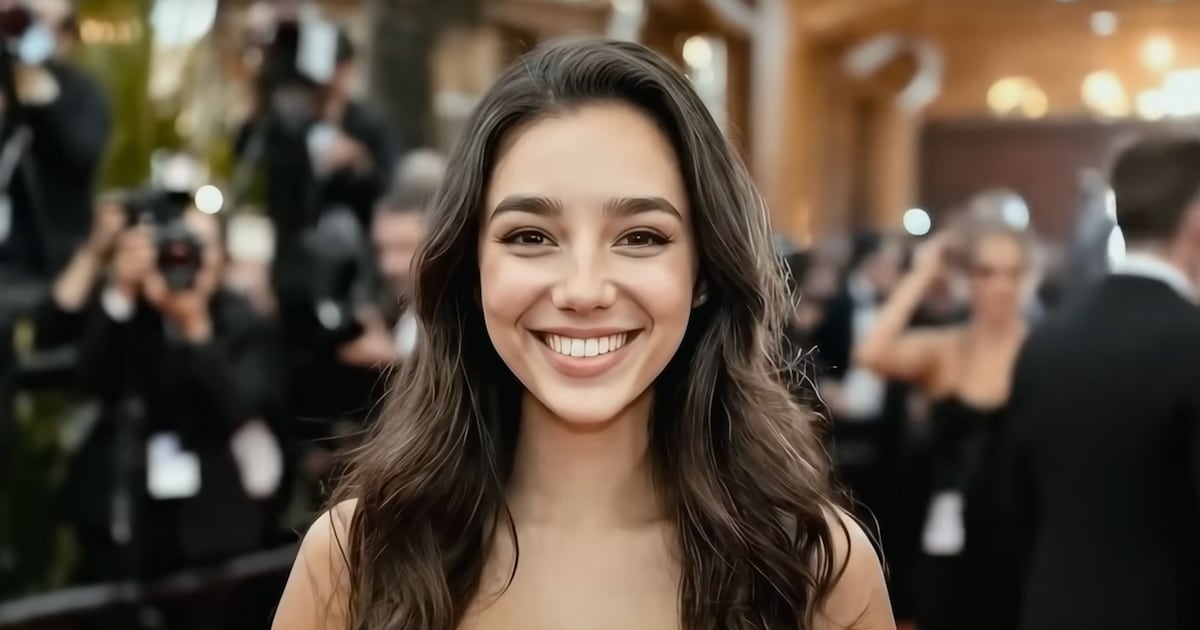
Arguably, the most talked-about actor last year was not a hot young star who sparkled on the red carpet. It was Tilly Norwood, a 20-something aspiring star, who appeared in an unfunny comedy sketch titled AI Commissioner and later took to social media to express her happiness at bagging her first big role.
The reason everyone was talking about Tilly wasn’t that she has a riveting screen presence. It is because she isn’t real. She is an AI construct, created by as a proof of concept by London AI “production studio” Particle6, and her existence has thrown Tinseltown into an existential panic. “Good Lord, we’re screwed. That is really, really scary,” said real actress Emily Blunt. “Please stop. Please stop taking away our human connection.”
But AI has no intention of stopping. No sooner had “Tilly terror” receded than the music business was breaking out in hysteria about Xania Monet, a digital pop star who has clocked up 17 million streams – prompting Forbes magazine to wonder if she was “the future of music”.
Nobody wants a pop star made out of software code – any more than they want an AI actor. And yet, behind the moral panic over these cybernetic celebrities, the worrying truth is that entertainment is already being manipulated off camera by AI and by algorithms. It’s just that, until now, the industry has been better at covering it up.
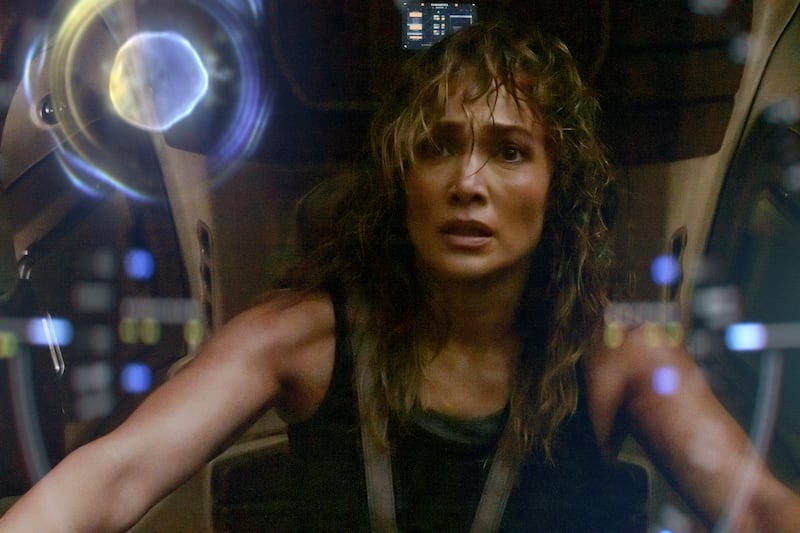 Jennifer Lopez in the title role in Atlas. Photograph: Ana Carballosa/Netflix
One of the chief offenders is Netflix, which has been churning out machine-tooled telly for years. The world’s biggest streamer is also the pioneer of a genre dubbed “algorithm movies” – aggressively generic films that exist only because the company’s spreadsheets tell it there is an audience for content devoid of passion or vision, designed to appeal to the broadest possible viewership.
This sort of gunk is all over the service – whether it’s Atlas, starring Jennifer Lopez (one box ticked), inspired by the Japanese genre of “Mecha” robot action (tick) and set in a dystopian far future (tick).
Or consider the deafeningly forgettable Red Notice, featuring popular movie stars Dwayne Johnson, Ryan Reynolds, and Gal Gadot (tick, tick, tick) with bantering dialogue (tick) and significant action set pieces (tick). Obviously, Hollywood has always been calculating in the sort of projects it brings to the screen. But algorithm cinema feels different: it has the same artificial gloss as that radiated by Tilly Norwood – in the recesses of our soul, we can tell that it isn’t natural and exists only to feed the content machine.
Music has been dealing with these issues, too. There was understandable horror during the year when it emerged that the popular Spotify band, The Velvet Sundown, had been created with AI – that this King of Leon-esque group had clocked up one million streams despite being as real as Tilly Norwood’s smile.
 AI generated band The Velvet Sundown
But again, AI has been an issue in music for some time – Spotify uses an AI DJ to “curate” playlists for subscribers, which contributes to the idea that music works best as mood-enhancing background noise rather than something to engage with as a fan. It’s easy to object to The Velvet Sundown – but Spotify’s relentless championing of playlists is far more pernicious and difficult to call out, because algorithms are manipulating you without you knowing it. As with so much else that is wrong in the world, AI is at its most insidious when you don’t realise it’s there – the apocryphal ghost in the machine.
[ Mark O’Connell: Can AI ever replicate human art? Maybe that’s the wrong questionOpens in new window ]
It is also worth pointing out that not all digital entertainers are bad. In late 2024, my daughter and I went to a concert in London by Hatsune Miku – a CGI pop star who was projected on to a screen and accompanied by a real band. It was one of the best concerts I’d been to that year – the blue-haired singer sang, danced and played guitar while the audience in the packed venue waved shining glow sticks. Yes, it was all a bit cult-like – but the tunes were great (and loud). AI has meanwhile been used by the experimental artist Holly Herndon, who sees it as a tool for broadening her musical frontiers: in 2019, she said, “I don’t want to recreate music; I want to find a new sound and a new aesthetic.”
 Virtual pop star Hatsune Miku
That is the key point. Used with imagination and passion, AI and computer-assisted art undoubtedly have a place. The problem arises when studios and streamers try to pawn it off sight unseen, via flavourless blockbusters or playlists that deaden our taste and atrophy our curiosity about new music.
So while Tilly Norwood and Xania Monet are, of course, a worrying symbol of the AI armageddon that may yet arrive – it’s the digital chicanery that we can’t see yet which is all around us, that surely poses the greater threat. The robot uprising, if and when it happens, will take place quietly and perniciously. It may, in fact, already be under way – delivered not by Terminator-style killbots but by Netflix and Spotify.