
When a teenage Kelly was pumping gas at that spot, it was called Bruce Reid Motors and he had the Sunday night shift from 4pm to 1am.
He’d picked up the job specifically to put new wheels on his then-prized Mazda RX2 Coupe.
The detail that Kelly had left out during his brief chat with the inquisitive young Z worker was that even before he’d started patrolling the forecourt, he was already working six days a week.
The part-time petrol station gig completed the set. He may have had money for new wheels, but he was short of time to drive them.
Part 1 of the secret to success: Work often
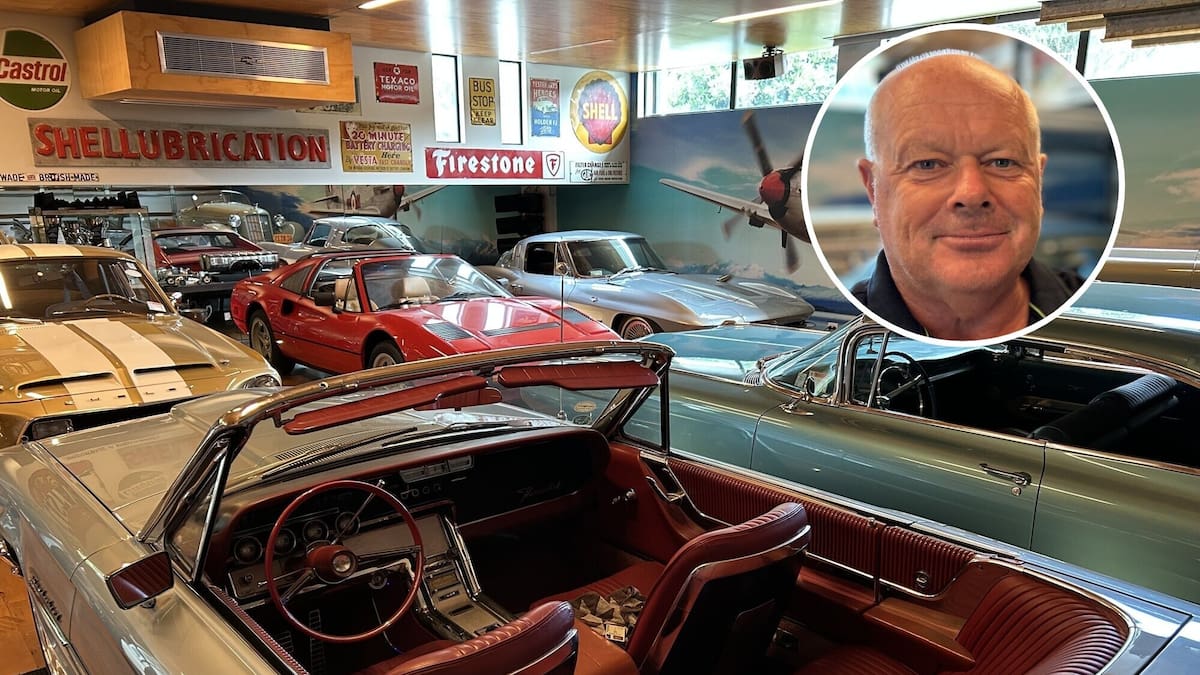
The Lamborghini that caught the young attendant’s eye is one of about 20 cars that Kelly owns. He’s not sure of the exact number.
“I’m really, really good at selling cars. I’m just no good at selling my own,” says Kelly.
Christchurch businessman Paul Kelly and some of his exotic cars.
He’s right on both counts. Paul Kelly Motor Company has been a used-car juggernaut since the late 1990s, but the wheels were in motion long before that.
His father was a hard-working Irishman who became a market gardener in the Horotane Valley in Heathcote between Christchurch and Lyttelton. Before that, and shortly before Paul was born, he was a contract shearer in Invercargill.
“He came here from Ireland when he was about 19 or 20.”
Kelly remembers his father as a seriously hard worker who always provided well for his family.
“Was he massively financially successful? No, not at all. But we were certainly a middle-stream New Zealand family. We probably had it a lot better than most because we had quite a big property.”
His Horotane Valley upbringing gave him freedom without finances.
“I never went on a single overseas holiday. We never owned a tent, never owned a caravan, never owned a boat. We didn’t have anything extra like that because we just didn’t have the money. And that’s something that I always wanted as a kid.”
Part of Paul Kelly’s exotic car collection. Photo / Mike Thorpe
His mother was a telephonist at Smith’s City and was incredibly resourceful. She’d make her son Paul clothing by buying the latest fashions (on appro) before measuring them up and reproducing them on her sewing machine in cheaper fabrics.
Their actions educated Kelly at home, but their words couldn’t inspire him at school. Nothing could. In his words, school wasn’t for him. At just 14 and halfway through 5th form (Year 11), Paul was already investigating how to leave Linwood High School.
“I managed to get a job at a parts department, at a place called Carthy Holden when I was still 14, and the rollover date for me getting that job was about three days after I turned 15. They didn’t know I was 14 when I applied for the job, but I got it, so that was me straight away.
“I was only there for eight weeks and I got made redundant. And so, I was 15 years old facing the dole with no job, much to my parents’ disgust.”
Soon after, he was again employed, in the parts department of a company called Smith Regrinds – and again he’d been creative with his age to get an interview.
“You had to be 18 and have a minimum of School Certificate and UE [University Entrance]. I was 15 and got the job. I went back later on and asked the boss if I could have a talk to him. I said I just want to let you know I’ve actually lied to you – I’m 15 and I’ve got no education. So he shook my hand and said, ‘You’ll do well in life, son. Start on Monday’.”
After a short stint working for his uncle in the United States, Kelly returned to Christchurch. Now in his early 20s, he had decided he wanted to move out of parts and into selling cars.
He was working at Kirk Motors at the time.
“I went and found a job at a car dealer on Moorhouse Ave. When I went to hand my notice in [at Kirk Motors], the dealer principal at the time, Andrew Simms said, ‘Oh nah, mate. You’re not going there. I’ll give you a job here’.”
Kelly sold a “truckload” of cars and his employers recognised he had talent and an impeccable work ethic too.
Part 2 of the secret to success: The more you work, the better you get
Kelly’s working relationship with Simms was about to level up.
Simms’ business partner, Gary Donnithorne (Donnithorne-Simms Mitsubishi), had decided to exit the new-car franchise and took Kelly with him to open up a used-car yard. About 12-18 months later, Donnithorne chose to exit the motor vehicle industry entirely.
That left a Paul Kelly-sized hole in the market, and both Simms and Donnithorne knew their young protege would be the perfect fit.
“Andrew rang me up and said, ‘You need $100,000 for a dealer’s licence and I know you haven’t got it. So, I’ll put in $50k, Gary’s going to lend you $50k, and then we’ll go and borrow some money off UDC Finance to floor plan the cars’.”
Asked why he thought the pair gave him that incredible opportunity, he says, “because I worked harder than anybody else”.
At that time, Kelly had $18,000 to his name. Within 12 months, the business was so successful that Kelly was able to buy Simms out – but the key to that success was a pioneering pricing plan. Every car on the lot was $9990.
“Myself and Andrew Simms sat down and talked about qualifying the buyer, and to be honest, it was probably more his idea than mine. The first thing you get told when you go to sell a car on the yard – first and foremost, you have to qualify that buyer,” Kelly says.
“There’s no use showing them a $25,000 car when they’ve only got $10,000 to spend. And $10,000 is probably about the common denominator most people would spend as an average New Zealander.”
So they made every car the same price.
“And I made sure that those cars were by far the best thing you could buy for $10,000.”
Kelly would send his buyer to Japan with a budget, making hundreds if not thousands of bids on cars every week – some simply hoping to get lucky with a lowball offer.
“The odd one, you’d just fluke it and instead of putting them out the back and selling it for $14,000 – put it out the front and sell it for $10,000 and they’d be like our loss leaders.”
It was calculated. If he could get enough of those deals each week, they’d effectively pay for his newspaper advertising that went out on a Friday. The best-value cars would be at the top and would bring in customers all weekend.
“Those cars would be sold on phone calls within half an hour [of newspapers being published]. So, then I got a completely free ad for the rest of them at $9990 and I got the profile for nothing.”
The Paul Kelly Motor Company dancers, pictured in 2008, entertained the crowd before Crusaders matches. Photo / Photosport
PKMC everywhere …
Kelly’s profile was skyrocketing – and so was interest from his competition.
“Nobody could work it out. All the other dealers are going, ‘I just cannot believe this bloke’s been trading for five minutes and is literally spending hundreds of thousands of dollars in advertising a year’. And it was just so simple it wasn’t funny.”
The loss leaders bought Kelly blanket coverage, but he wasn’t satisfied. Next step was putting his name up in lights. A sponsorship opportunity arose at AMI Stadium (the Lancaster Park edition) when a new grandstand opened with naming rights available. It would soon be known as the Paul Kelly Stand.
“That was an insurance policy.”
The insurance was to show his opposition that his marketing pockets were deeper than theirs, though they weren’t as deep as many may have thought. Kelly recalls the proposed cost of naming rights was a whopping $250,000 a year. He negotiated them for $90,000 a year by signing on for 15 years and, in true Paul Kelly fashion, he found a way to make it pay for itself.
The Paul Kelly Stand at AMI Stadium, Christchurch, pictured in 2010. Photo / Photosport
“I had the opportunity to sell all the advertising on that stand for more than what I paid Christchurch City Council [for the naming rights]. I farmed that off to somebody else – he gave me what I owed the council every year and he made the money out of the advertising.
“I got the whole entire stand [sponsorship] for nothing.”
The insurance policy paid off, according to Kelly.
“I did that, they just shut down [their advertising spend]. They’re like, ‘mate, we just cannot compete with this guy because this moron’s paid half a million a year for that – he’s out of control’. I paid nothing and change. I even got a free beer.”
Kelly would frighten his opposition at the same time as rewarding his loyal staff.
The Vegas trip …
As Paul Kelly Motor Company’s 20th anniversary neared in 2018, he wanted to do something big for his team of almost 50. They celebrated their anniversary each year, but for the 20th year, Kelly wanted something extra special. Initially, he looked at an Amazing Race-type event across Central Otago – but the price was hard to justify for what they were getting.
Frustrated, Kelly asked a travel agent to price a trip for 48 people to Las Vegas.
“To all have their own 160sq m suite at the Bellagio [Hotel], I wanted to take all of those people there and back for a week – and it worked out at $221 more to take them to Las Vegas for a week than three days in Central Otago doing three things [activities]. It was outrageous.”
Kelly booked Vegas and the gesture hit headlines throughout New Zealand.
The 55-year-old has less to do with the automobile arm of his business now, spending more time on commercial property. There are links between the two.
“Because I have spent all my life driving up and down Moorhouse Ave amongst my car yards, it seemed to be the place that I’d like to buy. I think I probably own more of Moorhouse Ave than anybody.”
One property has arguably more significance than the rest. Remember that full-circle moment at Z and his conversation with the inquisitive young forecourt attendant? It didn’t end at the Lamborghini.
“I said I’m actually the landlord here – I own the gas station. He just shook his head and laughed.”
Paul Kelly went from forecourt attendant to landlord of this Christchurch petrol station. Photo / Mike Thorpe
Kelly’s favourite property is his treasured Sumner home. Over time, he has acquired three neighbouring sections, supersizing their beachfront house and creating a recreational hub for his two sons and their friends.
“I like where I live and so do all the neighbours’ kids because there’s about 400 of them in my backyard every day. Which we love! The kids go surfing before school – it’s really cool.”
A new perspective …
Fatherhood came relatively late to Kelly.
“When the kids came along, it made a huge difference to my thinking and the way things work. That really took a lot of drive out of me for what I used to do at work – which was long coming. I need to enjoy as much as I can with my wife [Erina] and my kids.”
The childhood his sons enjoy is financially quite different to his own – but there are limitations to what they’re spending.
“I ain’t the guy running out and buying new iPads for the kids because they haven’t got them anyway.”
When it comes to sporting pursuits and holidays, however, it’s a different story.
“Don’t care. Whatever it takes – whatever we do, when it comes to us and the kids going away on holidays and bits and pieces. More surfboards, more this, more that.
The Kelly kids are keen surfers and have Sumner Beach on their doorstep. Photo / Mike Thorpe
“They’re both very, very keen surfers and when you’ve got a 12-year-old boy that’s firing a 4ft-something board off some big waves in front of your house on the Gold Coast – that’s pretty cool!” says Kelly with unabashed parental pride.
Then there’s his own treats. A garage full of them.
“I’ve got a thing called an Auburn Speedster. It’s like something out of The Great Gatsby movies. It was the fastest-going production car out of the showroom in 1936.
“It’s the only one in the whole of the Southern Hemisphere – that’s an extremely expensive car. You’d buy a very good house for the price of that car – and I drive that down to Mitre 10. I might need some nuts and bolts to fix something at home. I’m not joking, when I come outside there could be 20 people standing around that car.”
Paul Kelly’s 1936 Auburn Speedster, the only one of its kind in the Southern Hemisphere. Photo / Mike Thorpe
On the face of it, Kelly has had all the answers since leaving high school without a single qualification. But post earthquake, he was faced with a new question in the form of anxiety.
“I’m quite open about it. Through the earthquakes I got really sick. Overworked myself and all of a sudden you’re feeling wobbly on your feet. And you’re thinking, what the hell is going on here?”
The relentless hours caught up with him.
“I’ve always been into doing a lot of work and after that earthquake I went into overdrive. It was just stupid, the amount of hours I was doing.”
He tells me he has slowed down since then, before admitting he still “does plenty” – but there’s a conscious limit now.
“I just bought a commercial property yesterday and that’s the ninth commercial property I’ve bought this year. That’s nine buildings that’ve needed to be redecorated, re-tenanted – new lease negotiations with the tenants. I do the whole lot myself, I love it.”
‘You make an absolute fortune’
Kelly’s exponential equation for success is relatively simple – but in his opinion, it’s “not for everybody”.
“If you get two people doing the same job, one is doing 40 hours and one is doing 60. If you’re doing 50% more of whatever you do, you’d have to say you start getting better at it. Because you’re getting better at it, you’re getting more productive per hour, aren’t you?
“So if you can become more productive and do more – it’s not like you’re just doing 50% more, you’re doing 100% more. Next minute you’re doing 200%, 300% more.”
“If you do more hours you’re going to make more money. And then if you work smart within those hours and do more hours, you make an absolute fortune. It’s just the way it is.”
It’s how Kelly has proved himself to employers and created a life for his family. But it’s not how he’d like to see them live.
“Even my own children, I won’t be telling them that because as far as I’m concerned, I’ve done it for them.”
He has a simpler message for them.
“If you can do a decent day’s work, you’ve got a lot of common sense and people like you – you’ll do well in life.”
Mike Thorpe is a senior multimedia journalist for the Herald based in Christchurch. He has been a broadcast journalist in television and radio for 20 years and joined the Herald in August 2024.