
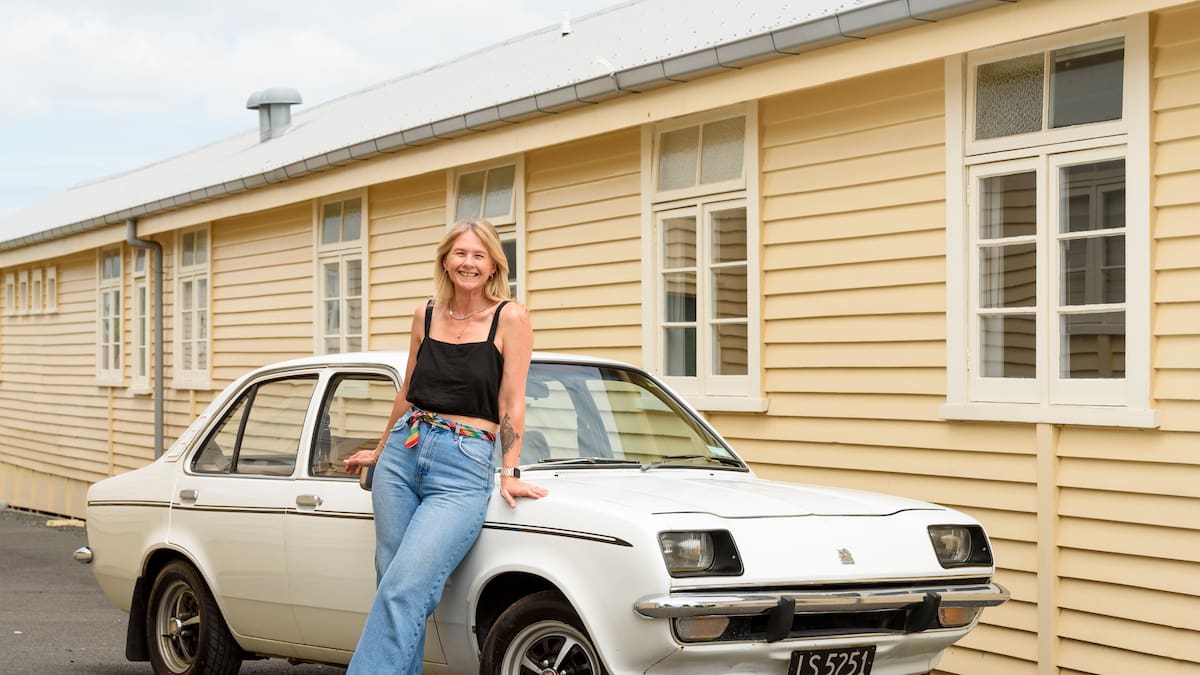
The Daily Driver
1979 Vauxhall Chevette GL sedan
Many Kiwis bought a Vauxhall Chevette as their first car but that was last century, and it sure isn’t the done thing this decade. What on Earth was Saskia Kirkbeck thinking?
Kirkbeck comes across as pretty level-headed as she explains how she’s
had plenty of cars during the years – including work cars – but until this oldie seduced her on Trade-Me, she had never personally owned one.
That devil nostalgia (“I had a boyfriend in the 90s with a Vauxhall Viva”) and budget constraints meant the small Chevette seemed “a great match”. When the vendor in Whanganui dropped the price to $4000, Auckland-based Kirkbeck hit “Buy now” and the marriage was binding.
The honeymoon period is now over. You’ll be relieved – perhaps shocked – to learn she is still smitten. She delights in driving her Chevette daily and the pair even disappear out of town from time to time. “What I appreciate most is the simplicity and, believe it or not, the reliability. I just enjoy every trip and even look forward to sitting in traffic. There’s no stereo, so it’s just me and the car.”
Just the two of them – and a stack of Chevette repair manuals on the parcel shelf. And what’s this? A 1979 copy of Consumer magazine.
Pretty straight: Following repairs, Kirkbeck’s feet get less wet in the rain. Photos / Andrew Kerr
She turns to the page that declares the Chevette to be the highest-rating vehicle (by a solitary percentage point) in a robust test of five small New Zealand-assembled saloons, including the legendary Toyota Corolla. Male testers with mad sideburns and neckties broader than cricket bats praise the Chevette for its handling, well-proportioned styling and fuel economy. But they wallop the Trentham-assembled car for a multitude of assembly defects: loose engine mounting bolts, cooling system faults, water leaks and even corrosion in the body.
These would be undesirable features in any car let alone a brand new one that set you back $6825 in March 1979 – almost $35,000 today, adjusted for inflation.
Let’s refocus on the motoring miracle at hand. It not only boasts a current Wof but is being driven daily by an ever-optimistic owner, albeit one with some petrol in her veins.
“My dad, Brent, was a car nut,” Kirkbeck reveals. “In the 1970s, he worked on the final assembly of Peugeots at Campbell Motors in Thames. We had at least 6 to 10 cars in our driveway in various states – everything from Ford Anglias and Morris Minors to Jaguars, a Humber Super Snipe and a 1967 Aston Martin DBS.”
We wait patiently for the Vauxhall Chevette to appear in her roll call of makes and models. It does not. “Honestly, it just wasn’t a car that was in my childhood. And when I told my older brothers about my purchase, they referred to it as the Shove-ette.”
Yes, well, maybe they knew what your dad knew. But how about Kirkbeck’s son, who now works as a mechanic in Thames?
“After collecting the car from Whanganui and driving north, I eventually limped into Thames. By this stage I had endured a clutch on its last legs, a split exhaust that scraped along the Desert Road into Tūrangi, and a sustained loss of power.
“Neither the fuel gauge nor the temperature gauge worked. My son put the car up on his hoist to confirm whether or not I had bought a lemon. I have never seen so many blokes gather beneath a car!”
“She looks pretty straight,” was the surprise verdict. It turns out a disconcerting amount of heat coming through the floor was caused by an exhaust that wasn’t meant for a Chevette. That was simple enough to sort out. But water leaking into the footwells has been an ongoing challenge: “I soon understood why the car came with Dynamat flooring but no carpet. I used to get about a litre of water in each footwell after heavy rain. It’s way less now that I’ve had some repairs done.”
Budget permitting, Kirkbeck wants to get the Chevette water-tight so she can fit some carpet this summer. And – you guessed it – the little Vauxhall needs rust repairs.
That news prompts a final question: will she continue to Love-ette or Shove-ette?
“One day, I’d love to do a full strip and paint – and drop in a bigger engine.”
Working wheels: George Evangelidakis with his 1982 Kingswood ute. Photo / Andrew Kerr
The Workhorse
1982 Holden WB Kingswood Utility (1-ton)
When we catch sight of the no-nonsense Kingswood ute, it’s backed into a busy suburban building site. There’s no fancy canopy or tonneau cover at the rear, just a flatbed laden with building rubbish. It still passes for ruggedly handsome, especially with its quartet of headlights and broad metal grille, possibly pinched from a Holden Premier.
Its presence means George Evangelidakis is on the job. He turns out to be the principal at Principle Homes, even if he doesn’t spin that line himself. What Aucklander Evangelidakis does say is he has owned his Kingswood for about three years and uses it weekly to collect stuff, cart rubbish and do whatever builders do more commonly in a modern Toyota Hilux or Nissan Navara.
“It’s an interim fix,” he says. “I had something similar when I was 21 and, as you know, you start to reminisce about such things. My old car was bulletproof.”
Nostalgia must be biting hard because our man is currently undertaking a comprehensive restoration of a 1973 Holden HQ. He learnt to drive aged 15 in an HQ Sedan on the streets of Hamilton. Within seconds of these revelations, he produces a photo of a freshly painted car on a low-loader. The old HQ boasts some concessions to modern motoring, including a six-speed manual, and looks to have an excellent stance on big alloy wheels. It really gets your attention.
The Kingswood ute on the job, and (below) Holden utes at a car meet in Auckland. Photos / Andrew Kerr
But back to the broad-chested Kingswood, an honest 43-year-old that was in sound condition when Evangelidakis bought it sight unseen off TradeMe but is “significantly better now”.
“It ran fine mechanically and I’ve slowly made an effort to tidy it up. I had some rust cut out and got some paint done. And it can be used in any weather now that I’ve stopped the leaks. I’ve fitted a refreshed 308 V8 and also changed the three-speed ’box to a four-speed.”
There’s plenty of vacant real estate in a cabin that is spartan by today’s standards. But less is often more with no-frills old-timers and Evangelidakis reckons “the absence of electronics is a good thing”.
What he hopes to add is a central console because his Kingswood didn’t come with one. Such things must be in demand: “I did see one for sale recently but I missed out on it …”
No doubt the trusty Holden has done a power of work in its time and if it goes around the clock once more, it will hit half a million kilometres. But now that it’s performing once-a-week duties, one wonders whether KT4401 could soon be pensioned off.
“Once the HQ Sedan’s up and running, it could be time to move it on,” Evangelidakis admits.
Fair enough. But we sense this bloke is becoming quite attached to his old-school workhorse, so a decision to part ways with the Kingswood won’t be taken lightly.
“You might yet see it outside some more high-end new-builds.”
German precision: John Crook’s 1989 BMW E30 318i/2 is in near-original condition. Photo / Stephen Perry
The True Survivor
1989 BMW E30 318i/2
BMW’s second-generation 3-series had received a mid-life facelift by the time John Crook’s two-door variant was registered by Jeff Gray BMW in Palmerston North. We’re going back more than 35 years, to mid-1989. The fact the car is almost indistinguishable from new speaks volumes about BMW build quality in the 1980s.
Credit also goes to diehard BMW E30 fan Crook. As is often the case with spontaneous purchases, he spotted the 318i/2 on TradeMe in 2018 and didn’t hesitate to grab it. He is only the second owner and lives in a pleasant part of Auckland where the 318i has lots of posh-car competition but still stands out.
It’s a boxy little gem with a straightforward specification: two doors as opposed to the usual four, five-speed manual gearbox, comfortable grey cloth upholstery and standard 14-inch alloys. Unmarked cirrus blue paintwork gives the car an air of sophistication.
“Aside from my general admiration for E30s,” Crook says, “I actually bought it as a first car for my son, who learnt to drive in a manual. My thinking was along the lines of it being easy to drive, low on horsepower [it has 113bhp or 84kW] and appealing to own.”
Few cars bought without first seeing them in the flesh truly exceed expectations, but this one delivered.
“Once in my possession, I fully appreciated the time-warp condition inside and out and decided – based on my own driving experiences as a youngster – that perhaps I ought to choose something newer for my son, something safer and less cherished!”
In his eyes, everything about the E30 seems just right, from the weight of controls to the ergonomics and driving position.
“But the elements I appreciate most are the slim pillars and large glass area. You never have any visibility issues.”
Asked if he considers his BMW to be a coupé or a saloon, he says it seems correct to call it a two-door saloon because the roofline is shared with the four-door. “However, due to the door length and rear pop-out windows, the car does have quite a different look.”
Given its age and original condition, would Crook be prepared to drive the E30 down country? Happily, he says he would.
“We tend to forget just how comfortable older cars can be. Modern vehicles often focus on sporting suspensions, low-profile tyres and large-diameter wheel rims. This car has only 14-inch wheels and it is super-comfortable. It soaks up bumps easily and quietly and the suspension is definitely softer than moderns. Plus, fifth gear in the manual ’box is just about right for cruising. I would definitely enjoy taking this car on a big road trip.”
So far, so very good. In fact, by now, Crook probably has the purists drooling. He slips into overdrive. “The manual shift is smooth, the clutch is light and I enjoy shuffling the gears – even around town. Performance is quite leisurely, as you would expect from a four-cylinder with 1795cc, but how fast do you need to go?
“And sure, the steering needs more turns, but it doesn’t dart all over the lane or change direction in rutted tarseal. And there’s no hatchback to be seen, just a proper boot.”
Crook has clearly done a solid 180 with his intentions for this Munich marvel. “I now see myself as a custodian charged with keeping it as original as possible. That means preserving where possible the parts currently on the car and replacing them with OEM [genuine manufacturer] parts where necessary.
“For me, I like driving as it was – the slice of history that comes with a highly original BMW E30. And this 318i is exactly that. It’s a true survivor if you like.”
Going the extra mile: Allan Clarke in the
mid-1980s. Photo / Supplied
Allan Clarke was a far-sighted force in Auckland car sales. He set up shop in Albany in 1974 and soon dominated the village. Advertising for his vast dealership carried the tagline “only 12 minutes north of the bridge”, pinpointing a location that was easy to access and which benefited from quiet surrounding roads. He was soon selling 70 used cars a month and enjoyed “great reach through the Kaipara and as far north as Kerikeri, although many customers came from south of the harbour bridge”.
A mechanic by training, Clarke describes the quality of New Zealand-assembled cars from that decade as terrible.
“Our assembly was so inefficient that I was told it would take Japan six weeks to produce what we managed in a year. Nothing about the cars was 100% correct. A pre-delivery inspection might take over half a day to get everything fitting. And lighter-coloured cars were particularly prone to rust.”
In an era when car quality was inconsistent at best, the dealership placed extra emphasis on vehicle presentation and customer satisfaction, with ever-present Clarke taking an old-school approach to building a genuine rapport with customers.
“I did my best to shake hands with every buyer – even if it was a $2000 car – and offered a 48-hour money-back guarantee. If someone drove back to Kerikeri and wasn’t satisfied, I’d happily meet them in Whangārei and exchange the car for one that did meet their requirements. But that rarely happened. I take pride in the fact that 73% of sales were either to repeat customers or from referrals.”
A major advertising agency turned Clarke down as a client “so we did our own jingle and advertised Allan Clarke Motors twice a month, in newspapers and on radio and TV”. He says marketing costs did not exceed 1% of turnover. From the mid-1980s, turnover ballooned to $120 million per year from seven acres of new and used cars across several franchises. Toyota was a notable addition from 1986, and Clarke says the fast-growing Japanese giant fuelled further sales growth and dramatically reduced the number of service jobs performed under warranty.
In his mid-70s, Clarke established Auckland City Electric Vehicles in Takapuna, specialising in EV and hybrid sales. He finally retired from the industry in 2023.
Andrew Kerr is an Auckland-based motoring writer, photographer and road safety advocate. In part 2 next week: an incredible restoration in Invercargill, and top architect Ken Crosson delivers design verdicts for the featured cars while sharing his passion for Italian motoring.
SaveShare this article
Reminder, this is a Premium article and requires a subscription to read.
Copy LinkEmailFacebookTwitter/XLinkedInReddit