
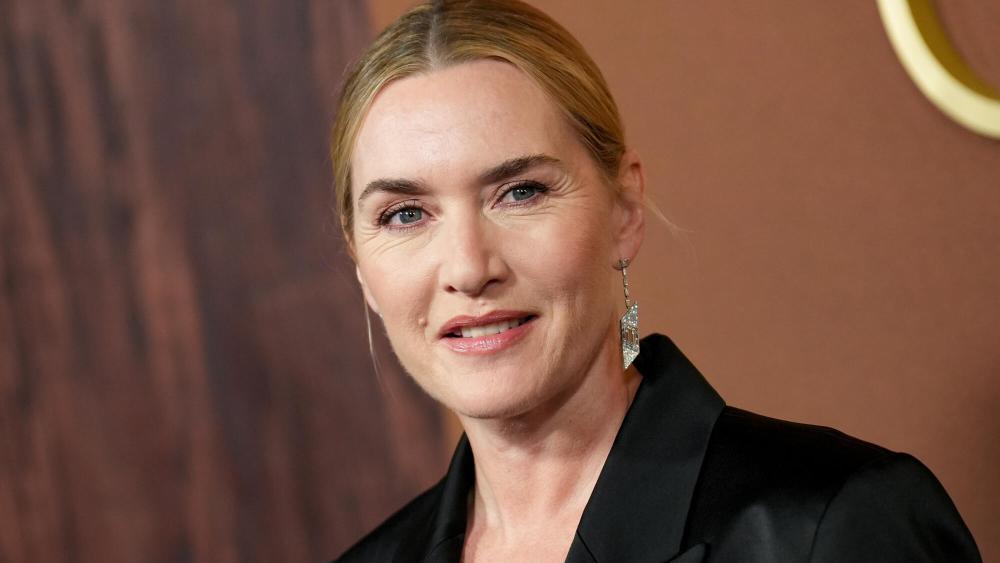
Kate Winslet sits down with a mix of exhilaration and disbelief. She’s still processing the magnitude of what she’s just done. The Oscar-winning actress (2008’s “The Reader”) has delivered her directorial debut, “Goodbye June,” an intimate family drama written by her son, Joe Anders, and the reality of it hasn’t quite settled in.
“Even hearing you say that I’ve directed a film, I’m almost experiencing the aftershocks,” Winslet says with a smile. “As a woman, making films is hard, even as an actress. Women directors have to advocate for themselves so fiercely. I’ve spent years advocating for others, so suddenly finding myself in that community feels thrilling. I don’t think I ever truly imagined I’d be here.”
The moment arrived not through urgency, but timing. Winslet had always prioritized motherhood. Now, with her children grown — or growing — space finally opened. “Directing is an end-to-end commitment of a year, sometimes more,” she says. “That’s enormous. But the stars aligned, and in my 50th year, I damn well have to do it — and I loved it.”
“Goodbye June” centers on a family gathering as its matriarch faces a terminal illness, a subject Winslet approaches with lived understanding after losing her own mother in 2017. The film boasts a formidable ensemble: Helen Mirren, Toni Collette, Timothy Spall, Andrea Riseborough and Winslet herself.
Winslet drew on decades in front of the camera to rethink how actors are supported on set. Overhead boom microphones were eliminated. Hidden mics replaced them. Cameras were locked off. For the most private scenes, the crew quietly stepped away.
“I wanted to disarm the space,” Winslet explains. “To remove the things that pull actors out of themselves.”
The result is a film that finds humor inside grief without softening its truth. “Life doesn’t stop being funny just because it’s painful,” Winslet shares. “Sometimes laughter is the only way through.”
For a first-time director, Winslet’s approach feels both considered and instinctive, rooted in empathy and trust. Whether “Goodbye June” marks the beginning of a new chapter or a singular act remains to be seen. But for now, Winslet is allowing herself a moment to acknowledge what she’s built.
“I really did it,” she says, still sounding slightly surprised.
On this episode of the Variety Awards Circuit Podcast, Winslet talks about preparing for this moment in her career, working with her son, and what she wants to do next.

“Goodbye June” stars Helen Mirren and Kate Winslet. (Kimberley French / Netflix / Courtesy Everett Collection)
©Netflix/Courtesy Everett Collection
Read excerpts from her interview below, which has been edited and condensed for clarity.
How did your experience as an actor shape the way you directed?
I knew immediately how to bypass things that wouldn’t be helpful. What surprised me was how different every actor’s needs were. Each person needed something specific from me, and adapting to that was wonderful. It meant learning who they were, what they needed to feel safe — and building trust. That trust was everything.
Talk about the choices to eliminate boom microphones on set.
As an actor, I find them incredibly distracting. They move, they hover, and I always feel bad for the person holding them. Boom operators are brilliant, but they anticipate movement — and if an actor changes their mind mid-take, it can throw you out of the moment. I wanted to remove that distraction. We also had children in the film, and little kids always look up at the big black thing waving above their heads. Without booms, that problem disappeared.
What led you to lock off cameras and clear the set for intimate scenes?
In the quietest scenes — between Helen Mirren and Timothy Spall, or Toni Collette and Helen in the hospital bathroom — the actors were completely alone. Cameras were rolling, but no one was operating them. Helen said to me, “I’ve never had that in my life, and I’m so grateful.” That meant everything. It allowed a different emotional texture to emerge — something very real.
How did you balance grief with humor in the film?
That balance was essential. When you’re facing tragedy, laughter still happens — sometimes at moments that feel inappropriate. When my own mother was five days from passing, she told my daughter she should take her bras because she wouldn’t need them anymore. We laughed. That moment was how my daughter understood she was losing her grandmother. That’s life. Humor is part of it.
How did you manage a 35-day shoot with Helen Mirren for only 16 days?
I’m a forward thinker. If you’re number one on the call sheet and you slow things down, you jeopardize the entire day. With a schedule like that, you cannot afford to drop a scene — you may never get it back. My prep with my DP, Alvin Küchler, was incredibly detailed. He practically moved into my house for a week. We planned everything.
What was the biggest challenge about directing yourself?
That was the one thing I didn’t know how I’d handle. I had to be ready with multiple choices for myself so that in the edit I’d have options. My instinct is never to put myself first, so I’d always prioritize coverage of the other actors — and then realize I had to rush my own. It was insane. But also exhilarating.
Did your photographic memory surprise you in the edit?
I could remember specific takes—what worked, what didn’t. I’d say to my editor, Lucia Zucchetti, “Stay on take five.” She’d question it, and I’d say, “No, trust me.” And I was right. That helped us maintain a strong emotional through line.
What was it like collaborating with your son, Joe Anders, on the screenplay?
Joe doesn’t know how I work on set, and I can’t teach my children how to do this job. They have to find their own way. I’m incredibly proud of both my kids because they’re carving their own paths. Collaborating with your child — and having meaningful creative conversations — is very special.
What struck you most about Timothy Spall’s performance?
There’s a moment when his character is asked, “Do you still love her?” He says nothing. It’s all in his eyes. The hurt, the betrayal — you see his heart crack open. It’s some of the best acting I’ve ever witnessed.
How did you approach the film’s visual language?
This is a messy, complicated family living with long-term illness. I didn’t want cancer to become the narrative. That’s not the story. The story is how a family is pulled closer together. Early on, I hold back visually — it’s the space between people that tells us how distant they are.
Do you want to direct again?
I would love to. I genuinely would. I’ve only just delivered the film, so I don’t know yet — but yes, I’d love to.
What was it like returning to “Avatar: Fire and Ash” and what did it remind you about acting?
I shot it years ago, but the experience was extraordinary. The training was intense. Jim Cameron’s passion is unmatched. And as I get older, I realize how much I love being in a pack with other actors. That energy matters. I was fortunate to be part of it.
Variety’s “Awards Circuit” podcast, hosted by Clayton Davis, Jazz Tangcay, Emily Longeretta, Jenelle Riley and Michael Schneider, who also produces, is your one-stop source for lively conversations about the best in film and television. Each episode, “Awards Circuit” features interviews with top film and TV talent and creatives, discussions and debates about awards races and industry headlines, and much more. Subscribe via Apple Podcasts, Stitcher, Spotify or anywhere you download podcasts.