
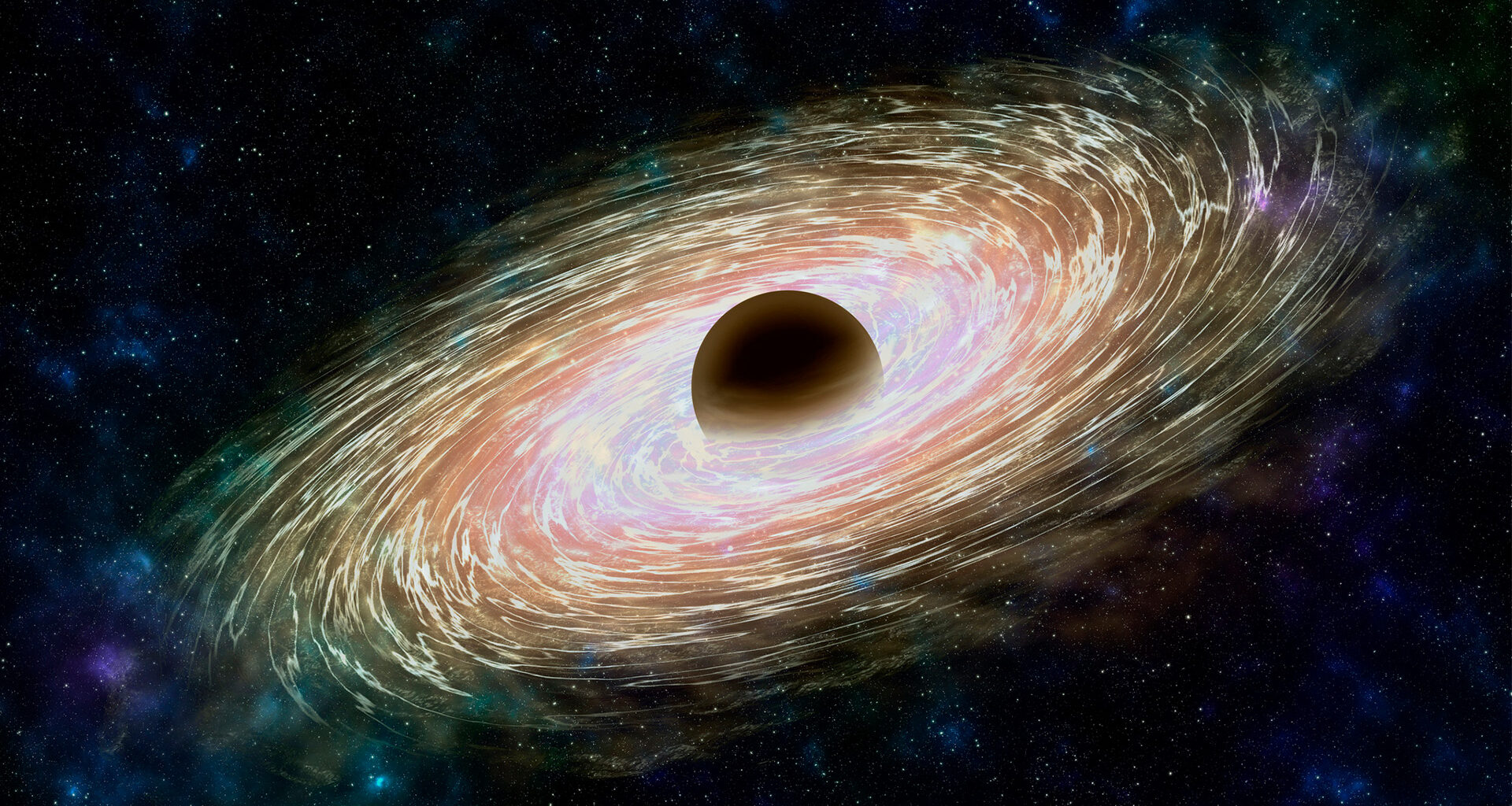
When astronomers look deep into the early universe, they don’t expect to see fully developed cosmic objects but small galaxies, young stars, and black holes still struggling to grow.
However, recent observations with the James Webb Space Telescope have revealed something totally unexpected—a giant black hole existing almost alone, with barely any stars around it.
This object is spotted in a galaxy called Abell 2744-QSO1. It lived just 700 million years after the Big Bang and already had a mass about 50 million times that of the Sun.
Its existence challenges the basic idea of how black holes are born and raises an interesting possibility that some black holes may have formed before stars ever existed.
“This is a puzzle, because the traditional theory says that you form stars first, or together with black holes,” Boyuan Liu, one of the study authors and a postdoc researcher at the University of Cambridge, said.
A cosmic object that breaks the rules
In standard astrophysics, black holes and stars are closely linked. Stars form from collapsing gas clouds, and only much later, when the biggest stars exhaust their fuel, black holes appear.
Over time, these black holes grow by feeding on gas and merging with others. This process takes time, which is why astronomers struggle to explain how extremely massive black holes appeared so early in cosmic history.
QSO1, the host galaxy, makes this problem even harder. It contains very little stellar mass, meaning there were not enough stars to explain the presence of such a huge black hole.
According to the study authors, this creates a fundamental contradiction that the black hole seems to have grown large without first building a normal galaxy around it.
Testing an idea older than the discovery itself
To explore this mystery, the researchers turned to an idea proposed decades ago but never confirmed—primordial black holes. These hypothetical objects were suggested in the 1970s by Stephen Hawking and Bernard Carr.
Instead of forming from dying stars, primordial black holes would emerge directly from extreme density variations in the universe shortly after the Big Bang. Most such black holes, if they formed, should have been tiny and short-lived.
However, Liu’s team investigated whether a small number could have survived and then grown rapidly under the right conditions. They built new, more sophisticated simulations that followed how gas behaves around an initial primordial black hole, how stars might later form nearby, and how material from stellar deaths could feed the growing object.
In these simulations, the researchers began with a massive primordial black hole seed of about 50 million times the Sun’s mass, then followed how gas flowed into it, how stars formed nearby, and how stellar explosions fed material back into the growing black hole over time.
Unlike earlier simplified models, these simulations accounted for multiple interacting processes at once. When the team compared the outcomes with real JWST data, they found a close match—not just in the final black hole mass, but also in the small number of stars and the chemical elements detected around QSO1.
“With these new observations that normal (black hole formation) theories struggle to reproduce, the possibility of having massive primordial black holes in the early universe becomes more permissible,” Liu added.
Black holes become more intriguing
The findings do not prove that the black hole in QSO1 began as a primordial black hole, but they show that such an origin is consistent with observations. According to the researchers, this is encouraging because standard models struggle badly with this object.
Going forward, they plan to refine their simulations and compare them with future JWST discoveries. If more galaxies like QSO1 are found, they could provide crucial evidence that some of the universe’s largest black holes are not the end products of stars, but were born at the dawn of the universe.
However, some issues need to be addressed. For instance, typical simulations of primordial black holes rarely produce objects larger than one million solar masses, far smaller than the roughly 50-million-solar-mass black hole seen in QSO1.
This means that, under ordinary assumptions, primordial black holes struggle to grow fast enough to explain such an extreme object.
One possible way around this is that primordial black holes may have formed in dense groups in the early universe, allowing them to merge with one another and gain mass much more quickly—but this process is still uncertain and difficult to model.
Another unresolved issue is that primordial black hole formation may require intense bursts of high-energy radiation—and no such source has yet been identified near QSO1.
The study is published in the arXiv.