
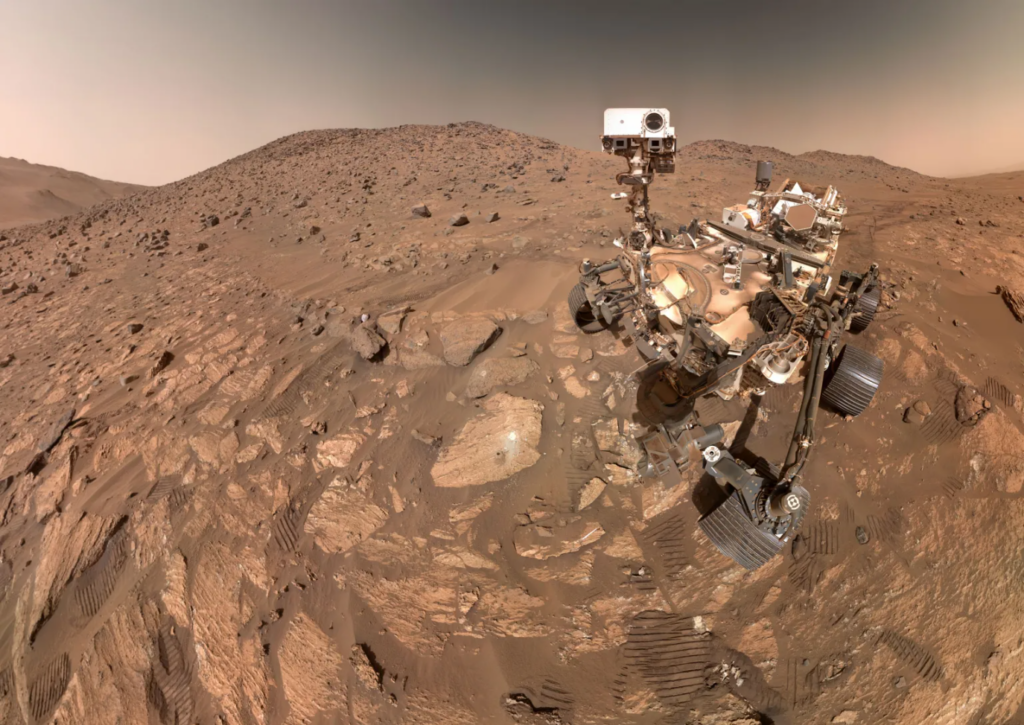
The NASA rover Perseverance, which has been on Mars since 2021, detected electrical discharges in the Martian atmosphere, researchers reported in Nature. The researchers documented 55 instances of “mini-lightning” over two Martian years, about four Earth years, detected by a microphone on the rover. The instances primarily occurred during dust storms.
The Perseverance Rover on Mars July 25, 2024
The “lightning” strikes were just inches long, more like static electricity than Earth lightning. The presence of lightning on Mars has been suggested for decades, especially after it was detected on Saturn and Jupiter, but never detected until now.
The electrical impulses could “have implications for surface chemistry, habitability and human exploration,” the researchers said in the study. The “mini lightning” is known as triboelectricity, which occurs when airborne particles, which are abundant during Martian dust storms, rub against each other and become charged. The charged atoms form an electrical field.
When the imbalance in charges becomes too great, negatively charged particles leap across the field, producing a small electrical arc. This occurs on Earth during sandstorms and the ash clouds caused by volcanic eruptions.
Daniel Mitchard, a particle physicist at Cardiff University who was not involved in the research said the “existence of small and frequent static-like discharges could prove problematic for sensitive equipment,” in a commentary accompanying the article.
Some scientists, including Mitchard, have pointed out that Perseverance’s microphone was not designed to detect electrical impulses and that the triboelectricity was not actually seen. Martian lightning has never been seen, despite the presence of several cameras over many years. Until additional instruments designed to detect this lightning can be sent to Mars, the debate about its presence will likely continue.
In 2006, a radio telescope detected microwave signals thought to demonstrate Martian lightning. However, an almost five year long study using a spacecraft in Martian orbit did not detect any radio signals that could have been lightning.