
What just happened?
It’s the same question the world asked itself in the hours and days following Russia’s invasion of Ukraine. Everyone understood that something vital in the world’s diplomatic machinery had stopped working. Something was happening that ought to be impossible. The past, with all the force of a Russian armoured column, was invading the present.
In the early hours of Sunday morning (4/1/26 NZT) the United States attacked the sovereign state of Venezuela and abducted its head-of-state, President Nicolas Maduro, along with his wife, Cilia Flores, Venezuela’s first lady.
What ought not to be happening was happening again.
William Faulkner (1897-1962) the American novelist, is best remembered for his observation that: “The past is never dead. It’s not even past”. As a Southerner, Faulkner was all-too-aware of history’s enduring influence over the defeated states of the old Confederacy. The sheer magnitude of the South’s humiliation at the hands of the modern world during the American Civil War, or, as the Southerners still call it, “The War Between the States”, ultimately made a reconciliation with modernity impossible.
The poisons coursing through the bloodstream of the American Republic remained undiluted throughout the Nineteenth Century’s final decades and for most of the Twentieth’s. Even in the Twenty-First Century their morbid symptoms continued to manifest themselves. White supremacy, with all its imperialistic corollaries, was never wholly purged from America’s system. In 2026, having recovered much of its old strength, racism is again driving American foreign policy.
The North’s 1865 victory may have been total militarily, but it failed to secure anything more than a ten-year truce in the cultural war between antiquity and the modernity. That failure now haunts not only the USA, but also the whole world.
One-hundred-and-sixty-one years after its surrender to the United States of America, the Confederate States of America has risen from the grave.
Historically, the geopolitical impulses of the slave-owning states that seceded from the USA in 1861 had all been towards seizing what lay below its southern borders. Their political and intellectual leaders dreamed of creating a vast slave-owning empire encompassing Mexico, all the smaller Central American states, most of the larger Caribbean islands, and a fair chunk of the South American continent itself.
This was not as fanciful as it sounds to Twenty-First Century ears. In the three decades preceding the Civil War the southern states had bent all their powers to extending slavery south and west.
Their first and most critical success was Texas. As a province of the Mexican Republic, which had abolished slavery in the 1820s, Texas presented a formidable geographic obstacle to its extension. As an independent republic (1836-1845), and then as the 28th state of the United States, Texas represented a huge victory for the promoters of slavery. After a brief war with Mexico (1846-48) the absorption of Texas was followed by the cession of the former Mexican provinces of California, Nevada, Utah, most of Arizona, New Mexico, and parts of Colorado and Wyoming). Having seized most of Northern Mexico by 1848, the slave-owners’ plans for seizing the rest were by no means unrealistic.
Temporarily halted by the Civil War and the subsequent westward march of the United States across the lands and the rights of Native American tribes indifferent to the needs of its “manifest destiny”, white Americans’ dreams of empire were reignited in the late 1890s.
By then the mid-century Christian arguments against slavery and racial distinction had been superseded by the “survival of the fittest” certainties of “scientific” racism. Eager to join the other European powers’ grab for empire, the United States picked a fight with the Spanish Empire and emerged from the ensuing conflict with effective control of its Caribbean possessions, most particularly Cuba, as well as the Philippines archipelago on the other side of the Pacific.
It is politically instructive that the man most responsible for the birth of the American Empire was President William McKinley who, alongside America’s first populist president, Andrew Jackson, continues to serve as a powerful source of inspiration for President Trump. Under McKinley and even more so under his successor, President Theodore Roosevelt, the imperial dreams of the slave-owning Southern aristocracy of the 1830s and 40s were becoming official American foreign-policy.
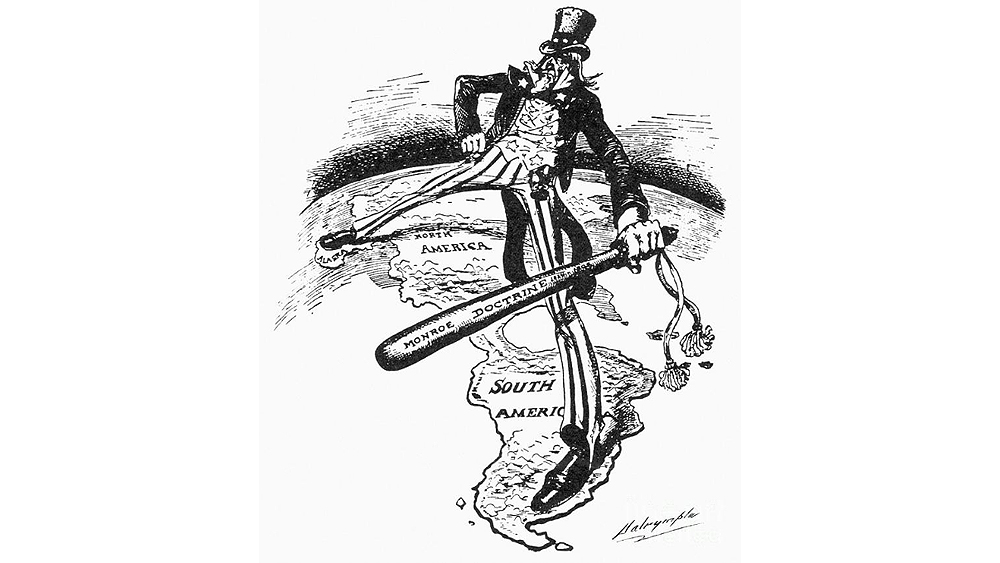
Between 1900 and 1941 American conduct in Central and South America and the Caribbean was guided by Theodore Roosevelt’s foreign-policy dictum “speak softly and carry a big stick”. The softly spoken part was aimed at the voters of the USA whose leaders thought them better off not knowing exactly how much damage the big stick wielded in their name was causing – or for whose benefit.
The 1935 testimony of one of the stick-wielders, Marine Corps Maj. Gen. Smedley Butler, provided a colourful answer to the question cui bono?
“I spent most of my time as a high-class muscle man for Big Business, for Wall Street and the bankers. In short, I was a racketeer; a gangster for capitalism. I helped make Mexico and especially Tampico safe for American oil interests in 1914. I helped make Haiti and Cuba a decent place for the National City Bank boys to collect revenues in. I helped in the raping of half a dozen Central American republics for the benefit of Wall Street. I helped purify Nicaragua for the International Banking House of Brown Brothers in 1902–1912. I brought light to the Dominican Republic for the American sugar interests in 1916. I helped make Honduras right for the American fruit companies in 1903. In China in 1927 I helped see to it that Standard Oil went on its way unmolested. Looking back on it, I might have given Al Capone a few hints. The best he could do was to operate his racket in three districts. I operated on three continents.”
The need to defeat fascism and then to provide an inspirational democratic alternative to Soviet totalitarianism threw a most unwelcome spanner in the works of America’s white supremacists. For a brief period spanning the 1960s and 70s it even began to look as though the unnaturally prolonged life of the old confederacy might be coming to an end. The extraordinary boost given to progressive politics by the civil rights movement and the anti-Vietnam War protests encouraged many young Americans to believe that the great emancipatory hopes of the 1860s and 70s were (albeit a whole century later) being realised.
But the decision of Ronald Reagan to launch his 1980 campaign for the US presidency in Philadelphia, Mississippi – the little town where three civil rights workers, James Chaney, Andrew Goodman, and Michael Schwerner, were murdered by the Ku Klux Clan in 1964 – made it clear that they were wrong.
The poison was still in America’s blood.
Forty-five years on, and hooded men roam the streets of America in search of Black, Latino and Asian “illegals” to arrest and detain, as if the Fugitive Slave Act of 1850 was still in force. The Monroe Doctrine, originally a declaration intended to warn off any European power contemplating the recolonisation of the Americas, has once again become an imperialist charter.
In the words of the National Security Statement 2025:
“After years of neglect, the United States will reassert and enforce the Monroe Doctrine to restore American pre-eminence in the Western Hemisphere, and to protect our homeland and our access to key geographies throughout the region. We will deny non-Hemispheric competitors the ability to position forces or other threatening capabilities, or to own or control strategically vital assets, in our Hemisphere.”
What does that mean? President Trump explained this new reality with admirable clarity:
“We will run Venezuela.”
The gibbering ghost of the old Confederacy, bloody stick in hand, stalks the margins of its long-anticipated and fast-expanding empire. All the poisons of America’s past have recombined to strike down its present and murder its future.
*Chris Trotter has been writing and commenting professionally about New Zealand politics for more than 30 years. He writes a weekly column for interest.co.nz. His work may also be found at http://bowalleyroad.blogspot.com.