
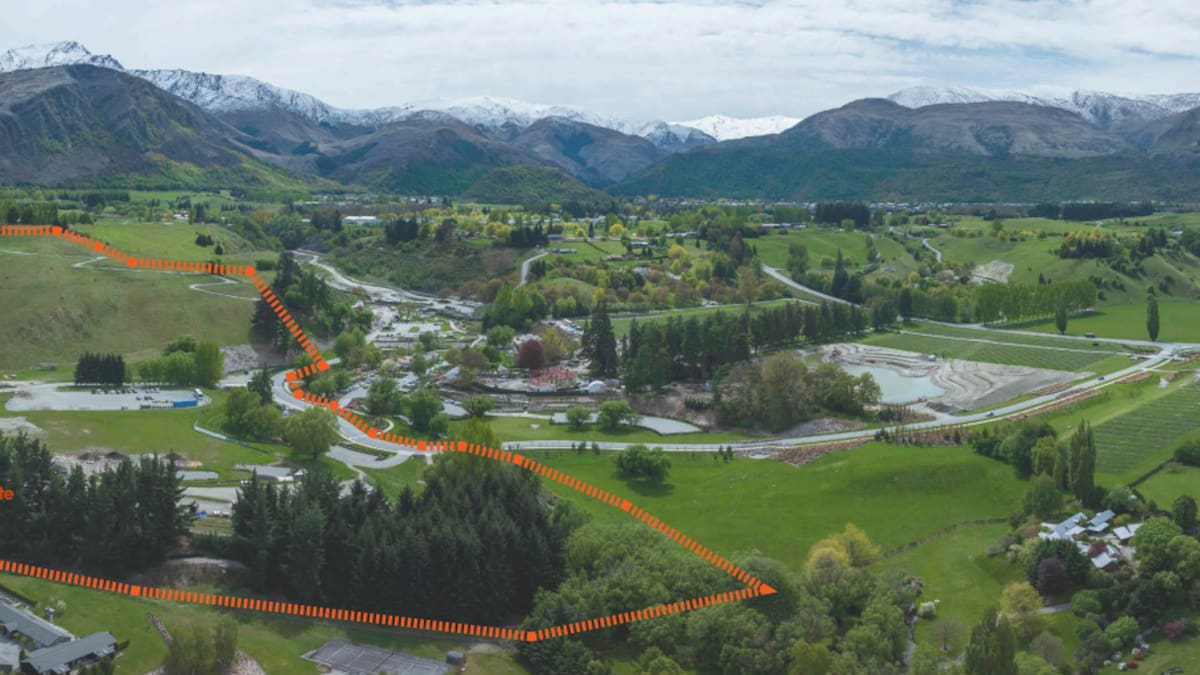
The Ayrburn Screen Hub proposal includes two sound stages, production facilities and supporting infrastructure on a privately owned site near Arrowtown, and is being considered under the fast-track approvals process. Image / Supplied
Neighbouring resident Neil Green said he “strongly opposed” the development.
Green described the proposal as a “Trojan horse”, arguing it was “a tactical manoeuvre to bypass the District Plan and secure a high-density accommodation in a rural zone, using a film studio as the vehicle”.
He said the proposal would affect “the quiet enjoyment of their properties, and the overall amenity values of the area”.
He also rejected the project’s economic case.
“The economic case is ‘sketchy’ at best. It lacks independent verification and fails to justify why this specific, sensitive location is required for regional film infrastructure,” he said.
Long-term resident and landscape architect Rebecca Hadley said she “strongly oppose[d] the Ayrburn Screen Hub proposal in its entirety”, also describing it as ‘a Trojan horse’ for visitor accommodation or high-density residential subdivision”.
Hadley said the development would destroy what planning documents have repeatedly identified as critical “breathing space” between Arrowtown, Millbrook and North Lake Hayes.
“The activity should not be located in an important rural landscape that provides open space (breathing space) between Arrowtown/Millbrook Resort and the North Lake Hayes Rural Residential zone,” she said.
She criticised the proposed landscape mitigation, which includes extending an existing landform using about 65,000 cubic metres of fill: “This design concept is flawed. It is not authentic.”
Hadley said the mitigation would “result in a loss of legibility of the natural form and geological features of the landscape” and “obstruct the breathing space required to be maintained by the PDP”.
Resident and chartered engineer James Hadley submitted that the proposal should be described not as a screen-hub, but “a commercial Film Studio with Offices and Short Stay, hotel-type accommodation”.
Queenstown Lakes District Council has raised concerns about the scale and location of development proposed across the site, while central government ministers have cited potential economic benefits. Image / Supplied
Hadley said residents had endured “no less than 10 different development proposals on the subject land” over the past decade, most of which had been rejected by councils, independent commissioners or the courts.
He warned the current proposal repeated the same pattern.
“It seems that ‘No’ does not mean ‘No’ if you are WPDL.”
He described the proposed earthworks as extreme, saying they were “more akin to a mining operation than a sensibly conceived building project”.
He added the buildings – up to 15 metres high – were “more akin to a city business park or industrial precinct” and “a square peg in a round hole.”
The development includes large-scale studio and backlot areas, which neighbours argue would introduce industrial-level activity. Image / Supplied
Neighbour David Kidd also objected, saying his property was “less than 50m from the site and about 100m from the closest collection of buildings”, and argued that low-frequency sound was “poorly attenuated by vegetation”.
“Over a sustained and ongoing period, the impacts on our amenity will be significant and unable to be mitigated to any satisfactory degree,” he said.
Other residents raised similar concerns about noise, scale and compatibility with rural living.
One submission said an industrial film facility and accommodation complex was “fundamentally incompatible with the rural-residential amenity of Speargrass Flat.”
QLDC opposed key aspects of the proposal, saying its primary concerns related to “the effects upon landscape character and visual amenity”, “inconsistency with many relevant objectives and policies in the QLDC Proposed District Plan”, and a “lack of capacity in the Council’s potable water scheme to service the proposal”.
The proposed Ayrburn Screen Hub would include two sound stages and production facilities on a 26-hectare site near Speargrass Flat. Image / Supplied
The council said peer review work assessed landscape effects as “moderate to moderate-high”, and warned that the scale and intensity of the development “amounts to urban development outside the Urban Growth Boundary”.
ORC took a more supportive but conditional position, saying it had not undertaken its own economic assessment, but that “taking this report at face value, the ORC agrees that the proposal’s economic benefits are of regional if not of national significance”.
ORC also pointed to potential water quality benefits, saying the proposal had the potential to “reduce sediment load to Lake Hayes for the life of the consent” if mitigation measures were adequately designed and maintained.
However, ORC also confirmed it had previously “issued an abatement notice in 2021 for a sediment discharge to the Clutha Mata-Au River” in relation to one of the applicant’s associated companies.
The developer, Waterfall Park Developments Limited, said the project would deliver significant economic benefits, provide purpose-built infrastructure for the screen industry, and include environmental remediation works in the Lake Hayes catchment.
In its fast-track referral application, WPDL also cited support from Film Queenstown Lakes manager Kahli Scott, who said there was “enthusiasm for a fit-for-purpose screen hub from an economic development standpoint”, and that supporting the film industry was a priority identified in the district’s Economic Diversification Plan.
Scott said the proposed hub was intended to “complement, rather than compete with, existing facilities like Screentime’s Remarkable Studios”, and would help address a shortage of indoor filming space in the district.
Infrastructure Minister Chris Bishop said he wished to “express my broad support for projects which deliver positive outcomes for New Zealand, including the Ayrburn Screen Hub project”, describing the letter as reflecting the Government’s economic growth and infrastructure priorities.
South Island Minister James Meager said assessments indicated the project would “inject approximately $258.00 million net present value (NPV) into the regional economy during the three-year construction phase”, supporting about 1890 full-time equivalent jobs over the build period.
Tourism Minister Louise Upston said she considered the proposal “likely to deliver positive outcomes for the Queenstown Lakes District and the wider region”, including supporting economic diversification and visitor infrastructure.
The economic assessment prepared for the developer estimates construction and development spending of about $127m excluding land, with total direct expenditure of $190m over a three-year build period.
That spending is modelled to generate about $258m (NPV) in regional economic activity, with a further $462m (NPV) over the first 10 years of operation, according to WPDL’s assessment.
The proposal is now under consideration by an expert panel in the fast-track approvals process.
Ben Tomsett is a multimedia journalist based in Dunedin. He joined the Herald in 2023.