
“Manuhiri [visitors] couldn’t work out where the welcoming words were coming from,” Tipene said.
It wasn’t unusual for Māori of Karani Hiku Paraone’s era to live around native birds that were almost like pets. Photo / Supplied
People who saw Tipene’s post were prompted to share family memories of their own – one about a kuia in Huntly who trained two magpies to speak te reo; another about a Bay of Islands dad who also kept a talking tūī.
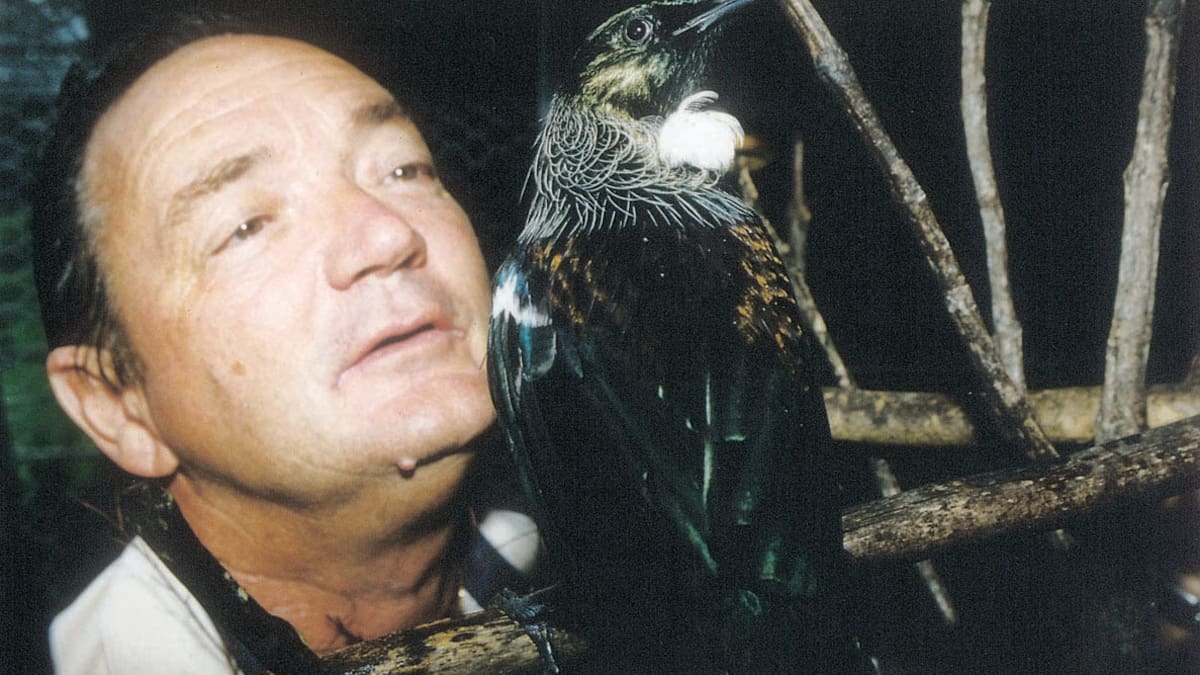
But the region also had a celebrity among its talking tūī. Woof Woof, a permanently injured tūī that lived at Whangārei’s Native Bird Recovery Centre, got TV coverage more than once in his 10 years of entertaining visitors.
Woof Woof died aged 16 during 2011, but he still lives on in the memories of many Northlanders who had the joy of meeting him, and there’s still footage of him on YouTube.
Woof Woof (because he could bark like a dog) was renowned for A real Kiwi accent, and he sounded exactly like his beloved keeper – centre founder Robert Webb.
Woof Woof had an extensive repertoire of conversation, one fan recalling: “I was lucky to have met Woof Woof. He told me about how he came to be at the aviary saying, ‘I fell out of the tree, broken my wing, can’t fly’. I thought it was a tape recording but he carried on talking, asking, ‘where’s the waxeye?’ (another native bird being cared for at the centre).”
Webb remembers fondly how Woof Woof loved to talk to the public and how articulate he was.
Woof Woof could imitate virtually any phrase to which he took a shine. His festive favourite was “Merry Christmas”. And he wasn’t afraid to interrogate his keepers, by asking them, “Where have you been?” or letting the cat out of the bag about Friday post-work beer and ciggies.
Webb said it was sadly common for the centre to receive an influx of tūī chicks in the spring. It had already hand-reared eight this season. All but one that couldn’t be saved had since been returned to the wild and one of those frequently flew back to visit the centre, Webb said.
He believed the keeping of wild birds as pets was popular in earlier Māori society, in cages made from bush vines such as supplejack.
He recalled a mate from his earlier truck driving career would chat about his pet tūī and how it used to say, “Put some kai on, we’ve got visitors today”.
Of course, the keeping of native birds is now forbidden, and even specialist facilities like the Whangārei centre, must have the requisite permit, Webb said.
Speaking to media earlier this year about Pleakly, University of Auckland School of Biological Sciences Professor Dianne Brunton said that having a wide repertoire and skill in song is important in tūī society.
Tūī constantly pull sounds from their environment to add to their songs, such as other birds’ calls and human-generated noises like car horns.
Young birds raised among people are known to pick up human phrases and add them to their song, she said.
“They have to learn everything, basically. And so at that stage, when they are actively learning, a lot like children, babies, they can be taught human sounds. And they can copy human sounds.”
Male birds are more likely to pick up the behaviour, but it is also known to happen among females, Brunton said.
Sarah Curtis is a news reporter for the Northern Advocate, focusing on a wide range of issues. She has nearly 20 years’ experience in journalism, most of which she spent court reporting in Gisborne and on the East Coast.