
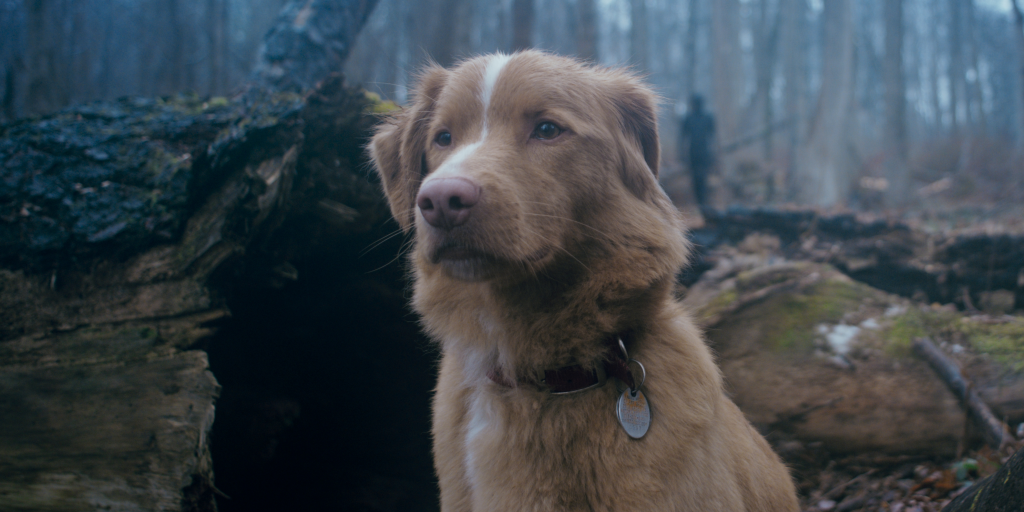
Ben Leonberg enjoys a challenge. It’s why, he says, he spent more than 400 days turning his family home into a haunted house to film a horror movie with his family dog, Indy.
Good Boy, a horror-thriller that debuted at SXSW, is told from the perspective of the loyal family dog, who moves to a rural family home with his owner Todd, only to discover supernatural forces lurking in the shadows. Not only that, but Indy is the only one who can actually see those evil forces, and he’s hard pressed to convince his owner that anything is wrong.
Indy wasn’t born to be an actor. In fact, his fur parents didn’t even think he’d ever star in a feature film when they brought him home. So, when he got the idea, Leonberg knew it would be quite a challenge to get Indy to cooperate.
“Keep in mind the working hours or the time Indy spent on set was our most precious, precious resource, which really is determined by his attention span, which, depending on what we’re asking him, might be a few minutes, or it’s going to be at tops like three hours,” he explained. “So of all of those days, Indy was only ever working…being himself on camera for max three hours the rest of the time, because we’re doing this for such a long duration, and because we have such a limited window for the character and actor that’s going to be in every single shot.”
In the below interview with Deadline, Leonberg reveals more of the tricks he used to make innocent moments with his pet feel sinister enough for a horror film.
DEADLINE: So, the film debuted at SXSW last year, and a lot has happened since. Can you give me an update?
BEN LEONBERG: I mean, so much has changed, obviously, since then. IFC came into the picture. The movie’s gone into the world. Before that, the trailer [and] all the development of how the movie was going to be put into the world took place. I mean, it’s just been super fun to, on a personal level, have people share my own obsession with my own dog. So that’s been pretty neat, too.
DEADLINE: Is that real footage of Indy as a puppy in the movie, as well?
LEONBERG: Yeah, so all the puppy footage, that’s actually him and his litter mates when my wife and I got him, not thinking he would be in a movie. That’s genuine home movies, I guess you could call it, of him in his first few months just being a pet, certainly not thinking he would be a movie star.
DEADLINE: Can you remind me how long it took to actually shoot the movie?
LEONBERG: So actual filming, physical production, was — we moved in the house in April 2021 and then we were filming until like the first day of August 2024. so it was across three years. It was over 400 days. The only reason I know it’s more than 400 days is that I have a log [of] every day we film, and we would dump the footage, and I lost track in my own accounting. So I know it’s more than 400, but I don’t have the exact number.

‘Good Boy’
Shudder/Everett Collection
DEADLINE: Yeah, okay, I was going to ask more about the logistics here of filming this at the whims of your family pet?
LEONBERG: I mean, it is definitely not the most efficient way to make a movie, and one of the biggest practical reasons it took as long as it did is that — I say it took 400 days. Keep in mind the working hours or the time Indy spent on set was our most precious, precious resource, which really is determined by his attention span, which, depending on what we’re asking him, might be a few minutes, or it’s going to be at tops like three hours. So of all of those days, Indy was only ever working…being himself on camera for max three hours the rest of the time, because we’re doing this for such a long duration, and because we have such a limited window for the character and actor that’s going to be in every single shot.
It meant that the most efficient way to do this would be for me and my wife to be the entire cast and crew during physical production. So in addition to directing, I was also setting up the house. The house where the movie takes place is also where we lived. We were setting up rooms that were part of our normal lives just to look the right way for the movie. My wife, who is not a filmmaker before at least making this film, is a very good sport. She allowed me to transform the house, one room at a time, into a haunted house. So yeah, there’s not much normal about this, but I guess in terms of the organization of the shoot, it’s all lending itself to: How do we get the best performance out of Indy? The main resource we needed to do that was time. Everything kind of flowed from there.
DEADLINE: I have to imagine there’s so much organization involved too in order to make sure you get all the shots you need. Were you editing as you went?
LEONBERG: Yeah, I edited as we were filming, because we were only getting a shot or two every day, and because of the variability of what Indy would give us, we frequently had to pick a shot on, let’s say day one, where Indy walks into frame and freezes, because he hears something. Where he stops and freezes, there are eight different places in the eight usable takes. So, the morning of day two I spend selecting what’s the shot we’re going to use for now and forever, and then build the subsequent shot off that blocking that we just achieved in the shot that we’re going to use now and forever, because I’ve picked it in the editing. We were working off storyboards. I’d drawn, loosely, essentially the entire film sequenced out in illustration. You know, stick figures and cartoon dogs that weren’t super precise, which was good, both as a as a reflection of my own drawing ability but then also that flexibility kind of allowed us to embrace the variability of what Indy would give us.
DEADLINE: There is, at times, very little dialogue. You’re also telling the story through the eyes of a dog, who inevitably has a more limited understanding of the world than a human. With those things in mind, how did you work to keep the story feeling propulsive?
LEONBERG: There’s a visual storytelling element of just using his perspective and the point of view of a dog. Sometimes it’s taking an old haunted house trope and just putting it in the perspective of a dog, [that] keeps things interesting or new. But another thing I was always thinking about and then having conversations with our co-producer, Brian Goodheart, who also marshaled the entire post-production sound team, is how sound was going to play into the final presentation. Brian was both doing all of the after dialogue replacement (ADR) of the vocal performances that fit into everything, as well as replacing all of the Indy sounds. He also ran point on how the music was going to fit into things. So there was always a conversation going on about how both the visual and the audio part of the storytelling would be married, and would also be doing, just as you say, escalating the story, moving things forward and keeping things feeling propulsive, like we’re going to this big climax in the third act.
DEADLINE: There are a lot of moments where something scary is happening to Indy in the film, and I presume it was a much more pleasant experience for him in real life. For example, he gets caught on a fox trap and is freaking out at one point. What were you actually doing to get those shots?
LEONBERG: I think those are the things, which, in some ways, are the hardest, but they’re also the parts of the filmmaking that excite me the most, and in some ways are the most fun, probably both for me and Indy. I think as a filmmaker, the power of suggestion is really exciting. That really unlocks something. When I was just studying how filmmaking worked, and you’re learning about Hitchcock, how just through the point of view, the perspective and the juxtaposition of disparate shots, you can create meaning, and we’re doing that all the time throughout the film. So for a lot of emotional beats, where Indy is meant to look scared, he’s not doing anything in reality on set. He’s just looking off camera at me, probably making bird noises at him, in reality, to get him to look a certain way and look a little perplexed, because I’m making bird noises. Then when we used the point of view shot, we showed what he’s looking at. There’s a shadow moving across the wall. There’s scary music, and the way the shots are sequenced together creates the illusion for the audience of fear. I, as the filmmaker, am telling the audience that this is scary, and the audience projects that emotion back onto Indy. So that’s one way we would do things on those emotional, troubling, scary, intense moments.
Good Boy
IFC
For, the more physical, there’s a moment he gets caught in a snare that the hunter has put out. So there’s a lot of old school camera tricks. There’s a lot of things are being done in reverse. We’re shooting things really close up and using a high shutter speed, and then adding some camera shake to make it seem really jarring and visceral. The reality of what’s happening in that moment is that Indy is on his back, ostensibly caught in a snare. There’s not actually even a snare around his neck, and I’m just off camera scratching his back legs, and he’s kind of doing a [does a movement to mimic Indy] happy dog getting his belly rubbed. But if you film it with all those other embellishments, the high shutter speed, the extra camera shake, and then sometimes, even if you reverse the footage, it just looks a little bit more unnatural. Maybe if he quickly rolls up and you reverse it, it looks like he’s falling onto his side. We did stuff like that all over the place, ways that we found, how could we play with Indy and then through the filmmaking give it that extra edge.
DEADLINE: I assume most of those are also Indy’s vocalizations, just not maybe at that exact moment caught on camera?
LEONBERG: Exactly. None of them are in the moment. So all of the audio is replaced afterwards. If you were to listen to the film with the production audio, meaning what was recorded as the camera was rolling, it would almost all be me and my wife talking to Indy, telling him ‘Good boy. Whoa. Stay, stay. Good boy.’ Then bird noises, funny sounds, words he doesn’t know to get him to look like he’s trying to figure out what’s going on. So the vocalizations, I think almost all came from Indy, but they’re from separate moments. We’d go out and we would have recording sessions where we knew he would make sounds. A lot of it is him playing fetch. He really loves fetch, and you get a lot of excited panting, yips and barks that.
If you isolate a yip that he lets out when he goes to retrieve a ball, and you’re a post production sound wizard, which, fortunately, we had in our roster, you can take that sound, bend it, make it sound like whatever you want it to. So we were adding all that stuff after the fact. The one dog noise I know we couldn’t get from Indy that we then got from a library were all the sniffs. There’s lots of sniffs in the movie, and I just could not, for the life of me, figure out a way to get Indy to smell a microphone without batting himself against it and ruining the audio. There were a few times too. I mean, there’s lots. Every shot was an adventure [and] took some level of problem solving that I did not expect. He did run into the camera several times, once so hard he was fine, but the camera — we were under the bed, filming together, and he runs into the camera and knocks it right into my face. The one injury on set was Indy hurt me.
DEADLINE: What was the most difficult thing to get Indy to do?
LEONBERG: Essentially, it’s hold still. The hardest thing would have been the easiest thing for a human actor. At the end of the movie, there’s this dramatic interchange of looks and close ups between Todd, who I’m standing in for just looking into his eyes. He’s looking into mine. To get those shots, I just needed very precise close ups where there’s a shallow depth of field. I just need him to hold still and look at one thing for like eight uninterrupted seconds. I believe, we went back and checked, it took us three days to get that. On Monday, we tried and like, it was like, ‘Well, maybe if we hold a piece of food off camera,’ but then, no, he’s too excited. So he wants to take it. We tried for the hour of his attention span.
At a certain point, as I mentioned, his attention spans are most important resource. When it’s gone, it’s like trying to get a little kid who’s overtired to do something. You just have to stop. So we try again on Tuesday, and I forget what we did the second day. I think we just used verbal commands to try and get him to stay and then look at my face. Then I think on the third day, we used a slightly different food that he wasn’t as excited about, but he still wanted. So it was three days of filming to get those close ups at the end of the film, which I think absolutely make that finale work. So it is definitely worth it. Yeah, that was very challenging.
DEADLINE: Were there any tricks you needed to teach him or did you try to rely mostly on commands he already knew?
LEONBERG: It wasn’t so much teaching him tricks or commands. I would say he is eager to please. He’s very intelligent, and he knows sit, stay, down, stand. Getting him to move from point A to point B, either starting sitting, standing or laying down, and ending sitting, standing or laying down, that’s almost the extent of his tricks. That’s only so useful, because so much of the film isn’t movement or action. It’s kind of what is he seeing. So it was finding new stimuli to prompt him with and new ways to engage his natural curiosity. So I mentioned bird noises. My wife and I thought, when we started making the movie, ‘This is going to be easy, because we’re going to start quacking…if we quack like ducks, he’ll look over at us.’ But then after a week of filming, he’s like, ‘The quack doesn’t actually mean anything.’ So then we started whistling, and then after a week, it’s like the whistle doesn’t mean anything. Maybe we can say a word to him. There’s a tone in which you speak to a dog, in which you say ‘sit,’ and if, instead of the word ‘sit,’ you say ‘pizza box,’ the dog will look at you, if you need him to look in a certain direction. So we had to constantly evolve a rolodex of commands and new stimuli to give him to keep that natural curiosity, which is powering so much of that perspective, curiosity-based filmmaking.
Good Boy
IFC Films
DEADLINE: Now you just have a huge swath of things you can say to him to get his attention.
LEONBERG: So, a fun thing he did learn that was more like a trick, is, I don’t know if you’ve ever been on set, but after a shot is completed, an AD will frequently say, if we want to reset and do another take, they’ll say, ‘Okay, everybody back to one’ as in back to first positions. And I would say that just kind of as a joke, just for me and my wife, like, ‘Okay, Indy, good job, back to one.’ Somehow he kind of gradually came to understand that if we were doing something repeated, especially if there was movement involved, he did learn the command ‘back to one,’ if there was a mark. Because he we did teach him ‘place,’ which is, ‘get on this thing’ or ‘stand here.’ He would understand ‘place’ was like, ‘go to that spot.’ He learned to equate ‘place’ with ‘back to one.’ So, he did learn a little bit of film set lingo.
DEADLINE: My last question for you is just what’s exciting you about the future?
LEONBERG: Yeah, I mean, I’m very excited to make a film that doesn’t star a dog. I’ve very much enjoyed this. It was an amazing family project, and I’m certainly going to continue to explore perspective and point of view as something that really powers a film in a very literal sense. But, I actually have another film, aiming to film in early 2026, that’s not animal related, but it’s in the same horror-thriller space. So I’m certain I’ll keep working in horror and thriller. It’s the genre I’m most excited and passionate about, and certainly the one I consume the most as an audience member. I also tend to enjoy these challenge movies, things that seem like ‘That’s a cool, relatable idea, but how would that ever work?’ Like, ‘How would you make a movie entirely with the dog?’ So, keep continuing to press things there is one of my missions.