
Marilyn Monroe died on August 4, 1962. My parents were discussing it a few years later and my older sister, who was 12, told them, “If only she’d had a horse.”
Freudian interpretations aside, her comment illustrates the equine fever that held our family in its grip for years. Weekends,
school holidays, summer holidays were all spent riding, training and competing, though none of us can remember what lit the fire in my sister’s belly. For it was a fire. She drew horses – on everything. She read books (more on that later) and waged a campaign to own a pony that was relentless in its intensity. Before she eventually succeeded, she used me as a proxy.
In 1960, we went to live in London for a few years. My parents were then in their late 30s, and we five children ranged in age from 7 years to 18 months. It took six weeks by boat. Anticipating the need for crowd control, my mother broke all her rules about how to manage children and bought a child’s harness. Made of leather, it buckled over the shoulders and around the chest and had a long loop you could hold – reins of a sort. It failed as a way of keeping either my brother or me in hand because we would simply lie down in it – “like a starfish”, my mother said – and refuse to get up. But it later got put to good use as an imaginary bridle – on it went and I was made to canter around our back lawn in London with my sister holding the reins and brandishing a stick. Boxes were piled up for me to jump over.
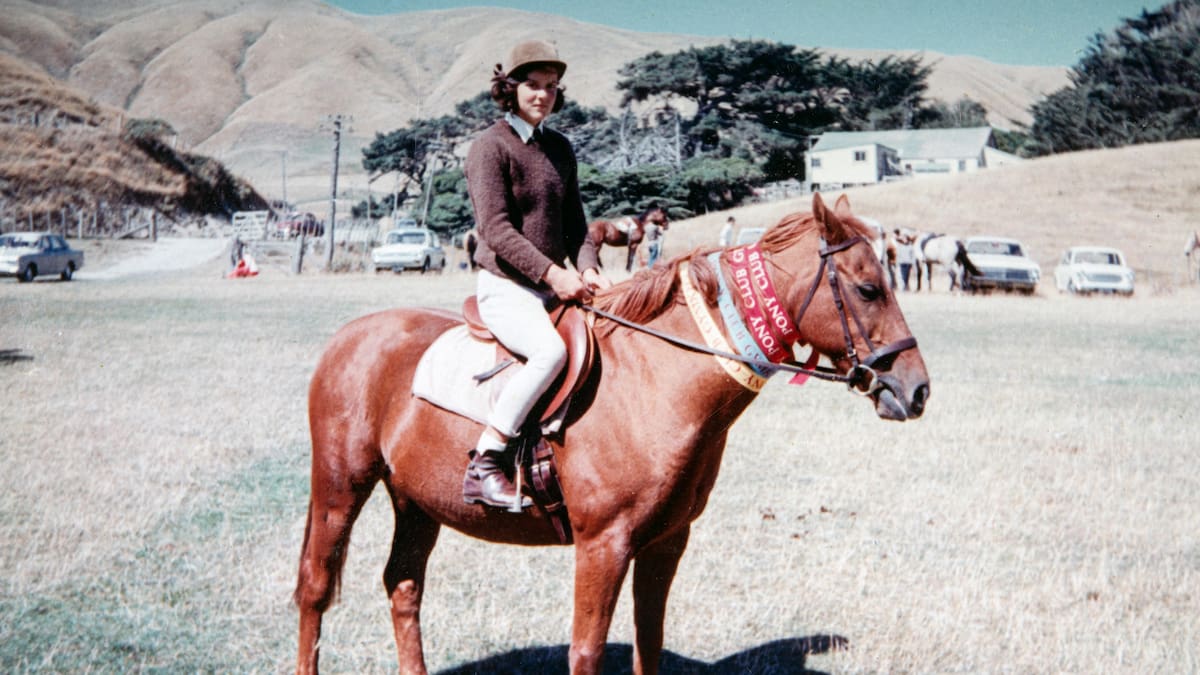
Nicola and Sergeant at the Levin A&P show in 1972. Photo / Supplied
I didn’t mind, as by then, I too had caught the fever. We returned to New Zealand and if our parents hoped other interests would take over, they were wrong. In their own slightly dotty way, they created the perfect set-up for the dream to come true.
We had been visiting friends who lived in Tītahi Bay, and on the way home to the Wellington suburb of Northland, my father drove us along the old Porirua Rd rather than take the exciting new motorway. On one side was the railway line to Tawa, Porirua and beyond, and on the other, farmland. It was leafy and quiet, and the road gently wound its way to Johnsonville. There was the odd house along the way and then, on the strip of straight road near the small settlement of Glenside, was a large double-storied place with a “For sale” sign on it. We stopped. All seven of us got out and walked through the main gates.
Unappealing though he was, Ned served the purpose of locking my parents into a horse-shaped future.
Nicola Saker
An elderly man, a Mr Tulloch, met us at the door, then showed us around. Itself called Glenside, the place had been a hotel stop for horse-driven coaches heading north from Wellington. It had seven or eight bedrooms, two large front rooms, a parlour, a kitchen with a bathroom off it, servants’ stairs, a cabinet full of Royal Albert and Royal Doulton china, verandas on both stories and an air of shabby former grandeur. The outside consisted of three large paddocks, four outbuildings – a henhouse, a milking shed and yard, a stable and a garage. A creek ran through it with a bridge across it to the two back paddocks. Large trees lined parts of the creek and the drive to the property.
My parents bought it. Weekends and holidays were spent at Glenside and we all adored it for different reasons. For us children, it was heaven. We had a rope swing over the creek, outbuildings full of treasure to explore – horse collars, grinding wheels, balloon-back armchairs, prints of The Stag at Bay … but that was before the arrival of the first pony.
My mother, who came from a farming background, felt at home. My father could have Guy Fawkes parties of a size and splendour that suited his impulsive generosity – kegs of beer, bonfires, all his friends with their children, and fireworks. Both my parents loved the whiff of danger along with the gunpowder. But all that excitement receded with the arrival of the first pony.
The old homestead at Glenside. Photo / Wellington City Archives
Ned was in one of the front paddocks when we arrived one Saturday morning for the weekend. It was as if, like a spirit animal, he had been summoned from the ether by the intensity of my sister’s desire. A chestnut with a white blaze, just there, unexplained. No one knew who he was or, more importantly, who he belonged to. All the longing, all the arguing, all the begging was swept away by his arrival. My sister had found her horse, or he had found her. It was meant to be.
Out of a storybook
It was as if the horse and pony books we had read had come to life – our life. All these books were by English authors and most had been written in post-World War II Britain. Times were hard and the central trope was a horse-mad young girl or girls and their hard-up parents scraping money together to get a pony and start their riding lives. In many of them, the villain was a rich girl whose parents bought her wonderful ponies but – spoiler alert – she wasn’t half as good a rider as the less well-off kids. And my word, those young female characters had agency. In Minda, by Kathleen MacKenzie, the central character illegally breeds her old, rather average mare with a local thoroughbred stallion and begets a winner. All is forgiven by the stallion’s owner further down the track because Minda is such an outstanding rider. Uplifting!
Ned’s owner did turn up, and some sort of arrangement was organised. My parents didn’t buy Ned, but his owner agreed to loan him to us. A bridle was found and my sister learnt to ride him bareback. She was helped by a young neighbour from across the road, Alan. He was a few years older, blond, good-looking, and already an accomplished rider with a pony called Prince. My mother called him “young Lochinvar”. He was amiable and kind and all of us were smitten with him. Alan suggested my sister attend the Onslow Pony Club with him.
Older sister Kerry on Sergeant at a gymkhana in Plimmerton in 1970. Photo / Supplied
It quickly became apparent that Ned wasn’t a suitable mount for someone learning to ride. He was an obstinate and bad-tempered horse; it wasn’t long before Honey was bought and Ned was returned to his owner. Unappealing though he was, Ned had served the purpose of locking my parents into a horse-shaped future for three of their five children. Being good sports, they climbed on for the ride, and what a ride it was. There was a lot to learn and at the centre of it was pony club. And at the centre of pony club was the formidable, unforgettable Mrs Gwen Gray, the pony club district commissioner. Not tall, and almost as stout as she was high, she had the lead-character energy necessary to control the diverse cast surrounding her – and who called her “Granny” Gray behind her back.
Barking and cackling
Mrs Gray was quintessentially Kiwi, from the toes of her red-top gumboots to the crown of her unruly, grey (what else?) hair. She was a widow, a farmer and the mother of three sons: Ken (the All Black, and a farmer), Alan (an oncologist) and Jim (also a farmer). The family land went from the Pāuatahanui inlet in Porirua Harbour right up to Pukerua Bay and was bounded by Gray’s Rd at its southern end and Gray St on its northern boundary.
She had a fleshy nose and a wide generous mouth from which she spoke in a croaky, deep voice that alternated between barking orders and mirthful cackling. She was the epicentre of the local equestrian world and extraordinarily generous and kind to her flock, many of whom, possibly surprisingly, needed her care. Because pony club, as with other sports, was a cross-section of society. Back then, unlike now, you didn’t have to be wealthy to afford a pony. In the same way, many working families then could build or buy a modest bach. There were pockets of poshness – families who had Harris tweed riding coats and their own horse floats – but they were outnumbered by the many who mended and made do with hand-me-down gear, much of it provided by Mrs Gray.
You are no longer a powerless child but a partner in a relationship that requires trust, skill, courage …
Nicola Saker
She also offered a place for those who were better off not at home, a place to spend weekends where there was always a cup of tea, a meal, and if need be, a bed. Young people like the teenager whose stepmother kept her so hungry she didn’t have the strength to control her horse. Or the few young male riders who, looking back, were undoubtedly gay and found an acceptance that was never talked about, but given with understanding and constancy.
Many fruitcakes
My mother witnessed a legendary Mrs Gray incident. If you were competing at a show, you got up at 4.30am and got your horse onto a cattle truck (the cheapest form of transport) which went to the showground. There, you washed your mount along with its mane and tail, ready for plaiting. Plaiting a horse’s tail is a skilled job and Mrs Gray would go around her competing pony club members and do it for them. One morning, the horse she was attending kicked her. Without a second’s hesitation she kicked it right back and went on plaiting its tail.
A show, usually an A&P show, was the apex of our riding calendar. There were “ring” events: “best turned out”, “best rider” and so on, then the gut-churning jumping events. My grandmother would always bring bacon and egg pie, several thermoses of tea and a fruitcake. A farmer’s wife herself, she loved an A&P show and had been a judge of fruitcakes at them for many years.
Fruitcakes of the human kind were everywhere in the horse world. Mrs Gray presided over three NZ Pony Club branches and they equalled Game of Thrones for the intensity and sheer viciousness of competition between parents, and from parents towards Mrs Gray, whose dominance was resented.
Lunchtime for Foxy, in this case the family’s lunch from the boot of the station wagon, in Tawa in 1966. Photo / Supplied
One father approached mine after his daughter had been beaten in a jumping competition. He wanted to buy our pony, on the spot, in cash – it was a hostile takeover that didn’t succeed.
We got to know blacksmiths, Tony Keen in particular, who wore wide leather chaps over his jeans. Getting a horse shod by a blacksmith is a theatrical experience – the bellows used to pump up the fire, shoving the cold metal shoe into the embers, which then emerges glowing red to be placed, sizzling, onto the horse’s hoof. There was the smell of burning keratin as the shoe was fitted onto the hoof, removed and hammered into a better fitting shape, then thrust, hissing, into a bucket of cold water to harden before being nailed onto the hoof.
I remember as a fearless 12-year-old being told by older girls that you start to lose your riding confidence as the teenage years progress and the inherent risks become obvious. I drifted away from riding when I left school and other possibilities opened up, but the aromas remain with me – of melting molasses into chaff for a winter feed, the gentle smell of saddle soap and clean leather tack, the stench of the long drop toilets at gymkhanas, the mealy aroma of horse sweat and the pungency of Neatsfoot oil for hooves.
The predominance of girls in junior levels of riding is overwhelmingly evident. It’s got a lot to do with agency – you are in control of a large animal and that feels powerful, as well as providing a means of transport at a young age. You are no longer a powerless child but a partner in a relationship that requires trust, skill, courage and emotional intelligence. Your mount mirrors you – both your mood and your abilities.
At its best it’s like being a centaur; you are one being. Inevitably, nobody puts it better than Shakespeare’s dauphin in Henry V: “When I bestride him I soar, I am a hawk; he trots the air, the earth sings when he touches it … he is pure air and fire.”
SaveShare this article
Reminder, this is a Premium article and requires a subscription to read.
Copy LinkEmailFacebookTwitter/XLinkedInReddit