
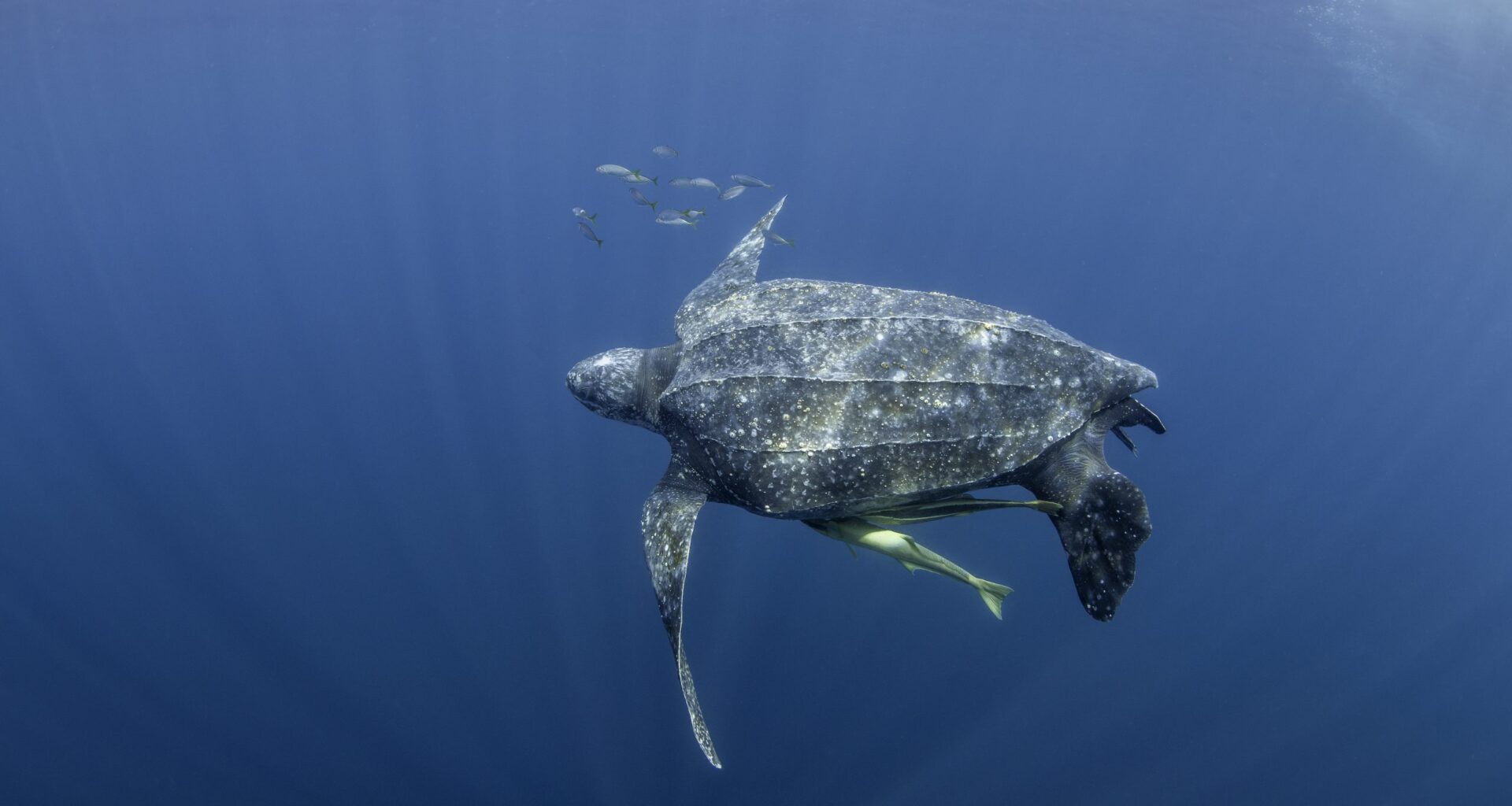
A prominent environmental group believes Conservation Minister Tama Potaka is wrongly hiding behind legal action to avoid taking action to prevent the death of critically endangered leatherback turtles.
The most recent fishing season saw the fishing industry have a historically high 44 interactions with sea turtles. Sixteen of these turtles were released alive, but injured.
No mortalities were recorded, but Fisheries New Zealand estimates a post-release mortality rate of 22 percent.
Using this figure, an estimated 10 western leatherback turtles may have died.
Hawaiian fishing rules cap leatherback turtle catches at 16 a fishing year. If that number is exceeded, the fishery is closed.
This has seen a dramatic reduction in the number of the endangered turtles being caught, meaning New Zealand’s longlining fleet is catching significantly more leatherback turtles than Hawaii’s, despite the turtles being a relative oddity here.
Seafood New Zealand chief executive Lisa Futschek said the numbers varied year to year, and that six leatherbacks had been caught and released alive in the first three months of the current fishing year.
Niwa fisheries scientist Dr Brit Finucci says leatherbacks are naturally occurring in New Zealand, but their presence is poorly understood, with the limited understanding mostly coming from fisheries bycatch.
Information being fishing-dependent means only part of the story is captured.
Figures from 2013, cited by the Environmental Law Initiative in its letters, placed the western population of leatherback turtles at around 1400.
Finucci tells Newsroom more recent estimates sit at around 1000 individuals across the Pacific Ocean.
“There are estimates that the population is declining at about 5 percent a year, and that’s based on a combination of surveys that are done at nesting sites, as well as some visual surveys that have occurred off of California.”
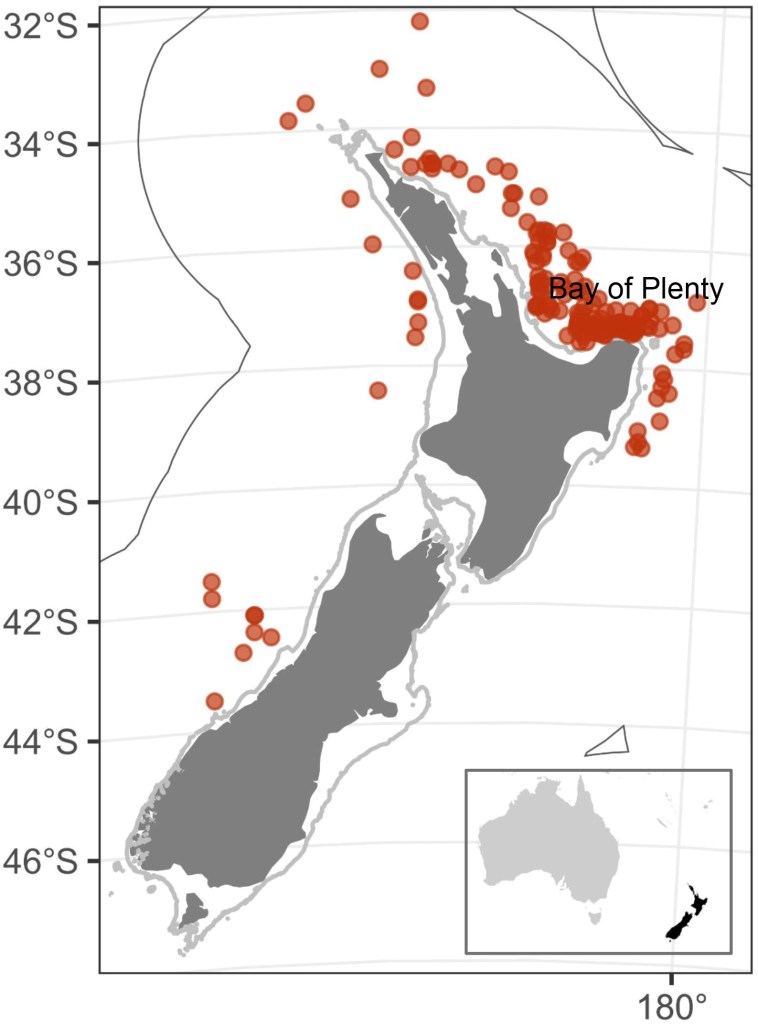 Distribution of fisher-reported and observer-reported leatherback turtle captures between the 2008 to 2021 fishing years. Graphic: Frontiers in Marine Science
The largest threat to these species in New Zealand waters is being caught in fisheries, but habitat loss elsewhere in the Pacific and ingesting plastic play a significant role in their reduction.
The most recent fishing season saw the fishing industry have 44 interactions with sea turtles, 16 of which released alive, but injured.
Despite no mortalities being recorded, an estimated mortality rate of 22 percent puts 10 – out of the entire population of around 1000 – as having died.
In November, the Environmental Law Initiative wrote to Conservation Minister Tama Potaka and Oceans and Fisheries Minister Shane Jones seeking action to prevent fishing-related interactions and mortality for the species.
In these letters, signed by the group’s research and legal director Dr Matt Hall, Potaka was urged to put together a population management plan and maximum allowable level of fishing-related mortality.
The Department of Conservation has never set a maximum mortality level, nor has it put together a population management plan in over two decades.
Jones was asked to impose an immediate mortality limit (possibly as an interim measure) or to consider closing high-risk fishing areas from January to March 2026, where and when leatherback turtle bycatch occurs most.
Recorded catches of leatherback turtles are most common in the Bay of Plenty, though interactions have been recorded as far south as Fiordland.
The turtles have an ability to partially thermoregulate, or generate their own body heat, which allows them to handle colder waters than most other reptiles.
According to a review of commercial fishing interactions with marine reptiles prepared for the Department of Conservation by Niwa in 2022, 217 leatherback turtles were caught between the 2008 and 2021 fishing years.
The ministers’ responses to the Environmental Law Initiative, shared with Newsroom, largely centred on what had already been done.
Potaka’s letter shut down the idea of immediately putting a population management plan and a maximum allowable level of fishing-related mortality in place.
“While it would be premature to comment on the use of those specific tools at this time (due to current court proceedings), it’s clear that action is needed to protect leatherback turtles, and we’re working to achieve this.”
While no specific action was referred to, it could only be the appeal of a High Court decision which ruled the Department of Conservation had failed or unlawfully refused to use powers to set limits on the bycatch of protected species using conservation legislation.
The appeal, lodged by Seafood New Zealand and two associated groups, questions two of nine causes of action from the High Court decision.
It won’t be heard until July 14, 2026, well after peak leatherback turtle season.
Potaka said he was expecting advice from officials on the recommended approach to manage threats to leatherback turtles and other sea turtles found within New Zealand waters by the end of the calendar year.
“I’m satisfied that the work the Department of Conservation is doing with Fisheries New Zealand, and the options presented to me, will help to protect leatherbacks moving forwards. Thank you for raising your concern for leatherback turtles and for taking the time to write to me with management suggestions.”
Newsroom asked Potaka’s office about this advice, but did not receive a response in time for publication.
The Environmental Law Initiative sent responses back to the ministers. In the response to Potaka, Dr Matt Hall took issue with the minister’s unwillingness to talk about population management plans and maximum mortality limits.
“We understand from this that the department has decided not to initiate a population management plan process for leatherback turtles on the basis that the seafood industry is appealing aspects of ELI’s High Court case on the failure to use population management plans to protect marine species.
“In our view, such a decision is unlawful. If our understanding of the department’s position is incorrect, please let me know as soon as possible.”
The initiative said the two grounds being challenged by Seafood New Zealand wouldn’t challenge the substance of the law, or the ability to implement it.
Speaking to Newsroom, Hall says the existence of this appeal didn’t prevent the conservation minister from using these powers.
“Further, if the minister and Department of Conservation are continuing to not exercise those powers because of the existence of an appeal, then that would also be unlawful.
The High Court has set out the law relating to population management plans and mortality limits as it stands and the minister and Department of Conservation need to follow that.”
Seafood New Zealand declined to comment on the legal action or the impact it would have on Potaka using these tools.
Its chief executive Lisa Futschek said the group had two staff members working full time on protected species and was working collaboratively with government agencies to reduce interactions and increase survival rates.
The response from Shane Jones centred on steps he said had already been taken to reduce the risk of fishing to West Pacific leatherback turtles.
These included circle hooks becoming a requirement for surface longline fisheries in 2023 – a Department of Conservation programme that provides turtle handling advice and de-hooking kits.
“These measures contribute to high post-release survival rates for West Pacific leatherback turtles. As you note, recent research has estimated New Zealand specific survival rates at 78 percent. I also note that 100 percent of Leatherback turtles in the 2022/23 to 2024/25 fishing years were reported as released alive,” Jones said.
The prioritisation of cameras on the longline fleet and a cross-agency turtle working group working on practical mitigation options, were also pointed to as positives for the species.
The turtle working group is informed by the successful Hawaiian approach and requirements of the Western and Central Pacific Fisheries Commission.
“Fisheries New Zealand and Department of Conservation are also pursuing opportunities for new research, both domestically and internationally, to better understand the leatherback turtle population and risk from fishing,” Jones said.
Hall doesn’t believe any of these are really mitigation measures or management responses to reduce leatherback bycatch.
“Circle hooks have been a regulatory requirement since August 2023, but they were already widely used in the surface longline fleet prior to regulation. Their formalisation has not materially changed fishing practice or addressed cumulative mortality risk.”
Circle hooks increase survival rates by hooking fish and other animals in the mouth rather than deep in the throat or allowing the hook to be swallowed.
Niwa’s Brit Finucci says turtles that get caught in fisheries get tangled rather than hooked in the mouth.
“They might get hooked in the flippers, but it seems like they’re just massive animals with really poor vision and they just tank through long lines and get caught.”