
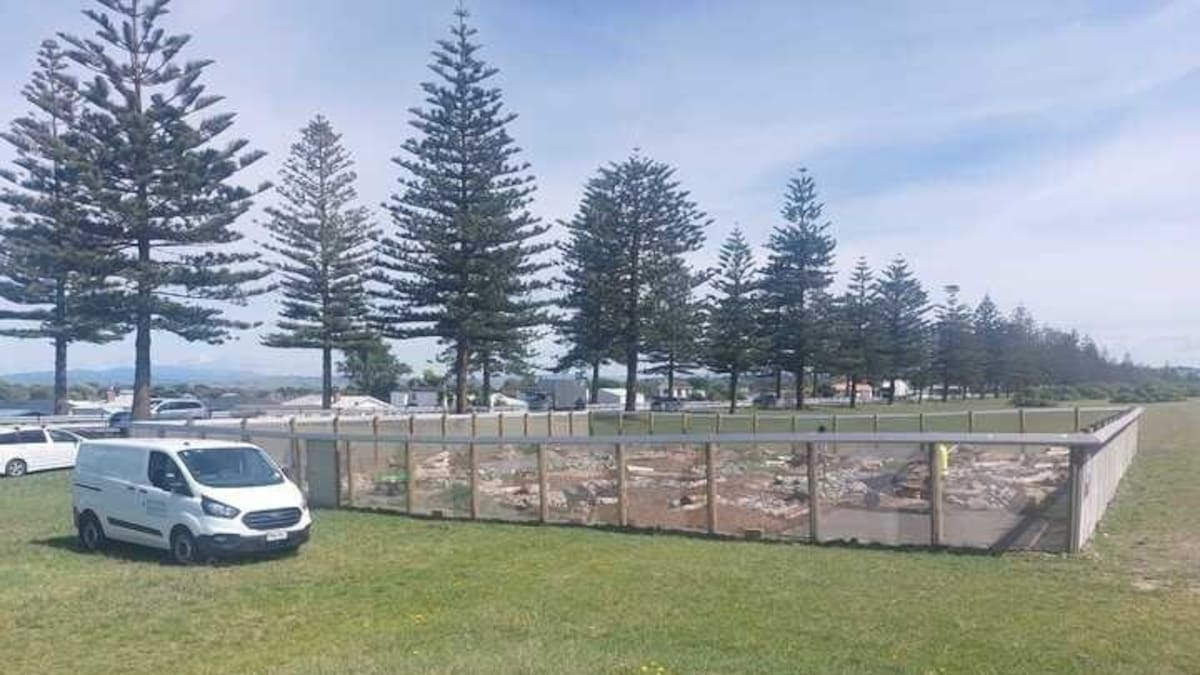
He said while the enclosure’s fence was finished, there was still some work to fine-tune the inside environment.
Inside the predator-proof enclosure on Marine Parade. Photo / Linda Hall
“This includes arranging rocks and driftwood. There will be a water tank going in this month, which will be used for plant watering.
“Once the tank is in, low-lying native plants will be established, which will, over time, provide additional habitat and tiny fruit that skinks can eat. The majority of this should be completed by the end of February.
“All going well, the rehoming would go ahead in March or April this year.”
The fence is designed to exclude mammalian predators, including mice, rats and cats, by using a fine steel mesh and a folded-over capping.
It is not covered, so birds can still get in.
Northern spotted skinks will be moved to a new predator-proof enclosure on Marine Parade. Photo / Biodiversity Hawke’s Bay
Woolcott said recent surveys indicated there were fewer than 10 skinks in the colony.
“However, as they are hard to detect, it is thought that there are perhaps 10-100 in the Napier coast population. The intent would be to translocate as many as possible into the sanctuary.”
The skinks are being relocated to make way for a $37.4 million stormwater infrastructure project between Maraenui and Te Awa.
A council spokesperson said in October last year the work was one of several upgrades the council had planned to improve its flood resilience.
The skinks, which are protected under the Wildlife Act (1953), inhabit what the council said was the most cost-effective site for the stormwater outfall infrastructure.
Napier City Council’s executive director of water services, Russell Bond, said at the time the skink enclosure was a practical solution that kept the project on schedule.
“We can proceed without delays that would cost far more, and it creates a permanent habitat protection for this rare native species,” Bond said.
The stormwater project is jointly funded by the council ($25m) and Kāinga Ora’s Infrastructure Acceleration Fund ($12.4m) and includes a new pump station with a back-up generator, a coastal outfall on Marine Parade and upgraded watercourses.
It is part of the Council’s Long-Term Plan (2021-31). The $25m will come from a mix of rates and loan funding.
Main construction is due to start in the middle of this year, with a target completion date of the end of 2027.
LDR is local body journalism co-funded by RNZ and NZ On Air.