
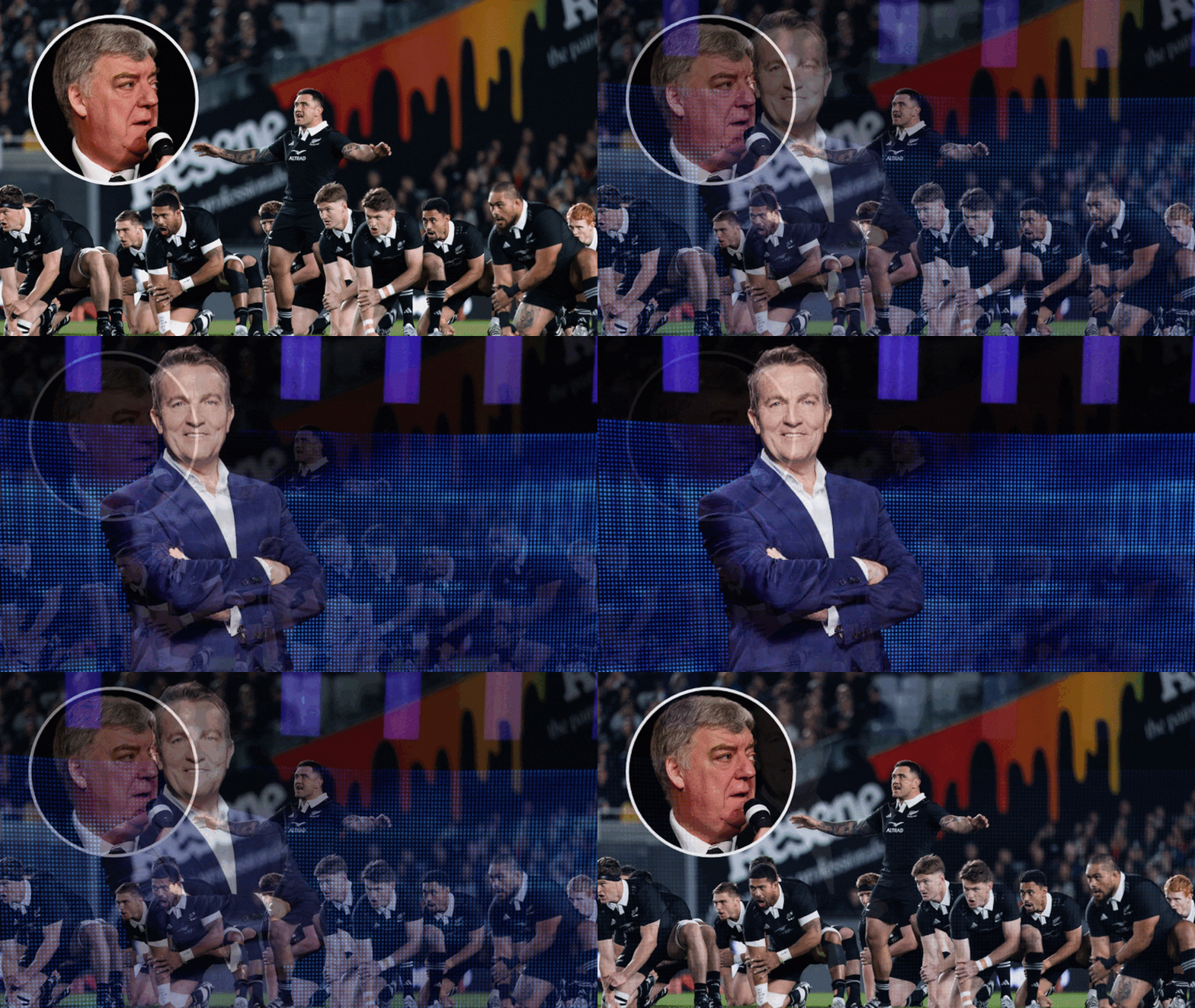
Jones is infamous in New Zealand; over the years, he’s had several cracks at the All Blacks haka – including describing it in 2019 as “bogus” and a “means of rank bullying on and off the field”.
He also doesn’t share the same adoration of the likes of All Blacks legends Dan Carter or Richie McCaw, and in August last year, he managed to rark up some Kiwi fans further, with the suggestion the Lions should cancel their 2029 tour of New Zealand.
Jones, to his credit, is very aware of his reputation in New Zealand, and has previously contemplated why he’s so unpopular here, to the extent that a ceramic mock-up of his head was once placed in the urinal of a Queenstown bar, so that patrons could pee on it.
Jones wrote this week in his farewell piece: “I’ve been voted into fourth place in a newspaper poll of New Zealand’s most-hated. Above me were Dominique Prieur and Alain Mafart, two French intelligence agents who blew up the Greenpeace ship Rainbow Warrior in Auckland Harbour.” (The others were former Australian rugby star Quade Cooper and the possum).
Jones’ feature this week reflected on his time as a Times rugby writer, under the headline “Thrills, friendships and deadline panic: my 42 years as rugby correspondent”.
Attached to the online piece are almost 500 comments – some of them praising Jones, some of them critical. There are also a couple of dozen others that were removed by moderators.
One reader, JH Dennehy, wrote that some of the deleted comments came from Jones himself.
“For those arriving here at this point, the deleted comments that ‘violated’ the [moderation policy] were Jones’ own unpleasant and thin-skinned responses … hilarious.”
British rugby writer Stephen Jones was labelled “thin-skinned” by one of those commenting on his farewell piece for the Times. Photo / Getty Images
Dennehy later added the comments, “wouldn’t get even close to getting past the moderator”.
He said Jones had gone on a “mini rampage telling people he was pleased he’d ‘******** them off pal’. Funny and sad. And there was no punctuation and no capitals.”
Another reader, S Cooper, wrote: “I really can’t believe … a journalist would choose to bow out in such an utterly classless way with these juvenile retorts.”
Nick Hardy wrote: “It’s like one of those leaving drinks when the leaver hits the bar too hard and ends up slagging everyone off.”
And Maurice Murphy said: “People have been quite spiteful towards him. I came on here to wish him well, then as I scrolled through the responses from SJ, I was surprised at how he reacted and let himself down.”
Neither the Sunday Times nor Jones has responded to emails sent to the news organisation this week, seeking comment.
British rugby writer Stephen Jones. Photo / Photosport
Those familiar with Jones’ social media style won’t have been surprised by his now-removed comments.
On X (previously Twitter), moderation rules are a lot looser. Jones is known to be a prolific blocker of accounts of people who rark him up and/or abuse him.
He also gives as good as he gets.
In December, he replied to one X user with the words “clueless dickhead” during a debate about England’s best current first-fives. In response to a person who wanted to know what might have provoked a Springbok star to eye gouge a Welsh player, he wrote: “Pal. You are sick. Get help.”
When another X user suggested in November that Jones did not aspire to journalistic nobility, Jones responded: “Who do you write for dickhead? I’m employed by [the] Times of London. But words will be too long for you.”
While he might do himself few favours with his social media approach, there has also been plenty of praise from fans and other UK journalists this week.
Jones is said to be a very personable figure with those he gets along with, and he is widely hailed for his support of women’s rugby.
That support does not extend to the haka, though.
“The haka has long been partly bonkers,” Jones wrote in a column for the Times in 2019. “It is now interminable; it takes up ages with the other team freezing. It is now a means of rank bullying on and off the field, and has become a posing strut rather than a tribute to the Māori heritage in New Zealand.”
Scott Barrett leads the All Blacks haka before a test match against Ireland in Chicago in November. Photo / action press
Jones suggested at the time that it was performed to satisfy sponsors and television, and felt it was time the rugby world moved on.
In a feature article for The Times in 2011, he contemplated his unpopularity in New Zealand.
“One colleague told me that I was a ‘national obsession’. Good grief. The origins of the hostility are mysterious, though we must bear in mind the legendary thickness of the Kiwi skin (a fraction of a millimetre) and their celebrated ability to spot irony — on a par with the Americans’.”
He contemplated whether his unpopularity was down to a previous observation that every New Zealand restaurant seemed to serve (not-very-good) pumpkin soup, or his views on the haka.
“There were a few other scattered bits and pieces they didn’t seem to like, such as my humbly drawing attention to the fact that New Zealand, who, as they have never stopped telling us, have been arguably the best rugby team in the world for the past 24 years, have not won a single World Cup in all that time and therefore must be termed rugby’s greatest global chokers.”
And while some Kiwi fans might think Jones despises everything about the All Blacks, that is not the case.
If you dig deeper, he has praised New Zealand rugby teams in the past.
“Those who slobber over the All Blacks would naturally claim that their 2015 team was better than the current Springboks side,” Jones wrote last October.
“They were not. It is important to remember that while 2015 was a great World Cup, the standard of the so-called elite teams was low. England were risible, Wales went into their quarter-final with 11 backs injured; Australia, the finalists, were mediocre and only beat Scotland thanks to a refereeing error.”
He further added: “When thinking about the greatest side of all time, it is still stunning how bad New Zealand were in the 2011 final against France.
“The best New Zealand team – and I was too young to study the 1967 vintage under Ian Kirkpatrick – was [Sean] Fitzpatrick’s 1996 touring side, which beat the Springboks three times in three weeks; once in a Championship game then twice in a three-Test tour. They would be too clever for today’s South Africa if they met, by a three-point margin.”
This week, he named four New Zealanders in his all-time best XV of the past 42 years – left wing Jonah Lomu, flankers Michael Jones and Allan Whetton and midfielder Frank Bunce.
TVNZ’s new Chase, Love Island deal
The Chase host Bradley Walsh.
TVNZ has announced a new deal with Britain’s ITV, which will keep The Chase, Love Island and Coronation Street on the state-owned broadcaster’s books.
The new deal is for multiple years, although precise details – including the cost – have not been released.
While Coro St and The Chase appeal strongly to TVNZ’s traditional, slightly older audiences, Love Island is a ratings phenomenon for a younger, digital native audience on TVNZ+.
The new agreement secures a range of Love Island shows, including Love Island UK, Love Island USA, Love Island Australia, Love Island Games and Love Island All Stars.
Love Island has now stretched to multiple seasons, and countries. Photo / TVNZ
There was also a lot of love in a statement issued by the companies.
ITV Asia-Pacific distribution executive Augustus Dulgaro said he was thrilled to continue the company’s long-standing partnership with TVNZ.
“In addition to having a simpatico working relationship with the team, together we have evolved and built this deal to the powerhouse it is today, with around 1500 hours of ITV content launching across TVNZ’s platform annually,” he said.
TVNZ commercial general manager Josh Wolfe said: “This deal ensures TVNZ remains the home of premium international entertainment in Aotearoa, from long-running favourites like Coronation Street to the complete Love Island franchise and an exciting slate of new dramas.”
The Chasers, from left: Shaun Wallace, Darragh Ennis, Anne Hegerty, Paul Sinha, Jenny Ryan, and Mark Labbett.
In a feature interview with the Herald last year, The Chase star Mark Labbett (aka The Beast) said that much of the show’s success was down to host Bradley Walsh.
“I’m tempted to be cheeky and say it’s me, but, no, I think that we’re lucky we’ve got Bradley, who, in my opinion, is the best game-show host in the English-speaking world, and as I’ve worked around the world, I can say that with some confidence.
“He’s a natural professional … and he’s also very generous. He lets the contestants in, he lets us in.
“I think we have a huge advantage in that we have potentially five conversations going on: Bradley and the contestants, us and the contestants, us and Bradley, the three of us all together, and then you can even bring in the guys and girls at the back there, so it feels much more natural and organic.
“To a certain degree, it’s more like a bunch of people at the bar trying to put one over on each other.”
NBR v IRD heats up – a recap
The National Business Review is set to take legal action against the IRD following revelations that the tax department copied and pasted a selection of paywalled NBR business articles into Word documents and distributed them to 600 staff.
As Media Insider revealed last month, the NBR had been demanding $36,000 in damages for what it believes is an open-and-shut case of a breach of copyright law – the IRD says it has apologised and offered $12,500 in what it believes is a fair settlement sum.
But those discussions have collapsed, with NBR withdrawing its offer and now cancelling the tax department’s sole subscription to the business website.
NBR owners Todd and Jackie Scott.
NBR co-owner and publisher Todd Scott has also banned the IRD from future subscriptions.
Scott told Media Insider in the past week that his company would now pursue district court action, “at which stage we will have further information that will see the damages balloon out considerably”.
In October, NBR secured settlements from three leading businesses after the online business publication found them to be sharing small numbers of subscriptions widely among their staff. NBR said they were breaching its copyright and subscription terms and conditions.
The firms have not been named, but one of them was a legal practice.
NBR announced in November it was taking legal advice in relation to the IRD’s own actions.
The tax department previously had a group subscription of 220 users, but in March last year, it cancelled that and took out a single subscription for an IRD media principal.
NBR says the IRD has admitted that between March 28, 2024 and November 17, 2025, it shared 22 different NBR articles with staff members. Those articles were distributed as stand-alone Microsoft Word documents to staff, with seven of the articles in question shared with 600 staff.
NBR has calculated that a group subscription covering 600 staff for four months would ordinarily have cost IRD about $36,000 plus GST.
IRD says when it “became aware that a potential infringement of copyright had occurred, we looked into it as a matter of importance”.
“Inland Revenue seeks to be diligent in its compliance with all of its intellectual property obligations,” said a spokeswoman.
She said the department had “accepted that an error had occurred and apologised for the error in our understanding of the extent of the licence”.
“We wanted to put right what had happened. We also sought legal advice. We made what we consider a reasonable offer in redress, keeping in mind what had actually occurred and what is a reasonable use of taxpayer funds in the circumstances.
“That was not accepted by Mr Scott. A counteroffer was subsequently made to IR that we did not accept.”
Of the seven articles distributed to 600 people over 18 months, the number of people viewing each article ranged from 18 to, in one instance, 130, she said.
NBR confirmed the IRD offered to settle the matter at a much lower cost, arguing that not all 600 staff had accessed those shared articles.
NBR, however, argued copyright remedies did not turn on actual use by the end user and that damages should be paid on a user principle basis, which essentially determines the amount the infringer would have had to pay for a licence if they had sought permission in advance.
“It is shocking that the government department tasked with making sure New Zealand businesses and individuals pay their fair share has admitted they were not properly paying for their use of a privately owned business’s product,” Scott said in December.
“It is, however, worse that they have then refused to pay the appropriate damages in recognition of the seriousness of the breach.
“The irony of the IRD’s refusal to pay for its breach will not be lost on the thousands of New Zealand businesses who have been struggling to make ends meet for several years.
“Following a couple of years in which several high-profile media businesses have folded in this country, New Zealand business and Government departments need to ensure they are backing the industry appropriately.”
The IRD spokeswoman said: “We were genuinely engaging with NBR to increase the number of subscriptions to 22 as well as put right our error. However, it was during the discussion to increase our subscription that Mr Scott cancelled the one subscription we had.
“We have now decided not to take up any NBR subscription in the foreseeable future. We are not concerned about not having any subscriptions.”
Five leaders, six questions
In the penultimate instalment of our summer Q&As, we tap into the minds of a selection of five top leaders from advertising agencies and the out-of-home sector.
The final Q&As from our summer series now run next week, with the full return of the Media Insider column.
Kelly Harvey, head of NZ, oOh!media
Kelly Harvey is oOh!media’s NZ chief executive.
What’s one word to sum up your mood heading into 2026?
Energised!
What surprised you in 2025?
’25 was a massive year on every front. As a business, oOh! had its fair share of uncertainty and curveballs, but I’m genuinely proud of how the team locked in, looked after each other, and pushed through huge change while staying laser-focused on what they do best – delivering for our clients and commercial partners.
The best surprise of 2025 was the level of support we felt from the market while we navigated these changes. It was a reminder of why we’re all so passionate about this industry and the people in it. That media community spirit was on full display for us in 2025, and it made all the difference.
What was your biggest personal or professional success in 2025, and what’s your biggest ‘work-on’ for 2026?
Stepping into the role of head of NZ has been a huge milestone for me – equal parts exciting, challenging, and rewarding. Even after many years with oOh!, these last few months have been a whole new learning curve.
As far as a work-on, I think continuing to focus on getting out into the market and building stronger, more meaningful relationships with all our key stakeholders. That means spending more time with our commercial partners, our agencies, and our clients – hearing what’s important to them and finding new ways we can make things happen together.
Which competitor – either person or firm – do you admire most and why?
I think the NZ out-of-home sector overall is very admirable. Launching knOOH in 2025, the unified OOH audience measurement tool, has been a critical step in progressing the channel forward. Without pulling together and striving for a common goal, we never would’ve got there – look forward to what’s next and how, as an industry, we can keep pushing ahead, together.
How do you think 2026 will play out for New Zealand media – what would be a game-changer for your company/audience/clients?
I think we’d all love a year filled with certainty, consistency, and minimal change – but I suspect 2026 will be another year of change across the media world.
The good news? I’m genuinely optimistic that this next wave of change will be driven by growth and positive momentum, and not the consolidation and cost-cutting we’ve all had to navigate over the last few years.
2025 gave us a real game-changer with the successful launch of knOOH, and I’m excited to see how it evolves in 2026. The smarter thinking, deeper insights and industry-wide uptake this platform will drive are exactly what OOH needs. We’re moving from a “data-challenged” medium to one that leads the market – and that’s seriously exciting.
What are your plans for the summer break?
The past few months have been absolute chaos for our household, so I’m very ready for a proper reset – no schedules, no rushing around, just low-key family time and zero plans.
Phil Clemas, chief executive, Lumo
Lumo chief executive Phil Clemas.
What’s one word to sum up your mood heading into 2026?
Optimistic.
What surprised you in 2025?
Reserve Bank’s hesitancy in dropping the OCR;Commerce Commission approval of the mega agency holding company merger in NZ;Sky NZ buying Three;The lack of pace from the Government to reform, but pleased to see a late flurry in Q4. We need a centre-right Government to readjust the settings to allow businesses to thrive and return us to economic prosperity;The relatively subdued start to the new Auckland Transport out-of-home contract tenure.
What was your biggest personal or professional success in 2025, and what’s your biggest ‘work-on’ for 2026?
Buying out our investor shareholders to take control of Lumo;Purchasing Hamilton-based DOOH operator Globox to extend our audience reach in the regions;2026 work-ons: Consolidation of our network investment and managing our AI strategy, which is aimed at improving our value proposition to our clients.
Which competitor – either person or firm – do you admire most and why?
In the wider media sector, Sophie Moloney, CEO of Sky NZ, for getting traction on some of her strategic initiatives in 2025;In the out-of-home sector, the team at Phantom Billstickers for sticking to their knitting and doing it well.
How do you think 2026 will play out for New Zealand media – what would be a game-changer for your company/audience/clients?
An improving economy will help lift consumer and business confidence and in turn grow ad spend;After moves in 2025 that included Stuff/Trade Me, Sky NZ/Three, Netflix/Warner Bros and rumblings of a move by Nine Australia, it seems clear that media owners are taking positions to strengthen their holdings and support their growth strategies or the next phase of the economic cycle;Out-of-home grew strongly in 2025 (over 13%) upon a solid foundation, and I expect this may fuel some M&A activity to consolidate the sector and leverage those long-term growth opportunities. Lumo has already played a small part of that consolidation after it purchased regional digital operator Globox back in June;Traditional media like linear TV, print and radio will continue to lose their share of the advertising pie as their transition to digital inventory can’t keep pace with the ad spend erosion. Out-of-home is the only exception (of traditional media) where digitalisation has actually driven growth of the channel;AI impact on the advertising industry will be more significant in 2026, which will provide risk and/or reward for all involved. Those who adapt the quickest will reap the most reward.Brands will redirect more of their budgets to brand health and profile, away from so much performance marketing. Digital creativity for OOH will become higher profile as clients seek differentiation from competitors and innovative thinking in this broadcast channel;Game-changer for 2026 will be how we shift from using AI to running various aspects of our business with AI agents. One benefit for a media sales organisation like Lumo, it will allow our people to focus on partnerships and relationships, far less on admin.
What are your plans for the summer break?
Looking forward to enjoying some family time in Auckland over Christmas and New Year with a 10-day stint down in Taupō in early January before travelling down to the South Island for some motor racing action at Teretonga (Invercargill) and Highlands (Cromwell) late January. We will also do some alpine hiking across the Routeburn Track in between the car racing weekends. A nice distraction and refresh before getting back to what will be a busy and exciting 2026.
Lee-Ann Morris, chief executive, MBM
MBM CEO Lee-Ann Morris.
What’s one word to sum up your mood heading into 2026?
Grateful. The end of the year has a way of recalibrating things. The summer break helps, as does gaining perspective. Writing this after the devastating events that occurred in Sydney in December makes it hard to lose sight of that.
What surprised you in 2025?
It was a challenging year for the New Zealand advertising industry. Local publishers faced pressure with constant changes across the media and marketing landscape. What surprised me was how the industry responded. The New Zealand advertising community is small. People check in, and support crosses agency lines. Regardless of where we work, we are part of the same community, with a true sense of camaraderie. That instinct to rally together feels uniquely New Zealand, and it was genuinely good to be part of it.
What was your biggest personal or professional success in 2025, and what’s your biggest ‘work-on’ for 2026?
Being part of the Communications Council board and the launch of He Tangata. This initiative reflects our commitment to building an industry that truly represents Aotearoa and offers a sense of belonging to everyone involved. It feels like the start of something meaningful. There is still much to work out, but the intent is genuine and the work feels necessary.
At MBM, we spent the year refining our understanding of clients’ actual needs. “Full Picture Thinking” became a way to describe that shift and to build more useful, connected solutions around it.
My biggest area of focus for 2026 is prioritisation – choosing what matters most and letting go of the rest.
Which competitor – either person or firm – do you admire most and why?
There are many strong competitors in the market, which is something we are genuinely proud of. Competing against talented people doing excellent work raises the bar for everyone, and this year truly demonstrated that. Seeing Lassoo win Agency of the Year felt like a moment that the whole industry rallied behind.
Motion Sickness is another agency we enthusiastically support. We love collaborating with them and their work consistently challenges expectations of what’s possible here.
Publicis Groupe also had an incredible year, with strong financial results and continued leadership in AI and data.
How do you think 2026 will play out for New Zealand media – what would be a game-changer for your company/audience/clients?
2026 is likely to be another year of consolidation, with fewer players and continued reshaping of the local media landscape.
While there are signs of economic recovery, marketing confidence will take longer to return. Marketing spend will loosen slowly and with intention, rather than snapping back. AI will continue to integrate into day-to-day work. The significant shift will be in its application—clear governance, shared standards, and a focus on safety will matter more than novelty. That clarity will help teams and clients trust where and how AI is utilised.
However, the real game-changer will still be people. This is fundamentally a service industry. Tools can help, but they are only effective when used with judgment and care. Staying close to clients and using technology to make better decisions – not just ones that win awards – will be most important.
What are your plans for the summer break?
Sun, swimming, books, family and friends. Ideally, nothing ambitious.
Nikki Grafton, chief executive, Omnicom
Omnicom New Zealand chief executive Nikki Grafton.
What’s one word to sum up your mood heading into 2026? Focused (and ready for a holiday!)
What surprised you in 2025?
2025 made it clear just how quickly expectations are shifting. Clients are now far more focused on effectiveness, integration and accountability than they were even a year ago, and all of this while managing significant change in their own organisations and in the technology available to them.
What stood out was the willingness from clients, partners and our teams to challenge established ways of working and try new approaches. In a market the size of New Zealand, that kind of openness makes a real difference and is exciting as we head into 2026.
What was your biggest personal or professional success in 2025, and what’s your biggest ‘work-on’ for 2026?
Professionally, I’m most proud of how the Omnicom Media team supported clients through a year of change. We completed a significant acquisition while maintaining strong relationships and momentum, which reflects the depth of experience and professionalism across the group.
Just as importantly, we remained focused on operating transparently both in how we led through change internally and in how we work with clients day to day. Clear, accountable and open media practices are very important to me, and they are a focus for how we operate.
Looking ahead to 2026, my biggest work-on is pace and consistency. We’ve put strong foundations in place, and now it’s about simplifying where we can and moving faster to deliver clear, tangible value for clients.
Which competitor – either person or firm – do you admire most and why?
I admire organisations and leaders who stay curious and collaborative, even in a competitive market. Those who invest in talent, embrace new tools responsibly, and keep client outcomes at the centre of decision-making push the whole industry forward.
How do you think 2026 will play out for New Zealand media and advertising – what would be a game-changer for your company?
2026 feels like a year where strong partnerships will matter more than ever. Clients are looking for agency partners that can bring clarity, connect thinking across channels, and help them navigate change with confidence. For us, a game-changer will be continuing to deepen those partnerships using data, technology and creativity in ways that are straightforward, accountable and genuinely useful.
What are your plans for the summer break?
Family, friends, swimming, cooking and all the things that make a Kiwi summer great.
Penelope Brown, managing director – media, Together
Together managing director – media, Penelope (Pen) Brown.
What’s one word to sum up your mood heading into 2026?
Momentum.
What surprised you in 2025?
This was the year of Tuesdays. Every Tuesday, a new piece of bombshell industry intel was released. From mergers to acquisitions, pitches to account shifts, promotions to departures, this year had it all, some of it was shocking, not just surprising. Am not sure there was one thing in particular that was the most surprising, but definitely the following have changed the game locally – the Warner Bros Discovery and Sky TV merger, the Omnicom and IPG merger, and the Auckland Transport outdoor tender results.
Do not ask me why it was always a Tuesday.
What was your biggest personal or professional success in 2025, and what’s your biggest ‘work-on’ for 2026?
Professionally, 2025 has been a year of momentum and meaningful milestones for me at Together.
We kicked off the year by welcoming AMP and the Education Workforce (Ministry of Education) and we didn’t stop there. Since then, Contact Energy and Goodman Fielder have joined the fold and we’re preparing to onboard Kiwibank in early 2026. These iconic Kiwi brands choosing Together is a testament to the power of local partnerships – and I’m proud to have played a part in helping make that happen.
The biggest highlight has been the launch of our Wellington office – a significant step for the agency, achieved in a challenging environment. It’s a reflection of our belief in deepening regional partnerships and growing our footprint to better serve clients across Aotearoa.
Looking ahead to 2026, my focus is on people and depth. I want to spend more time with our growing team – supporting their development and unlocking their potential – and go deeper on our clients’ business challenges to ensure we’re not just delivering plans, but driving even better results.
Personally, I’m proudest of the joy I see in my two beautiful boys – I have a 6-year-old scientist and a 4-year-old artist. The best.
Which competitor – either person or firm – do you admire most and why?
Right now, it’s our competitors managing their way through change at IPG and Omnicom. From those I’ve spoken to, I admire that despite so many not knowing the final outcome of the merger and what it might mean for them personally, they are showing up every day and continuing to deliver great work for their clients.
How do you think 2026 will play out for New Zealand media – what would be a game-changer for your company?
My hope is that 2026 brings a more stable and confident economic environment – and there are early signs of that recovery underway. A robust market benefits all of us and my wish is for a media landscape where our industry peers have job security and the freedom and resource to produce truly great work.
That said, we also have to be realistic. The year ahead is likely to bring further disruption, particularly as the impacts of recent mergers continue to ripple through the market. More structural change is coming – and it won’t be easy.
On a more positive note, I believe 2026 will see further support of “local”. This year, we’ve seen clients increasingly value transparency, senior expertise and proximity – all of which play to the strengths of independent models. I expect that trend to accelerate, particularly with a renewed spotlight on transparency and accountability in agency partnerships.
For Together, a real game-changer is the new government procurement rules which came into effect on December 1. These changes mean government agencies must now evaluate the economic benefit to New Zealand, and for smaller contracts under $100,000, the new rules expect agencies to award work to Kiwi businesses by default unless there’s a compelling reason not to – a major step forward for independent businesses.
We marked the day as “Independents Day” at Together because it signals a genuine shift in how opportunity is shared. We’re hopeful this creates space for more innovation, more competition, and better outcomes for everyone – clients included. It should support the growth of our Wellington office and team.
What are your plans for the summer break?
Same as last year – black sand, BBQ and a beer. #piha.
Editor-at-large Shayne Currie is one of New Zealand’s most experienced senior journalists and media leaders. He has held executive and senior editorial roles at NZME including managing editor, NZ Herald editor and Herald on Sunday editor and has a small shareholding in NZME.