
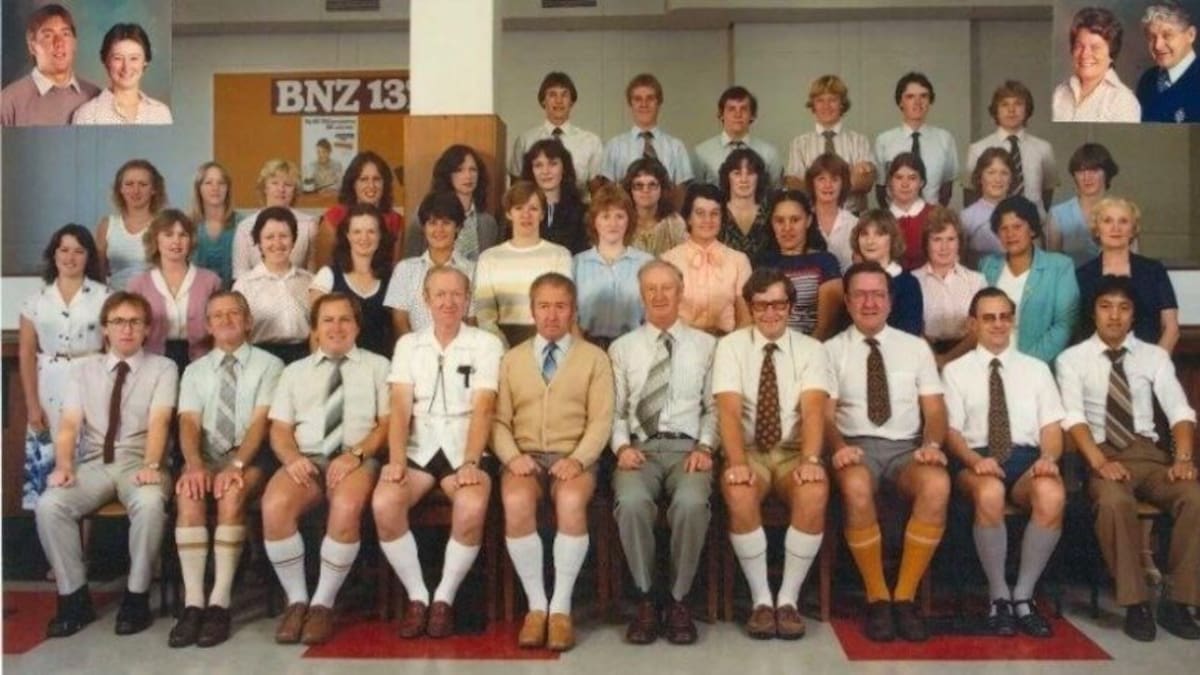
I fell down a rabbit hole, a deep dive into the Papers Past newspaper archive and a treasure trove of slightly tapered walk shorts for (I am not making this up):
“Yes-men. Men who say ‘yes’ to virile fashion. Husky, insolent, stubborn … mixable matchables by Canterbury. Barefaced buddies in candid colours. Devil-may-care wear. For men. Like you. Yes!”
At first, I thought the copywriter had misspelt “viral”. Then I realised the advertisement was from 1966 when the only thing ad men were rapidly circulating was themselves.
Is it getting hot in here?
Consider styling your circa 1969 bri-nylon shirt with “McGregor Scotset permanent press walk shorts in the new spectrum colours – waterhole blue, curry, lava, saffron, rhubarb, blazer blue, lobster, green, parchment, white and navy”.
(Seriously, is it getting hot in here? Or are you just a 56-year-old woman who hasn’t worn nylon, bri or otherwise, since her oestrogen levels fell off a cliff alongside the energy required to shave her legs, fake tan her legs and put those legs in a pair of shorts – assuming she can find a pair of shorts with a hemline that hangs lower than the front pockets).
In 1970, Hardy Amies, a Savile Row fashion designer and official dressmaker to Queen Elizabeth II, visited Christchurch. He told a local reporter that if the weather was hot, then “by all means” men should wear shorts to work.
“Shorts would certainly be out of place in London on white-legged, knobbly-kneed men, but here your men are sturdy and athletic,” he said.
The Antipodean knee had, of course, already been freed.
In the late 1950s, the Public Service Association had lobbied the State Services Commission into walk-short submission.
“Where staff wish to wear shorts they may have the choice of one colour in white, grey or fawn,” it decreed.
The decision was, reported the PSA, the thin end of a wedge – tartan and check, polyester and corduroy, combined with everything from suit jackets to long socks and roman sandals, became a standard uniform for the male public servant. By 1969, the Lane clothing factories in Taupō and Tokoroa were sewing 550 pairs of men’s walk shorts a day.
Walk-shorted staff from the BNZ’s Mt Roskill branch, photographed in January 1969. Photo / BNZ Archive
Step out in style. Crease-resistant and washable. Available now in crimplene, polyester and seersucker fabrics. Hundreds of column centimetres were devoted to the sale of work (and walk) shorts for men.
“Why I hate Kiwi walk shorts,” complained a columnist in 1988, urging women who were “window shopping for blokes” to wait until summer before committing because “some of the most stylish men can, without warning, suddenly emerge as closet walk short wearers”.
It is not, by the way, getting hot in here. Conditions in the modern air-conditioned office are Arctic and at this point in January, a crochet knee blanket would be more useful than any items of clothing that finish at the knee.
Should you wear shorts to work?
In my office, this question was asked and answered on my first day back. Is it even January if the sports editor doesn’t hit the office looking like he’s just come in from mowing a lawn? (This is not a euphemism.) Is it even 2025 if the fashion writer isn’t working on a story suggesting that, when the sun shines, you should wear more clothes? (The only people with a greater hate of UV rays are dermatologists.)
I asked my colleague (27) why he was wearing shorts (belted, knee-length, charcoal drill) and he replied: “Because it’s summer.” I couldn’t disagree.
Kim Knight joined the New Zealand Herald in 2016 and is a senior journalist on its lifestyle desk.