
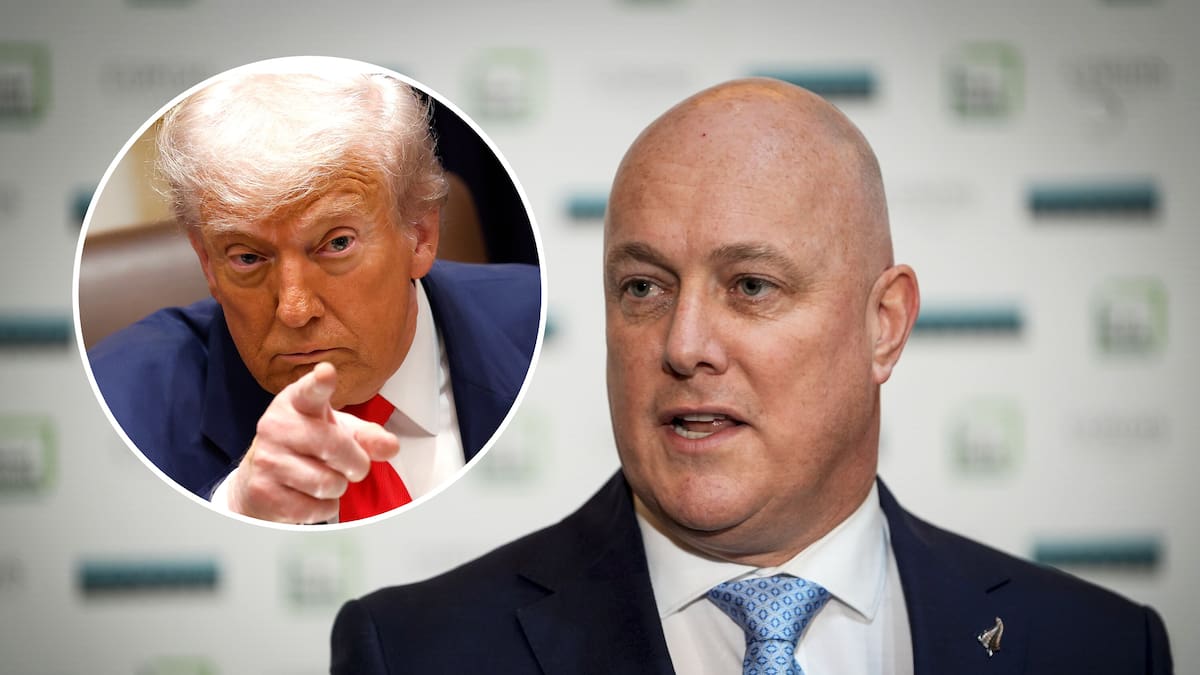
He demanded Canada and Mexico renegotiate the North American Free Trade Agreement, withdrew from the Paris Agreement on climate change and was always lukewarm about Nato and even Five Eyes.
In his second term, Trump’s “Liberation Day” tariffs destroyed any semblance of trade rules being governed by the WTO system. The US boycott of the UN’s latest climate change summit surely spells the end of the Paris Agreement. This week’s events in Venezuela and subsequent threats against others merely extend Trump’s approach to international relations to military interventions.
Liberal institutionalism is undoubtedly the best system for New Zealand, small countries and the world as a whole, but we delude ourselves if we think its authority existed independently from the reality of US military and economic might.
However desirable any temporary veneer that lies over the top, the international system is always the product of anarchy and raw power, limited only by the physical barriers of water and mountain ranges and, more recently, by the logic of mutually assured nuclear destruction.
US presidents since Harry Truman have known this but have usually calculated the value of a rules-based system to the US and the world exceeded the costs of compliance on specific issues.
Even when President George W. Bush decided to invade Iraq in 2003, he at least felt obligated to send his Secretary of State Colin Powell to the UN to go through the motions of making a case. Trump sees that as unbecoming of a superpower.
The Venezuela intervention was as good as foreshadowed in Trump’s National Security Strategy (NSS) published in November. It explicitly declared a return to the Monroe Doctrine of 1823, which demanded Europe and other powers keep out of and allow US dominance over its sphere of influence in North and South America while implying the US would not become involved in geopolitics in Europe, Asia and Africa.
To the Monroe Doctrine, the NSS introduced a new “Trump Corollary” that the US would intervene to protect itself from illegal immigrants and drugs and to “deny non-hemispheric competitors the ability to position forces or other threatening capabilities, or to own or control strategically vital assets, in our hemisphere”.
That’s all bad news for Mexican and South American drug cartels and regimes connected to Russia, China, Iran and, apparently, Denmark. But it isn’t much better for countries or territories outside the western hemisphere that think they have a US security guarantee: most obviously Ukraine and Taiwan, but also Latvia and the rest of Nato, Japan, South Korea, the Philippines and Australia.
To the extent New Zealand has an implicit American security guarantee through our military alliance with Australia and Five Eyes, it is now as worthless as any other international agreement involving the US.
Moreover, the return of the Monroe Doctrine implies the US no longer much cares what other great powers might get up to in Southeast Asia, Australasia and the South Pacific.
If the US, China and Russia aren’t going to follow or enforce international law, then there’s no such thing as international law.
Luxon has not yet commented on this week’s events, leaving Peters to issue the obligatory statement calling on “all parties” – none of which he named – “to act in accordance with international law”.
Fair enough. There’s no point New Zealand distinguishing itself from the pack and risking higher beef tariffs or other US retaliation. Nor should Peters unilaterally rewrite New Zealand’s standard talking points while the Prime Minister remains on holiday. But we should not mistake them for reality.
In the new realist world, by far New Zealand’s greatest assets are the stopping power of water and assured food security. Physical invasion and occupation of New Zealand would stretch the capability even of the US, whose Venezuela operation suggests it has learned its lesson in Iraq and Afghanistan. China rightly respects the 160km Taiwan Strait as a barrier to forcefully resuming its exercise of sovereignty over the island. Russia has no history of projecting naval power. If a global conflagration threatened international trade, we’d be more at risk of getting fat than of starving.
In a world divided into spheres of influence rather than governed by global rules, protecting our moat should be our main strategic goal. It calls for much greater independent defence capability to surveil it, for an even closer defence relationship with Australia and our friends in the Association of Southeast Asian Nations (Asean), and for keeping great powers out of the South Pacific, whatever the cost.
In reality, New Zealand could only ever be threatened if Australia had already fallen, which argues for its defence – as is the case now – being an overwhelming priority. Moreover, if we can no longer depend on the integrity of the WTO or any other trade deal, unrestricted access to Australia for goods, services, investment and residency becomes even more important, while extending such access as far as possible through the Asean region.
New Zealand and Australia then need to pay whatever it costs to keep great powers, including China but also Trump’s US, out of the South Pacific. The Lowy Institute suggests China invested about $8.3 billion in the South Pacific between 2008 and 2023 and the US some $6.6b. Australia and New Zealand will need to increase their investments from the $36.6b and $7.3b, respectively, over the same period to match and exceed that offered by the great powers, conditional on South Pacific states agreeing to deny them further influence and infrastructure beachheads in the region.
It sounds a lot but is worth about half the cost of the four-year tax policy Luxon took to the 2023 election, which the Government is continuing to borrow for.
At the same time as prioritising Australia and Asean for our trade relationship, true diversification from China and the US must be pursued, even if it doesn’t make financial sense in the short term.
Luxon’s personal foreign policy, defence and trade priorities aren’t too far off this outline. When he returns to work, top of his list needs to be articulating how they fit together to prepare us for the post-rules era.
Matthew Hooton has over 30 years’ experience in political and corporate communications and strategy for clients in Australasia, Asia, Europe and North America, including the National and Act parties and the Mayor of Auckland.
Stay ahead with the latest market moves, corporate updates, and economic insights by subscribing to our Business newsletter – your essential weekly round-up of all the business news you need.