
Concluding our series on Kiwis with a passion for older cars, Andrew Kerr talks to an owner who can’t drive his beloved Morris Marina, and seeks the verdict of an Alfa Romeo-owning architect. To read Part I, go here.
The Sporty Number
1972 Morris Marina TC
Coupé
Gordon Georgel might never have considered buying a Marina had his father Allan not sold them for a Morris dealership in the 1970s. Allan Georgel’s years in the Invercargill car trade led his son to become a serial buyer of what some regard as one of the 10 worst cars of all time. Most damning were the larrikin presenters of TV car show Top Gear, who heartlessly destroyed them for fun.
Hats off to Gordon Georgel for helping reverse the Morris Marina’s route to extinction by not just buying the things but also carefully restoring them. What makes this scenario even more unlikely is that Georgel, now 62, stopped driving more than 30 years ago and has been completely blind since 1999.
Sharp pricing and sound practicality meant Marinas enjoyed solid popularity throughout New Zealand from the early 1970s. Georgel, who still lives in Invercargill, recalls his father’s penchant for adding stripes to cars to lift their appearance when he later became used car manager at Motorcorp (NZMC) Invercargill. That’s where Georgel bought his first Marina – a tidy 11-year-old TC Coupé that the dealership accepted as a trade. “Because it was a year older than what they stocked on the yard, Dad offered it to me,” he recalls.
Think of the Marina Coupé as a lukewarm response to the excellent Ford Capri: a hastily concocted, mediocre version topped with a mild sauce and sprig of parsley. Unmoved by automotive fashion and fuelled by a southern man’s common sense, Georgel ran the tan two-door throughout the glitziest years of the 1980s, although whether that glitz filtered down to the Deep South is debatable.
True colours: Georgel’s Marina has a new coat of Arianca Tan paint. Bottom right, the model’s signature wood-rimmed steering wheel. Photos / Supplied
Fast-forward 40 years and Georgel’s current Marina Mk1 Coupé is virtually identical to the one his dad sourced. GD1398 was also registered in 1972 and sports the same Arianca Tan paint, parchment vinyl interior and wood-rimmed steering wheel. Like all Marina Coupés sold here, it was assembled in Australia.
“A lifelong friend spotted a tidy example at an auction in 2009 and convinced me to buy it. I paid 10% more than my self-imposed limit. But it was a genuine one-lady-owner car that had always resided at a house on the Mt Wellington Highway in Auckland. And it was delivered new in August 1972, the same month Dad began selling new Marinas.”
Being a TC variant means the 1748cc E-series engine has twin carburettors and is good for 67kW (90hp). What’s more, those oversized rear side windows (a result of the coupé having regular-sized doors rather than longer, bespoke doors) have stainless trim and they open out. On lesser versions, they are fixed.
Before losing his sight as a consequence of multiple sclerosis, Georgel worked in automotive parts sales throughout the 1980s and 90s. He says he knows his way around the cars despite not having formal mechanical training, and his fingers are more than adept at fault-finding and fixing.
When it comes to discussing Marinas, Georgel initially plays it quite cool, expressing moderate enthusiasm as he plumbs a deep well of knowledge. But after some hours on the phone, it’s clear his interest is not prone to fatigue.
“The centenary of the Morris marque in 2013 gave me the impetus to restore the coupé over a 10-month period. I stripped it down by myself and stored the parts in various bins, cupboards and wardrobes throughout my workshop, garage and home. Only the running gear and dash were left in. I sent the body off to a panelbeater from the old school – a true master of his craft. Then it went to the painter to receive a fresh coat of Arianca Tan.
“My first Marina Coupé died about 30 years ago and that became a donor car to a small extent. It had been repainted red when I found it at the local wreckers. I managed to salvage strips of stainless-steel window trim and its TC badging.”
Even though he had to give up driving, Georgel says he still appreciates a Marina that will round a bend when pointed at one, so he went to great lengths to improve the ride and handling of his coupé. “I admit that the ride around town is now a little harsh with my suspension upgrades but they do transform the car on the open road.”
Friends helped him complete the project on the eve of his 50th birthday, and guide dog Maddox appeared as relieved as anyone when the car was finished. Restoration costs had spiralled, as they invariably do; Georgel reckons the car owes him about $20,000.
Emotional attachment: Gordon Georgel and guide dog Maddox. Photo / Supplied
Work is never done
In the 16 years of Georgel’s ownership, the Marina has travelled only 6000km – all in the hands of other drivers. A few things remain on the to-do list: “I’m currently reconditioning the front brake callipers and need to fit a new seal kit to the brake master cylinder. Oh, and I want to make an adjustment to the front left suspension. Other than that, I just need to sort out a stone chip beside a headlight and make a repair to the front carpet.”
Further evidence of Georgel’s skill in dismantling a car can be found in his workshop, where a Marina 575 pickup awaits reassembly. Its gleaming body has recently returned from the paint shop. This Marina carries even more of an emotional attachment as it was a car his late father sold new in 1980, soon after he transferred to Motorcorp following the decline of Morris dealer Watts & Grieve. Georgel got wind of the pickup in Winton 10 years ago and has owned it for nine. He expects to have it back on the road this year.
Better than new
His mates are serious when they insist Georgel’s Marinas will be better assembled than many of the cars that rolled out of Morris factories. Mint examples are now scarce and unlikely to form the butts of jokes outside of Jeremy Clarkson’s circle. In fact, Georgel relates how his coupé attracted the attention of two young women at a car show in Riverton: “I was sitting in the TC and I heard one girl ask another if she knew what my car was. The friend replied that she thought it was a Ford Capri. I thought, ‘Yes, that’s a win!’”
Ever the realist, our winner willingly cites the Marina’s many shortcomings, suggesting a poor reputation is justified. “Marinas simply don’t handle well and the coupés are possibly even more agricultural. They are brilliant for demonstrating prodigious understeer. And Dad advised me to pack bags of river sand at each corner behind the tail lights to settle the rear. Also, the gearshift lacks definition and the throw from first to second is painfully slow.”
B’ute: Georgel’s Marina 575 pickup, sold new by his father in 1980, is now back in the family. Photo / Supplied
On a brighter note, he describes the rack and pinion steering as “quite positive”, but promptly qualifies the compliment: “It’s positive, but it can’t cure all that understeer.”
After learning that Georgel pulled a rotten Marina out of a paddock in 2020 (“I paid a Southland farmer $40 and that gave me the coupé treble”), I took a very deep breath before enquiring whether anything else was on his wish list. “I did get a little excited by news of a six-cylinder Marina in Temuka some years back,” he admits, “but it just vanished when I started making enquiries.” Probably just as well – Georgel has plenty on his plate with the pickup reassembly and says he doesn’t have the space or funds for another large project. Plus, his MS means his mobility continues to decline.
Could he ever part with his coupé? “If I could achieve five figures, I would certainly consider selling it. It’s outside under a car cover while the pickup parts are spread throughout the workshop and garage.”
There is one thing he would like to tweak regarding the Marina’s backstory. “If there’s one small regret, it’s that I didn’t make more of an effort to track down my coupé’s original owner, especially after I restored the car. I’ve since learnt that Mrs Greenhalgh lived until the age of 97. I think she would have liked to know that her Marina has been given a new lease on life by a blind car nut.”
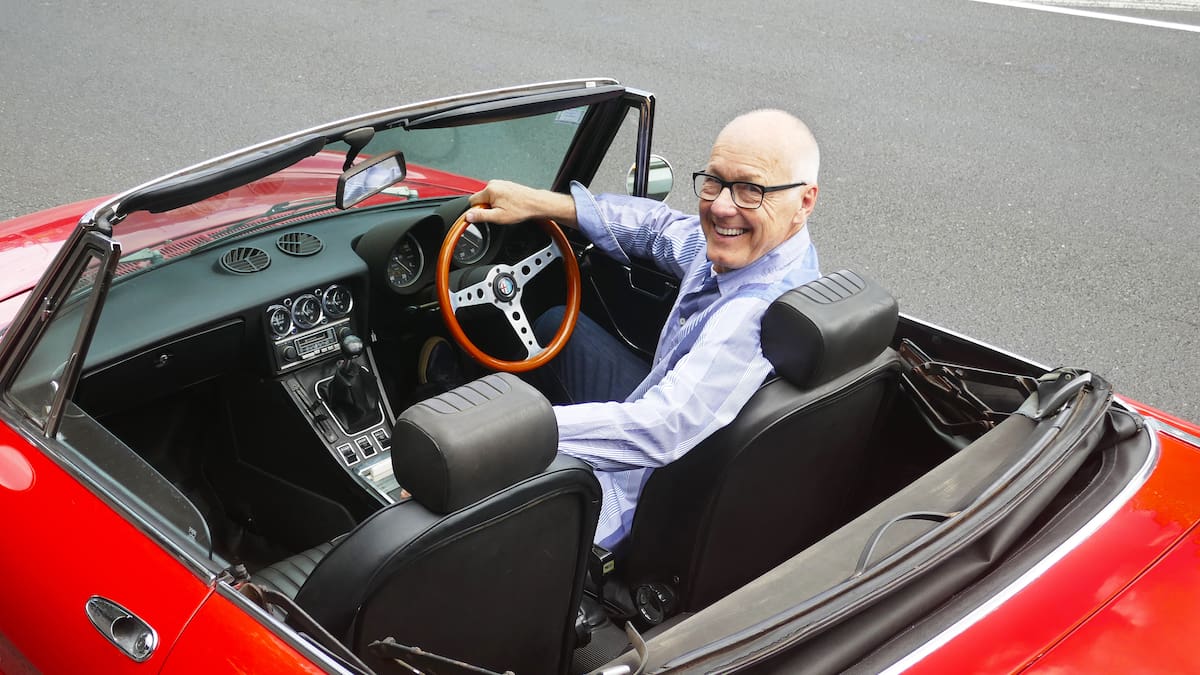
Ken Crosson has owned his 1973 Alfa Romeo Spider for about 25 years. Photo / Andrew Kerr
The design perspective
Architect Ken Crosson runs a trained eye over our selection of ‘classic’ cars.
Ken Crosson is a lauded architect and creative director at Auckland’s Crosson Architects. He may also be a familiar face to viewers of the 2016 TVNZ documentary series The New Zealand Home and, more recently, New Zealand’s Best Homes with Phil Spencer. Despite his commitments, he is very obliging when it comes to squeezing in a car chat.
It’s no secret that his stable boasts several modes of Italian transport, from a Vespa to an open-air Maserati. In summer, you might also spot him peddling his 1973 Alfa Romeo Spider, designed by legendary design company Pininfarina. What does he make of the Morris Marina?
“You know, I respect the coupé’s quirkiness and character. There’s a certain thriftiness in the design and they look to have made good use of standard parts. It’s slightly elongated and a bit bulgy. A mother could love it.”
Enough said. And the Vauxhall Chevette sedan featured here – is it an aesthetically pleasing solution?
“Well, the shape is not very engaging from the side but I do like the chiselled front end. It expresses lots of character, especially with those distinctive, deeply indented headlights. And the lack of grille makes it look like a precursor to modern EV design.”
Crosson has previously owned a 1980s BMW 3-series, a straight-six version with manual gearshift – “There’s only one way.” So he must be a fan? “I was seduced by the German engineering, the performance and the refinement of what is now a compact classic. I guess I went along for the ride. My ownership was satisfying but short-lived. I actually find the design quite sedate and soon yearned for something quirkier.”
As for the Kingswood – the quintessential Aussie family car of the 1970s – he gives it a thumbs-up. “I just love it and [the 1982 ute featured in Joy ride Mark I] is not pretending to be anything other than a utility. It’s raw and it’s honest. Perhaps the ute’s overall design is a bit unbalanced but I like the formality up front with the big grille and headlights. It’s kind of American in that respect.”
The Kingswood nameplate rekindles memories of Crosson’s childhood on a farm outside Methven with Mt Hutt as a backdrop. “A 1972 Holden Kingswood wagon was our family car. I was one of six kids crammed in the bench seats and I remember the advert describing the HQ as ‘the most changed Holden in the history of Holden’. We then had a Premier wagon with the same nose treatment as George [Evangelidakis]’s ute.”
Despite the fond memories, it’s safe to say none of the quartet of cars we’ve featured would make a Crosson wish list. He seems intent on steering the conversation back to Alfas. Not new ones, though, because he doesn’t buy new cars and is not interested in SUVs.
His 50-year-old Spider instantly appeals as a classy Italian classic for a fraction of Ferrari money, a fun plaything with nice patina. It’s a Series 2 “Coda Tronca” or Kamm tail, with a cut-off rear. With rear-drive and a two-litre twin-cam, it could be a frisky charge, no?
“I’ve owned it for about 25 years and, for many of them, it was perfect. But I don’t drive it a lot and it’s been a bit of a mixed bag lately. There are compensations, of course, especially the design, which exudes a simple elegance with some curves. There’s a pleasing softness to it.
“Good automotive design,” he concludes, “is where art meets engineering, meaning a car is fit for purpose, performs well and looks good. I prefer Italian cars for their flamboyance and dynamism.”
Andrew Kerr is an Auckland-based motoring writer, photographer and road safety advocate.
SaveShare this article
Reminder, this is a Premium article and requires a subscription to read.
Copy LinkEmailFacebookTwitter/XLinkedInReddit