
He has appealed unsuccessfully to the High Court to get his sentence reduced, arguing partly that the judge should have given him more consideration for his personal background.
High Court Justice Dani Gardiner disagreed, saying a jail term of two years and three months on a charge of injuring with intent to injure was not “manifestly excessive”.
Khoshaba is in his early 30s and his chequered history is outlined in legal decisions from the New Zealand High Court and the Australian Review Tribunal, which finally determined he should not be allowed to stay in Australia.
The Australian tribunal decided to uphold the decision to cancel his visa under “character grounds” in section 501 of Australia’s Migration Act.
That section has been used to deport thousands of New Zealand citizens back across the Tasman, even when they have little or no real connection to the country that issued their passports.
Khoshaba refugee from Iraq
Khoshaba was born in Iraq during the Gulf War and spent two years in a Jordanian refugee camp as a young child.
His family resettled in New Zealand in 1997 but he subsequently told the Australian tribunal he did not fit in and was subjected to bullying and racism at school.
The High Court at Auckland dismissed Rami Khoshaba’s appeal. Photo / Jason Oxenham
Khoshaba lived in New Zealand for about eight years as a child.
In 2005, at the age of 13, he moved to Melbourne, where he found friends among other youths who had come from the Middle East.
“Rami was so happy there were people like us around,” his sister later told the Australian tribunal. “It was really nice compared to … New Zealand where we felt like outsiders.”
But his friendships also led him into crime. His sister said the “boisterous activity” of his negative peers slowly turned into testing the law.
Evidence before the New Zealand courts showed this led to Khoshaba’s involvement in substance abuse, gambling and petty crime.
He became addicted and his offending continued to escalate.
The only jobs Khoshaba had in Australia seemed to be in fast food outlets when he was still a teenager.
He indulged in what the Australian tribunal called a “pattern of increasingly serious conduct over approximately a decade”, including dishonesty, drugs and firearms offences and ultimately armed robbery.
The only period of respite came when Khoshaba was aged between 18 and 21 and the family had moved to Canada to get away from his bad influences.
He worked there in a family business and reportedly was law-abiding and drug-free.
But he relapsed into methamphetamine use and was in trouble with the law again within three months of his return to Australia.
In 2016, he was imprisoned for four years for armed robbery and attempted armed robbery, and was then sent to a detention centre pending his deportation.
The Australian tribunal found against Khoshaba in 2020. He was soon back in New Zealand, where he had no family and was isolated and unsupported.
He was also missing the young daughter he had with an Australian woman and who had been born while he was in prison.
In 2021, he recorded his first New Zealand convictions.
Dispute over parked vehicle
The date of Khoshaba’s latest offending is not disclosed in the High Court at Auckland decision confirming his sentence.
But the decision said the victim was a construction worker on a building site close to where Khoshaba lived.
The victim’s colleague had parked a vehicle on the footpath outside the building site, which Khoshaba became agitated about.
Khoshaba and the victim argued about the vehicle for a few minutes.
Shortly afterwards, the victim saw Khoshaba approaching him and they got into an argument, which escalated to the two men throwing punches at each other.
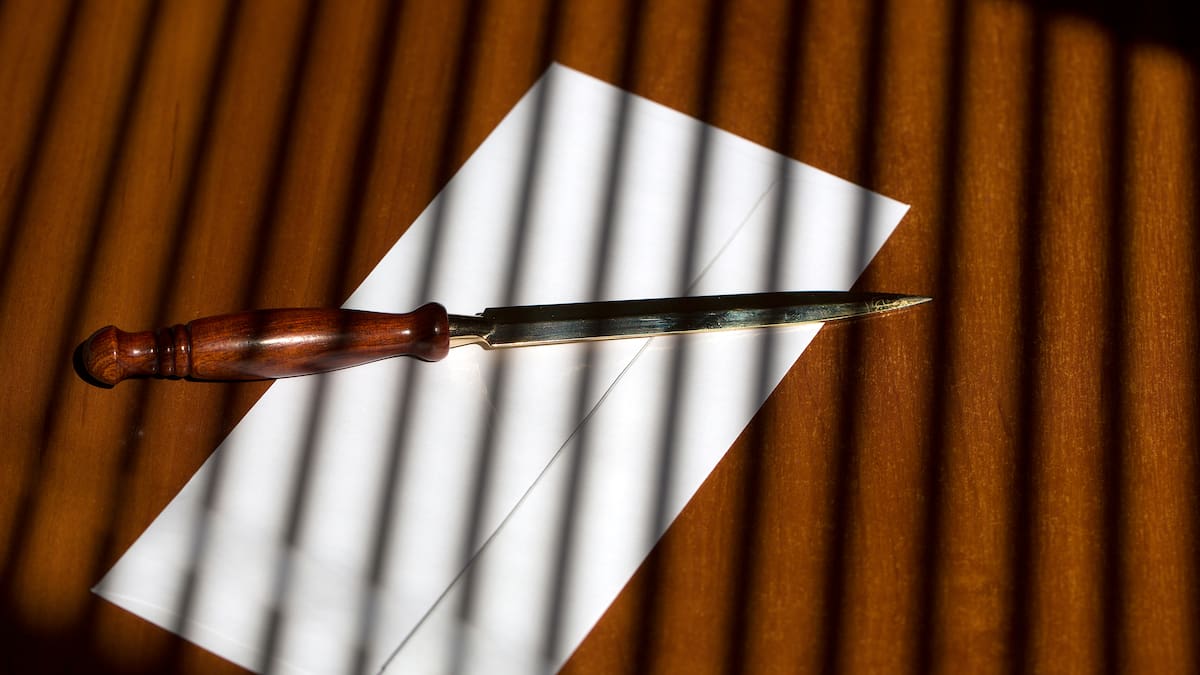
Khoshaba then swung at the man with a sharp object, a letter opener, causing an 8cm cut on his cheek that required seven stitches.
On October 25 last year, District Court Judge Edwin Paul sentenced Khoshaba to two years and three months in prison on a charge of injuring with intent to injure.
Khoshaba appeals sentence
Khoshaba appealed his sentence to the High Court on the grounds the judge had allowed him insufficient reductions for his personal background and rehabilitation.
His lawyer submitted that in another case a 15% sentence discount had been allowed for a refugee background and meth addiction, whereas Khoshaba received 10%.
The Crown, however, said the judge had fairly determined there was no causative link between Khoshaba’s refugee background and his offending.
Khoshaba also sought a 10% discount for rehabilitation efforts and remorse, rather than 5%, saying he had attended programmes and abstained from drugs.
However, the Crown said he had not attended restorative justice but merely expressed a willingness to do so. Nor did he make an emotional harm payment.
Justice Gardiner said she saw no error in the sentencing judge’s approach of assessing Khoshaba’s personal background and addiction “as justifying a discount at the lower end of the available range”.
She said Khoshaba received an overall discount of almost 40% for all factors and his end sentence “cannot be regarded as manifestly excessive”.
She dismissed the appeal.
Ric Stevens spent many years working for the former New Zealand Press Association news agency, including as a political reporter at Parliament, before holding senior positions at various daily newspapers. He joined NZME’s Open Justice team in 2022 and is based in Hawke’s Bay. His writing in the crime and justice sphere is informed by four years of frontline experience as a probation officer.