
Japan banned the production and use of asbestos in 2006, but new health cases caused by the carcinogen continue to emerge while problems remain over compensation and buildings containing the hazardous material.
Symptoms of health damage caused by asbestos can appear dozens of years after exposure.
And studies are needed before buildings can be torn down to prevent asbestos from being dispersed into the surrounding area.
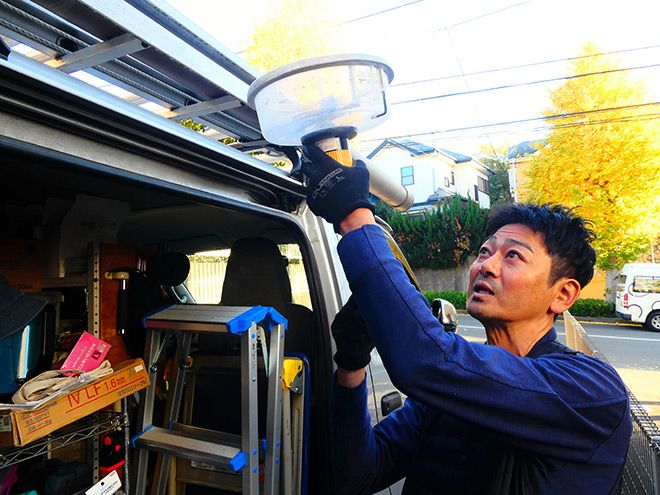
Yoshimasa Negishi may be a double victim.
The 53-year-old resident of Machida, western Tokyo, started feeling ill in early 2022. Later that year, he suddenly felt like he was suffocating while climbing a ladder to install electrical equipment.
Negishi, who had trained at a sport science university, consulted an internal medicine clinic nearby, where X-rays showed one of his lungs was white.
More detailed testing at a hospital in March that year found mesothelioma of the right lung. He said a doctor told him that asbestos was the only conceivable cause.
Negishi realized the origin of the illness.
A university graduate, Negishi began working full time as an air conditioner installer in 2008.
He used drills to cut plasterboards, heated insulators and sand-coated walls to install air conditioners on store ceilings and household walls. Dust would swirl around his face.
Negishi, however, wore no masks or goggles, even though the dust may have contained asbestos, he said.
He was treated with anticancer agents before undergoing surgery in August 2022.
Negishi consulted the support group Japan Association of Mesothelioma and Asbestos-Related Disease Victims and Their Families and had his disease officially recognized as work-related in August 2023.
He continues to work as a self-employed electrician on the sidelines of his treatment. He also took a short-term certification course in 2023 to work on and conduct advance surveys on asbestos.
Negishi knows firsthand that the long incubation periods mean the danger of asbestos is seldom perceived the moment it is inhaled.
“I want workers to guard themselves, without fail, against asbestos,” he said.
STILL IN THOUSANDS OF BUILDINGS
Asbestos was used as a cheap fireproof and heat-retaining building material.
An infrastructure ministry survey showed that asbestos was likely used in about 260,000 private-sector buildings with a floor area of 1,000 square meters or more built between 1956 and 1989 and still standing as of March 2024.
Demolition or repairs for such buildings are expected to peak in the coming years.
Under regulations amended in 2020, buildings facing demolition or repairs must first undergo advance asbestos surveys by qualified persons.
That requirement, which started in 2023, will also cover “structures” other than buildings, such as boilers, from January 2026.
Some buildings have already been torn down without undergoing the survey, meaning that asbestos released during the work could be causing new health problems.
Following a 2021 Supreme Court decision on asbestos damage, the government set up a fund to pay benefits to sufferers.
The benefits, however, are provided only to people who engaged in construction work at certain indoor places no later than Sept. 30, 2004.
Negishi said he is not eligible for the payments.
Manufacturers of building materials have yet to contribute to the fund, and group lawsuits have been filed across Japan to hold asbestos makers to account.
Settlements were reached in cases at the Tokyo High Court and the Osaka High Court in August 2025.
There are moves to seek court-mediated settlements for an early resolution of other disputes.