
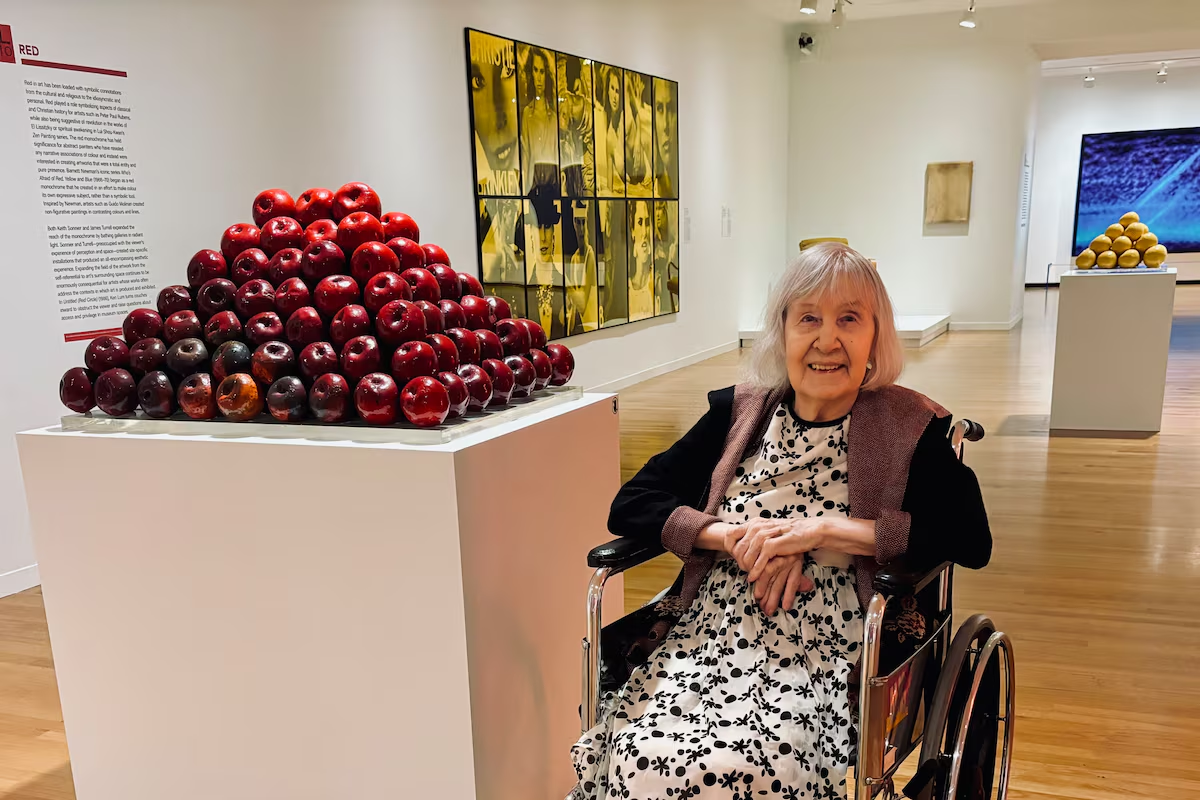
Gathie Falk at the Vancouver Art Gallery.Supplied
Gathie Falk was a tireless innovator, a painter, sculptor, superb colourist, inventive ceramicist and performance artist, who from impoverished beginnings became one of the hardest working and most celebrated artists Vancouver has ever produced.
Her art revealed the miraculous in the commonplace: a slippery fish, a red apple, a watermelon, the night sky full of stars. Over a long lifetime, she remained enthralled by the world’s beauty and strangeness.
Her work was shown in Montreal, Toronto, Ottawa and other cities across Canada, as well as Sydney, London and Paris. Yet Jo-Anne Birnie Danzker, when she curated at the Vancouver Art Gallery in 1985, the first of three career retrospectives Ms. Falk received, wrote in the catalogue: “Certainly an artist of Falk’s stature would have been accorded much greater recognition if she had not continued to live and work on the West Coast.”
Ms. Falk died on Dec. 22 at her East Vancouver home at the age of 97, of a lung infection.
30 Oranges by Gathie Falk in 1968.Equinox Gallery/Photo: Equinox Gallery
While she was a fine painter, she remains most famous for her sculptural work. The vividly coloured pyramids of ceramic apples, grapefruit, oranges, and baskets of strawberries and watermelon wedges that she created in the late 1960s and early 1970s lodge in the viewer’s memory, as do her haunting papier mâché dresses and the mysterious bootcases containing men’s single ceramic shoes.
Her distinctive fruit piles are all now in public or private collections and their value has skyrocketed.
“The Vancouver Art Gallery and the [National Gallery of Canada] have great collections of these,” said Ms. Falk’s long-time dealer Andy Sylvester of the Equinox Gallery. “But should one somehow become available, a small one might be $75,000 and a large one $300,000 today.”
Blue Running Shoes, by Gathie Falk in 1973, made of Earthenware, glaze, wood and paint.Vancouver Art Gallery/Supplied
Agatha (Gathie is the German diminutive) Falk was born Jan. 31, 1928, in Alexander, Man., a sheep station where her German-speaking Mennonite parents, Cornelius and Agatha Falk, had settled when they fled Russia two years earlier with their sons, Gordon and Jack. Cornelius died when Gathie was about nine months old, leaving his young family homeless and destitute.
After his death, the family moved frequently and depended on the charity of relatives and friends. Her mother remarried to a man she knew only from letters. She moved with him to Northern Ontario but he was unkind to her children, and she soon left him, taking her children to Winnipeg, where the boys worked part-time when they could and the family received government relief.
Gathie went to school, where her talent for music was noticed. But she had to drop out at 16 to work in order to pay off Canadian Pacific’s belated bill for the family’s transportation from Russia 18 years earlier.
Her brothers had moved to B.C., then enlisted in the Canadian army. After the war, Gathie and her mother moved closer to them, settling in Chilliwack. Here the teenage Gathie worked at chicken plucking, raspberry picking and waitressing, before finding better paying employment at a suitcase manufacturing plant, sewing pockets. At the same time, she worked with remarkable concentration at finishing high school by correspondence.
Gathie Falk in 1983.Tom Graff/Supplied
She was studying violin and music theory, and practising drawing on her own. The artist in her was struggling to get out. When she realized that she could go no further as a musician, she became anxious and depressed. Her mother and her music teacher jointly decided that she needed a change and should become a schoolteacher. She did not resist, though she had no enthusiasm for their plan.
In 1952, while working at the luggage factory at night, she attended teacher training at Normal School and cleaned houses on weekends. Somehow she found time to join an after-school art club offering art appreciation, life drawing and general encouragement for beginner artists. Here she began to understand the expressive possibilities of form and colour.
Gathie Falk’s The Things in My Head, 2015, at the Equinox Gallery.Equinox Gallery/Supplied
During the 12 years she spent as a teacher, she managed to support herself and her mother while getting a high-quality art education, mostly in the summer during school vacation. She studied drawing, painting and design with local artist Bill West in Victoria; painting and drawing with Jim Macdonald, and art history with Ian McNairn at the University of British Columbia; and sought instruction at the Vancouver School of Art. For a time she studied with an English artist named Roy Oxlade who forbade the use of bright colour.
In 1962, at the World’s Fair in Seattle, she saw the avant-garde works of Jasper Johns, Robert Rauschenberg, as well as of Picasso and other European artists – works that she had till then seen only in reproduction – and they made a deep impression.
Finally, her long apprenticeship was over, and at 37 she was ready to show as an artist. Her first solo show at the Canvas Shack, in 1965, was favourably reviewed by local critics. She also went to Europe for the first time.
Over a three-year period, starting in 1966, while she worked at paintings, she also studied ceramic modelling with Glenn Lewis at UBC. Mr. Lewis had studied with Bernard Leach, the renowned English potter who had brought Japanese techniques to the field; he also taught his students, including Ms. Falk, how to live as artists, without ostentation and waste, making what you could, creating beauty around you.
Gathie Falk, Pieces of Water #10 – El Salvador, 1982, oil on canvas, Purchased with the support of the Women’s Cultural Committee and the Canada Council for the Arts, 1983.Supplied
A key work that Ms. Falk produced between 1966 and ’67, at the bequest of the art dealer Douglas Christmas, was the installation Home Environment. This was a room with pink wallpaper, a pink birdcage with a plucked chicken in it, an acrylic case with two folded men’s jackets, a large ceramic telephone, a soft chair with ceramic fish on the arms and other discomfiting decor. It got her noticed (The Vancouver Art Gallery later bought it.).
She began to work on her ceramic fruit piles, building a gas-powered kiln with her potter friend Charmian Johnson in her garage. But for the next decade or so, until she started work on a commission by the B.C. Central Credit Union on a series of thermal blankets, she was mainly occupied with creating and taking part in Surrealist performance art, with a collective of artists. She did not paint for 12 years, though her three-dimensional work continued.
Gathie Falk in 1991.Jürgen Vogt/Supplied
Performance art lacks the characteristics of narrative theatre; it has no plot or character development. Ms. Falk was aware that most of the people who came to see it believed that the participants were just fooling around, although the performances were planned and rehearsed. Frequently they were staged at the VAG, which was then headed by the visionary Tony Emery, who had studied under Kenneth Clark at Oxford; ideas were changing about what constituted art and he believed that gallerygoers should see the art of their time.
In 1973, a charming con man named Dwight Swanson 20 years her junior, who had heard her on the radio in his jail cell, contacted Ms. Falk and the two began a correspondence. It was a tenet of her Mennonite faith to be compassionate to prisoners, and in 1974 she paid him a visit. When he was paroled later that year, they married.
Mr. Swanson had been in and out of penal institutions since the age of nine or 10, but his crimes till that point had been against property. Mr. Sylvester recalled a conversation that Ms. Falk told him about: “He was out very late and she asked him what he had been doing. He said, ‘The good news is I did not rob a bank.’” He moved out a year later, and they divorced in 1979.
In 1976 and in 1977, she had attended Mr. Swanson’s trials for two separate rapes. He was convicted and received a cumulative sentence of 10 years in prison, and was obliged to attend a sex-offender rehabilitation program. “Emotionally, financially [the marriage] was a disaster. But she got through it. She was tough,” Mr. Sylvester said.
Gathie Falk’s The Problem with Wedding Veils, 2010-11.Equinox Gallery/Supplied
A memorial to her brief marriage is implicit in a poignant sculptural work made in 2011 and titled The Problem with Wedding Veils. It is a stiffened flying white veil weighted with two large rocks.
In 1980, she returned to painting with a series showing the starry night sky, inspired by a trip to Italy where she saw Giotto’s famous star-studded chapel in Padua. She also painted at this time sections of ocean, which she called Pieces of Water. Like Monet, she planted a lush garden and painted it, too. She understood the power of repeating images such as a dozen chairs or 16 potted plants. Tireless, she produced enough new work to have a show every year.
It would be a mistake to call her work Pop Art, said Sarah Milroy, chief curator of the McMichael Gallery of Canadian Art in Kleinburg, Ont. “Pop Art was all about the machine-made, and consumer goods and plastics – it mimicked consumer culture in order to critique it – while Gathie’s art was all about touch and making things by hand, and engaging in creative manual labour,” she said in an interview.
Nor should the work be dismissed as whimsical and fanciful. “It’s true that her work reflects a delight in the visual world. But it’s just as true that it reflects her almost devotional attitude toward labour. To me, her serial sculptures of apples or grapefruits or shoes recall the repetitive work she did as a factory worker in her teens. There was real economic hardship there.”
Ms. Falk’s meticulous attention to detail was evident in the six papier mâché dresses she created in the 1990s, slightly smaller than adult size, that seemed alive, as if they were portraits of the women who might have worn them. Two such dresses were cast in bronze.
The last of her three career retrospectives was held in 2022 at the McMichael Gallery, curated by Ms. Milroy. The recognition that eluded Ms. Falk earlier eventually arrived. She won the Audain Prize for lifetime achievement in the visual arts (2013) and Governor-General’s Award in Visual and Media Arts (2003); she was named to the Order of Canada in 1997, and to the Order of British Columbia five years later.
She was predeceased by her brothers, Jack and Gordon Falk, and a nephew, Bob Falk. She leaves her nieces, Susan Falk, Carole Moore, Rachel Falk; and nephew Rick Nelson.
You can find more obituaries from The Globe and Mail here.
To submit a memory about someone we have recently profiled on the Obituaries page, e-mail us at obit@globeandmail.com.