
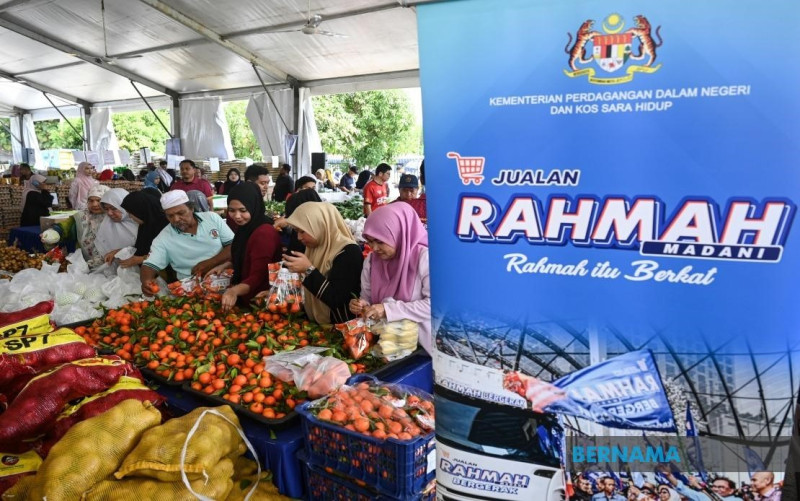
THE implementation of MADANI Sales three times a month in each state constituency in and around Kuala Lumpur has drawn strong positive attention from academics and policy observers, who view the initiative as a meaningful effort by the government to reduce the cost-of-living burden faced by urban households.
At its core, the programme is seen as a targeted intervention to help households manage daily expenses while reducing reliance on short-term debt, particularly among low- and middle-income earners.
Its regular frequency is also being interpreted as a sign of policy consistency rather than a one-off or seasonal measure.
Senior Lecturer at the Faculty of Management and Business, Universiti Teknologi MARA (UiTM), Dr Nurul Syifaa Mohd Shakil, said the initiative aligns closely with the values underpinning the MADANI framework.
“From a policy perspective, MADANI Sales is aligned with the principle of compassion under the MADANI framework and helps support the income of the B40 and M40 groups in urban areas.
“The frequency of three times a month reflects the government’s ongoing commitment, rather than a seasonal intervention. From the people’s economic standpoint, it reduces pressure on disposable income and dependence on short-term debt,” she said.
Dr Nurul Syifaa added that the programme could also generate positive spillover effects for small and medium-sized enterprises if they are directly involved in its implementation.
However, she cautioned that excessively low pricing could pose challenges to traders’ profit margins.
Political and social media analyst Associate Professor Dr Sara Chinnasamy described MADANI Sales as one of the government’s most impactful initiatives with immediate benefits for the public.
“I believe MADANI Sales provides significant benefits to the people and helps reduce the burden of the rising cost of living. So far, more than five million Malaysians have benefited. Holding it three times a month clearly demonstrates the MADANI Government’s commitment and serious attention to the welfare of the people,” she said.
Meanwhile, Senior Lecturer at the Department of Economics and Finance, Faculty of Business Management, UiTM, Dr Chong Siew Huay, noted that the initiative could deliver longer-term benefits if implemented consistently.
“In the long run, MADANI Sales can reduce cost-of-living pressures by ensuring that the prices of essential goods remain more controlled.
“At the same time, it encourages urban consumers to plan their spending more effectively without being overly affected by price increases, regardless of racial background,” she said.
Overall, observers agree that MADANI Sales offers not only immediate relief to consumers but also the potential to strengthen the local economy by supporting community-level commerce.
Although the programme operates as a subsidised intervention, there is growing public hope that it can be expanded and sustained to ensure broader and more lasting benefits in line with the aspirations of the MADANI vision. – January 11, 2026