
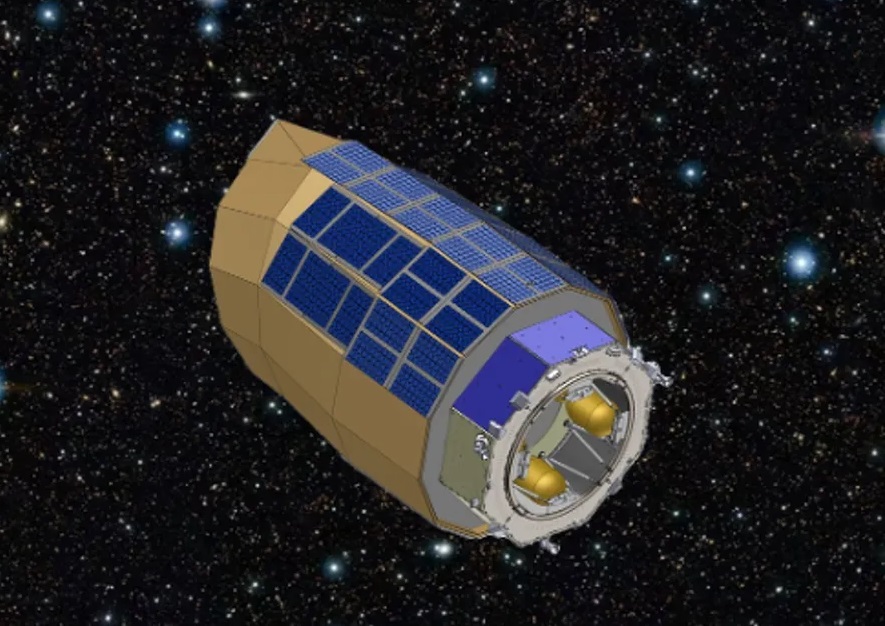
A privately funded space telescope larger than Hubble could reach orbit before the end of the decade. The Lazuli Space Observatory was announced on 9 January 2026 at a special session of the American Astronomical Society’s winter meeting.
Lazuli’s Design and Scientific Capabilities
Lazuli is designed to be the first full-scale private space telescope. One of its oustanding feature is a three-meter mirror that is larger than that of NASA’s iconic Hubble Space Telescope. The telescope will carry three main instruments: a planet-finding coronagraph, a high-resolution wide-field camera, and a light-splitting spectrograph. Together, these instruments will study the atmospheres of distant worlds and analyse the light from exploding stars. They will also help address major cosmological questions, such as the nature of dark energy. Lazuli is designed to be highly agile and will be able to quickly reorient itself to observe sudden and transient events across the cosmos.
Private Funding Enters Large-Scale Astronomy
The telescope will cost several hundred million dollars. The project is backed bySchmidt Sciences, the philanthropic organisation founded by Wendy Schmidt and former Google CEO Eric Schmidt. If successful, it could open a new chapter for astronomy, bringing private funding into a domain long dominated by government agencies.
‘For 20 years, Eric and I have pursued philanthropy to seek new frontiers. With the Schmidt Observatory System (which includes Lazuli), we’re enabling multiple approaches to understanding the vast universe where we find ourselves stewards of a living planet, said Wendy Schmidt in a statement.
The Schmidt Observatory System
Notably, Lazuli is one of several major efforts within the group of projects ‘Schmidt Observatory System’. Unlike Lazuli, the other initiatives are ground-based and share a modular design that relies on hundreds of small, relatively low-cost components to form much larger and more powerful observing systems.
One of these, the Deep Synoptic Array, will study the sky at radio wavelengths. Another, Argus Array, will operate in visible light. A third, smaller but scalable array will focus on collecting spectra from targets such as exoplanets and supernovae. According to Feldman, the aim is for all of these projects to be producing scientific results by 2029.
Federal Funding Challenges in the Background
The Schmidt Sciences team says that its projects were not launched in direct response to the current uncertainty around federal science funding, though the situation has been difficult to overlook.
‘I’d like to think we would be operating at this scale regardless, but the current situation certainly makes us take our mandate much more seriously,’ commented Arpita Roy, director of astrophysics and space for Schmidt Sciences.
Published by Space Enthusiast
An amateur rocket enthusiast with a keen interest in all space-related activity. Looking forward to the day when the UK starts launching rockets into space and I’m able to watch launches (from a safe distance of course).