
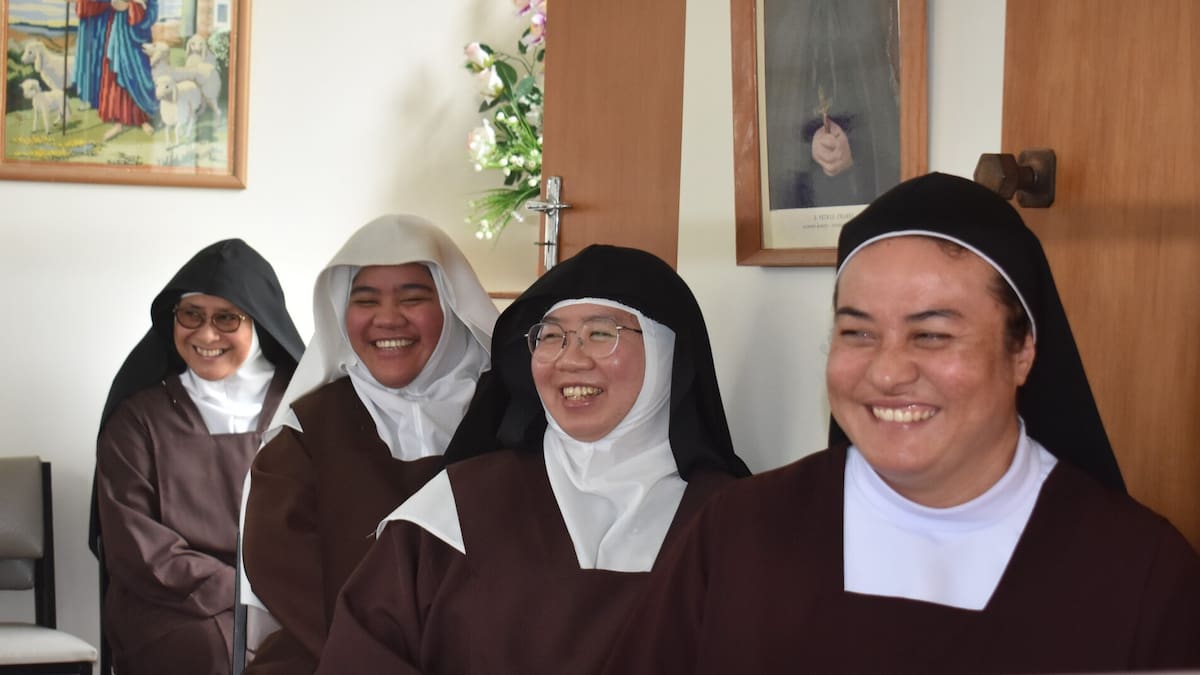
“The grilles are put there to safeguard our life of prayer,” one of the nuns, Sister Francis, explains. “We don’t need information from the outside.”
It’s not long before the nuns are ribbing this reporter about the Herald being good only for fish-and-chip wrapping. Their preferred source of news is Pope Leo’s daily Vatican News Service.
While they practise long, daily periods of silence, the women also love a laugh, and there’s no shortage of amusement as the nuns open up about their fascinating lives and tolerate this reporter asking about their feet – for a good reason.
Discalced means “without shoes”, because going shoeless or wearing only rope sandals was, until 1975, a sign of solidarity with the poor. “You don’t have to go without shoes to be discalced these days,” Sister Johanna explains.
The shoeless policy has been modernised, but ancient traditions – dating back to 16th-century St Teresa of Avila – remain. The nuns rise at 5.20am, recite the Angelus prayer, have morning prayers at 7am, Holy Mass from 7.30, breakfast, work, spiritual readings, Angelus again at 12pm, lunch, a siesta, spiritual readings at 2.30pm, evening prayers, Angelus again at 6pm, supper, recreation, then night prayers.
In between it all, they bake and sell communion wafer-bread and do what they can to help the poor, whether it’s visiting sick nuns, preparing food parcels for the needy or, again, praying. There’s a lot of Latin, and much research and referencing of saints.
The internet isn’t forbidden. “I’m on the internet all the time, doing the finances,” Sister Mariam says, though computers are mostly intended for designing cards, leaflets and Order of Service handouts.
Nuns at the Discalced Carmelite Monastery in Mt Albert include (from left) Sisters Maria Nive, Marie, Marie Ange and Johanna. Photo / Michael Botur
They don’t do social media. Instead, communications with the outside world tend to be centralised, with nuns giving their messages to a senior sister to send out. Even Facebook Messenger is sometimes allowed.
While male relatives can visit, contact with men is limited. Sisters generally do not speak to visiting tradesmen alone. When visiting the doctor or dentist, a female is preferred. They don’t wear jewellery or makeup, though wearing a habit and a crucifix are essential.
The nuns don’t eat meat as a rule but it is allowed when necessary for health. They fast (one meal plus two snacks a day) from the feast of the Exaltation of the Holy Cross (September 14) until Easter. The nuns take turns to cook, and help tend the gardens where they grow avocados, bananas, herbs, pumpkin and taro.
The only sign of alcohol is Whiskey, one of two visiting stray cats. . “They’ve found their calling,” Sister Johanna laughs.
There are recreation sessions every day (dishes, knitting, crochet, sewing, conversation, and occasionally bowling).
The newest nun-to-be is postulant Stephanie Saavedra, 33, who is in a six-to-12-month probationary stage. The process of becoming a Discalced Carmelite nun (called “Formation”) is anything between nine and 12 years, including one to two years as a postulant (brown habit), two years as a novice (white habit), and a further five years after the first profession of vows (black habit).
Postulant nun Stephanie Saavedra at the Discalced Carmelite Monastery in Mt Albert, Auckland. Photot / Michael Botur
Although nuns are mostly free to leave, it’s not a straightforward process. “If a nun with solemn vows wishes to leave, it needs a serious reason, and an application to Rome,” Sister Mariam explains.
Saavedra worked for eight years at an occupational hygiene and asbestos consultancy in Penrose before she joined as a postulant.
“It fitted my personality,” she says. “I tried three months of living here last year. It felt peaceful. I felt I belonged here. Now I take it one day at a time.”
Sister Mariam – who began in the 1960s – describes the monastery as “an oasis of faith in a desert of secularisation”.
Sisters Mariam and Francis, two of the most senior nuns at the Discalced Carmelite Monastery in Mt Albert, Auckland. Photo / Michael Botur
The nuns conclude the Herald’s visit by saying they’re pleased to hear – through the Vatican News, of course – that there is a trend of people returning to churches worldwide.
One of the nuns, Sister Francis, adds this: “Only God can fill your inner restlessness,” a similar message to that expressed by others interviewed for this story.
Mountaintop monks
Just 10 minutes from the chaos of the Dairy Flat-Silverdale interchange, from which thousands of Hibiscus Coast residents join stressful rush hour traffic every day, is a pair of red gates on Bodhisattva Rd.
Beyond the gates is the Karma Kagyu Thigsun Chokhorling Tibetan Buddhist Monastery, known as Karma Choeling (the mandala of Karma). Set on more than 20ha are a hilltop temple, hemispherical stupa domes, retreat huts, and a gigantic Buddha statue on a lotus throne.
Currently in residence are sangha monks Datemba Sherpa, 39, and Pasang Lama, 35, from the Himalayas. While Vajrayāna (Thunderbolt) Buddhism in Tibet dates back to the 7th century, today’s Karma Choeling monks come and go every few years. These monks – both Nepalese – are relatively new to New Zealand.
Datemba Sherpa and Pasang Lama in the temple at Karma Choeling Buddhist monastery in Auckland. Photo / Michael Botur
Apart from the lack of snow, one could easily mistake Karma Choeling for being in the Himalayas. There are eight giant stupas, consecrated by His Holiness the Dalai Lama in 1992, Tibetan flags everywhere inscribed with Sanskrit prayers, and Asian trees; colours and details abound.
During a tour, residential manager Kate Raynor-Brown, 59, says Karma Choeling was founded by “hippies” 50 years ago, before it became a Buddhist centre in 1981.
In 1999, it became the seat of the first New Zealand High Lama, Pong Re Sung Rap Tulku Rinpoche, a Kaukapakapa/Silverdale child who was deemed the incarnation of a Tibetan high Lama when he turned 6 – chronicled in the 2000 documentary Kiwi Buddha.
Today Rinpoche, 33, travels the globe, but you can check out the young man’s official Instagram account (@pong_re_rinpoche) for inspirational Insta-wisdom, mixed with Western pastimes, including attending a UFC match, supporting the Black Caps, and buying Big Wednesday tickets.
The first New Zealand High Lama, Pong Re Sung Rap Tulku Rinpoche (right), with former Black Caps cricketer Tim Southee.
People come to Karma Choeling for stillness and quiet contemplation during regular and sometimes very long meditation sessions. For those aspiring to become a lama, those sessions can stretch to three years, three months and three days of solitary prayer.
The purpose is to let emotions settle through meditation.
Raynor-Brown explains. “Our minds are full of dirty water, spinning. We need the dirt and rocks to settle and sink before we see clearly.”
She transitioned to Tibetan Buddhism in the 1990s.
Kate Raynor-Brown with the stupas, consecrated by His Holiness the Dalai Lama in 1992, at Karma Choeling in Auckland. Photo / Michael Botur
“I was always interested, as a school child, in religions. I got more interested as my mother had fragile health, declined and passed away.”
Raynor-Brown juggled a hectic career, producing major art shows with the British Council in New Zealand from 1996 to 2000 before devoting herself to Karma Choeling full-time. Having worked as an assistant to another High Lama, Raynor-Brown follows the monks closely.
Datemba and Pasang confirm many preconceptions about Tibetan Buddhism. They do believe in reincarnation, believe in enlightenment through emulating the Buddha, don’t believe in the Abrahamic God, and they avoid alcohol, gossip, meat, non-skilful speech, and intentionally killing anything, not even a bug.
Datemba Sherpa and Pasang Lama in the temple at Karma Choeling. Photo / Michael Botur
Women can be monks, and marriage is perfectly okay, though monks carefully control sexual thoughts.
While Tibetan Buddhists value solitude, they’re not always solemn. Raynor-Brown is a joyous person who periodically bursts into laughter, and the ever-smiling monks have a great sense of humour, too.
In fact, every second Sunday, the Tara Puja ceremony – which aims to generate energy and dispel obstacles – will see the temple filled with laughter.
Datemba says there was never any question he’d choose the monastic life. “My grandfather was a lama … I was born into it.”
Pasang was urged to come to New Zealand by Rinpoche. He got to know Datemba in Nepal in between being sent on missions to India and Tibet before his Kiwi sojourn.
Pasang loves social media, takes care of the monastery’s TikTok, and is a talented photographer.
His projects include creating Tibetan astrological charts. The monks are currently typing up a prayer book in Sanskrit as well as phonetic Tibetan.
While their daily rituals are bookended with silent morning meditation and in the evening with pūjā prayer ceremonies, with chanting, bells and cymbals, they are also called on to perform medicinal, death-related or “obstacle-removing” prayer ceremonies.
They get time off, too, and they’re encouraged to go out and socialise. “They play wickedly fierce ping pong,” Raynor-Brown laughs. “They’re very much part of the community.”
Kate Raynor-Brown with a giant Buddha statue at Karma Choeling in Auckland. Photo / Michael Botur
Raynor-Brown cites a police chief in Wales – who is a practising Tibetan Buddhist – as an example of a mainstream monk. “It’s very much about being part of the world, unless you’re on a retreat. We need Buddhists in our police, in our healthcare, in society.”
Says Pasang: “If you want to follow the Buddha, there’s no pressure to do so.”
Raynor-Brown says anyone in a busy Kiwi household could become a perfectly apt Buddhist. “You can benefit from Buddhism without changing your clothes. You don’t need to wear robes to be helpful,” she says. “ You can still find time to meditate. And you can still have loving, kindness, compassion while taking care of a family.”
Peacemakers out west
Nine years ago, high school guidance counsellor Shannon Ancrum-Mawdsley came across Peacemakers Retreat at Parakai, based in an old homestead near the muddy Kaipara River, not far from Helensville.
There she found two spiritual directors working to modernise Christianity on a bushy farm the directors called “A thin place” – close to God. It was exactly what she needed. Ancrum-Mawdsley had got to know Peacemakers’ leaders through counselling training, attending gatherings and holding her own retreats there over the years.
“I was in a crisis. My marriage had ended after 25 years, ” she says.
“I looked out at the birds and trees from my tiny home [at Peacemakers], God spoke profoundly, and healing happened. It was my first experience of direct connection with the divine.”
Everything Ancrum-Mawdsley saw in the following months, from winter darkness, spring rebirth, fallow fields and compost, suddenly took on personal meaning. In 2020, she left behind her old life.
“I said during Covid, ‘I don’t want to be a counsellor, I’m going to train to become a spiritual director, and I’m going to get a divorce’ – all in one week!”
Today, Ancrum-Mawdsley often ministers to ministers and has become one of the retreat’s five trustees. One of her methods is sand tray therapy, a counselling exercise in which people select symbolic toys and express themselves by creating scenes in a tiny sand tray.
Husband and wife Andrew and Susannah Connolly have been at the 5ha Parakai property since it started in 1988. The couple spent years ministering in the slums of Manila before training as spiritual directors from 1998.
Shannon Ancrum-Mawdsley (left) with Susannah and Andrew Connolly at Peacemakers Retreat at Parakai. Photo / Michael Botur
Andrew specialises in spiritual and sexual abuse and addictions, clearing anger, parenting, and contemplative spiritual practices, mostly for men. Susannah specialises in spiritual abuse, having completed a master’s degree in this field. She has also specialised in equine therapy and completed a Hokinga Mai personal journey, blending Māori spirituality into her counselling work.
“When I was Christian, I was told that everything Māori is ‘of the devil,’ and that was really hard,” she says.
The couple also help people “adjusting from spiritual abuse” – that is, repressive/abusive experiences in other churches.
“People often drive to Peacemakers to unwrap their trauma around who God is,” Ancrum-Mawdsley observes. “We see miracles every week in which people learn that what’s happened to them is wrong, and it isn’t always God.”
The Connollys live on the property with Ancrum-Mawdsley and an ever-changing assortment of people. Many come to get help so they can, as Andrew puts it, “Deconstruct or reconstruct their faith,” including getting direction on how to “unwrap” some of the contradictory passages in the Bible.
“Even people who are completely done with Christianity, we help them with their relationship with God,” he says.
Recent pilgrims have included a group of Māori writers, Christian environmentalists, and a group of women with senior roles in a nearby church needing a space away from the demands of church and family life.
Some visitors stay in the 18-bed main guest house for months; others are teens and parents who just drop in for family counselling.
What many have in common is being “on the edge of church and having big questions”, Andrew says.
Shannon Ancrum-Mawdsley with the collection of toys used for sand tray therapy. Photo / Michael Botur
Peacemakers Retreat doesn’t come under any church. In fact, during the Herald’s visit the trustees mention Anglicanism, evangelical churches, Pasifika deities, the Māori pantheon, Pentecostalism, Jungian psychology, Lectio Divina, waiata, companioning, and the use of Centring Prayer – a mantra/koan-focused practice borrowed from Trappist monks.
Far from pushing Christian values on visitors, the leaders let the land inspire people. Ancrum-Mawdsley shows off the estate’s food forest, cattle, sheep, geese, lily pond and counselling huts. Beyond is the Labyrinth, a spiralling path in which a person walks a symbolic trail and works on gratitude, breathing, quietened thoughts, releasing stress, and listens for a divine presence in the bushes or birds.
With the “Quiet Revival” in Western countries seeing a steady flow of Millennials returning to religion, Peacemakers Retreat attracts healthy numbers, and its spiritual directors tell me they don’t need to advertise. “We keep a low profile,” Ancrum-Mawdsley says. “We trust that the right people come at the right time.”
Sign up to The Daily H, a free newsletter curated by our editors and delivered straight to your inbox every weekday.