
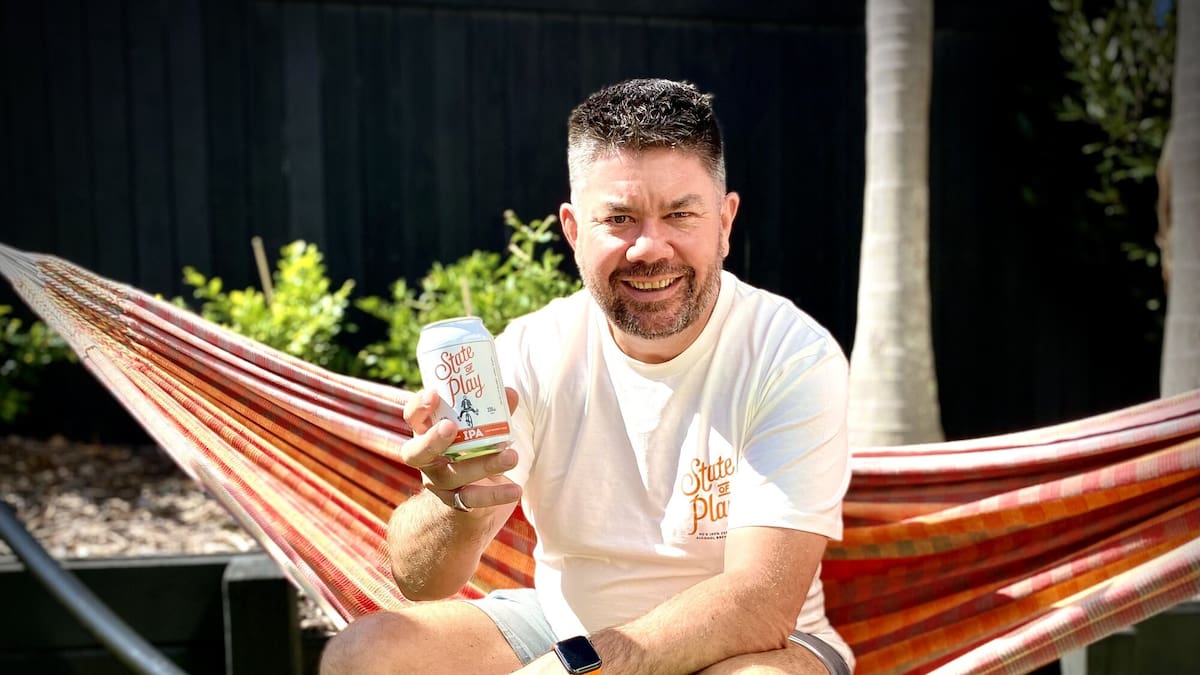
“I thought, ‘I don’t think the second half of this game is going to go to well if I don’t make some changes’.”
Caunter said that the moment of realisation led him to stop drinking alcohol altogether, and said there was no shortage of alternative non-alcoholic beers.
“What really astounded me was … it was more important that you were having a beer rather than how much alcohol was in the beer, and it was a bit of a lightbulb moment for me.
“Ten months later, I was 50kg lighter, and my heart rate was 30 beats per minute lower … I really think I can put it down to the alcohol.”
When Caunter moved back to New Zealand in 2021, he got to work to create his own line of non-alcoholic craft beer, brewed in Ahuriri, Napier.
“Our first cans came off the production line in April 2022. Our first was a State of Play IPA.”
He said at the time, people were “untrusting and suspicious, a little brewery could deliver on the promise of taste above all else”, but through his fermentation methods, produced uncompromised flavour.
Caunter said that since that time, more and more people are choosing to drink non-alcoholic beverages over those with alcohol.
He attributed this to consumers wanting to change for social and health reasons, but also being more conscious of what they put in their bodies and the impact it has.
“It’s equal parts social and wellness, there are functional benefits in non-alcoholic.
“We are following a global trend and a global phenomenon … When we launched in 2022, non-alcoholic beer was less than 2% of total beer, now we are almost at 4%.”
According to Alcohol&Me, adults in New Zealand are making responsible choices when it comes to drinking. Photo / Unsplash
Those choosing a drink with alcohol were doing so with more knowledge than before.
Jude Walter, programme manager of Alcohol&Me, said most adult New Zealanders enjoy a drink and knowing that a healthy liver can only process one standard drink per hour.
“In New Zealand, we are seeing encouraging trends in official data with most of us (83.4%) drinking responsibly, and there has been an across-the-board decline in multiple measures of riskier drinking over many years.”
She said education could help improve drinking culture even further, and Kiwis aged 18-34 years old appeared to be more knowledgeable about alcohol than older generations.
Just 34% of those aged 55 years and older could correctly identify a standard drink as ‘a drink containing 10 grams of alcohol’, compared with 61% of 18-34 year-olds.
“Our research shows that while most people believe they have good knowledge about alcohol, when we measure their actual understanding, it falls short.”
Hawke’s Bay woman Marina Rieger said she chose not to drink, and not because she couldn’t, but because she was aware of its impact on how she felt.
The 27-year-old originally from Brazil said she was much more aware of the impact drinking had on her wellbeing, so she made better choices to suit her lifestyle.
“If you drink, that affects your lifestyle quite a lot so little by little I started understanding if I chose to drink, I wouldn’t feel as good as if I didn’t and slowly I stopped.”
She said in her experience, New Zealanders had a stronger drinking culture than Brazilians, who would only drink socially.
“Most people I know and have met here … still drink if not every day every second day just at home, back home it’s more like a social thing.”
Rieger said there was also a lot more education around the impacts of alcohol and found that people of her generation, compared with older generations, had better access to this learning to enable smarter choices.
Walter said 30% of people thought a standard drink is a single bottle or can of beer or a glass of wine.
“The knowledge gap is greater among our older generations.”
Walter said the number of standard drinks is displayed on the label of all packaged alcoholic beverages.
“A standard drink is 10 grams of pure alcohol, whether you’re drinking beer, wine, spirits or RTDs, but the volume varies by how strong your drink is, which means it is usually not the same as a single can or bottle.”
Michaela Gower joined Hawke’s Bay Today in 2023 and is based out of the Hastings newsroom. She covers Dannevirke and Hawke’s Bay news and loves sharing stories about farming and rural communities.