
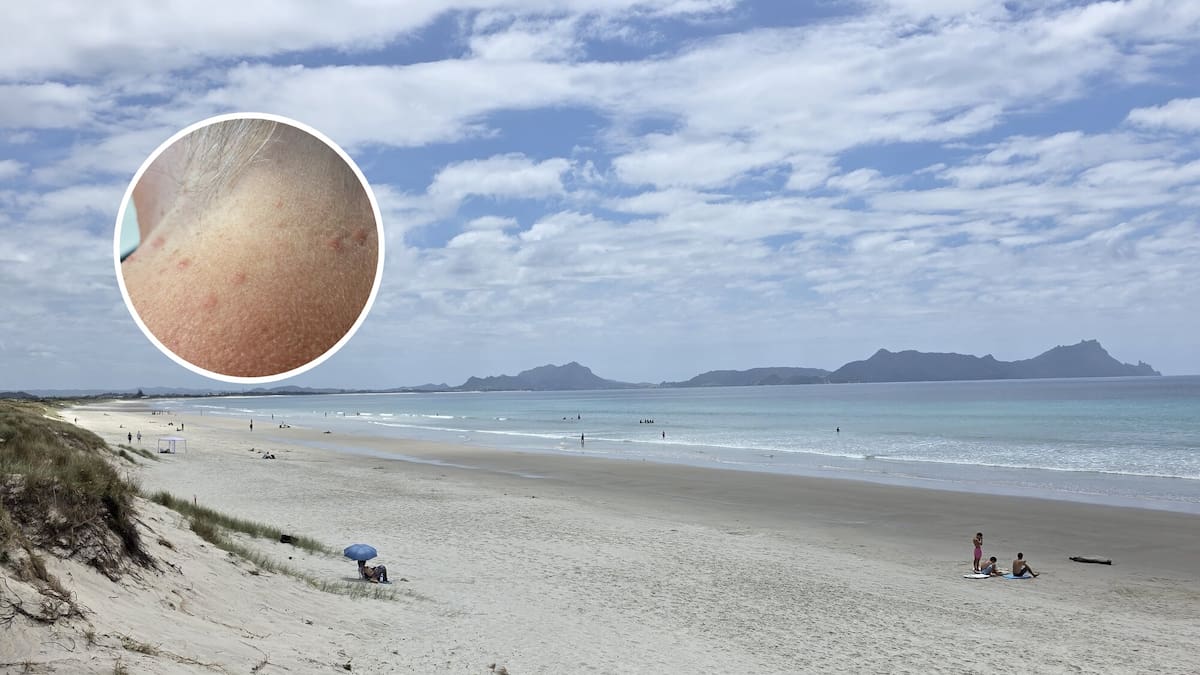
The unwelcome invaders cause significant allergic reactions in some people.
They sting without swimmers feeling it, their impacts typically not showing up until the first evening or next day.
Waipū Pharmacy pharmacist Brenda Wells said outbreaks of the painful pest were marked by their sudden start.
She said people had suddenly started coming into the pharmacy on Saturday and this continued on Monday.
Wells said antihistamine, calamine lotion, hydrocortisone and local anaesthetic cream were main treatment options, but treatment choice depended on how badly the stings manifested. It was important to get treatment advice.
She said the outbreaks typically occurred at this time of year.
Orrs Unichem Pharmacy Ruakākā pharmacist Warren Greene said people had also sought relief at the business on Saturday.
He said the outbreaks tended to happen in calm weather with warm seas.
“It seems to be when things are more settled. In the shallow water where it’s nice and calm and warm – like it’s been the last few days,” Greene said on Monday.
Uretiti beach conditions are unusually flat and calm at present and were particularly so on Saturday and to a lesser degree Sunday.
“They don’t tend to be about quite so much when there’s quite a bit of surf to wash them away.”
Earth Sciences New Zealand Ruakākā aquaculture facility operations manager Steve Pither said Bream Bay’s sea temperature was currently 22.44C.
Ruakākā Beach resident Hanna Modrich said her daughter Annabelle, 8, had been badly affected after competing in a very busy junior surf lifesaving competition at the beach on Saturday.
“She was absolutely annihilated,” Modrich said.
Ruakākā Beach was also impacted by the microscopic jellyfish. Photo / NZME
Annabelle had been stung all over her body where her togs were, and on her upper legs.
Meanwhile, her younger sister Nina, 5, was also swimming at the beach and got stung as well but not as badly, with red marks over much of her lower body.
Modrich’s young niece was also stung after swimming at the same beach on Saturday.
The jellyfish stings don’t show up till some time after swimmers get out of the water.
“The girls said they were itchy when they went to sleep. I just thought it might have been from their recent sleepover with the windows open and mossies,” Modrich said.
She’s now treating them with ice packs and calamine lotion.
Modrich grew up at Ruakākā Beach and has lived there with her family for the last eight years.
“I have never seen them before. It was quite surprising”.
Greene said people were differently affected.
Some swimmers might not be stung at all, while others next to them could be badly affected, and everything in between.
“It ranges from small, red, raised bumps that are itchy but not too bad, through to intensely itchy raised red welts and rashes,” Greene said.
He said it was important people made sure to get out of their togs and swimming wear as soon as they got out of the sea.
They should also make sure to rinse their togs in fresh water and use soap with that when they got home.
American research scientist Dr Anita Freudenthal, who visited New Zealand to study the tiny pest, said the tiny stingers often got trapped in togs or tangled in body hair and as a natural defence they released a sting when faced with pressure, friction or a change from salt to fresh water.
She said they looked like a dewdrop under the microscope, or a small pearly drop, and were almost impossible to see unmagnified.
■ LDR is local body journalism co-funded by RNZ and NZ On Air.