

A student-led group at Cornell University has successfully deployed the world’s first free-flying light sail.
Alpha CubeSat is also the smallest light sail deployed in space, thanks to its tiny ChipSat computer. The light sail, which weighs only 0.2 pounds (100g), was deployed on Tuesday, January 13, from the International Space Station (ISS).
Light sails present a relatively new method of spaceflight that could eventually send small probes far beyond the Solar System. They harness sunlight and are propelled only by the momentum of photons—particles of light.
Cornell students deploy free-flying light sail
The Alpha CubeSat team, from Cornell’s Space Systems Design Studio, built its light sail under a NASA program that supports student-built spacecraft missions. CubeSats are small, low-cost satellites, making them ideal for experimental missions. Their low weight also makes them well-suited to light-sail missions, which must maintain a very low weight profile to harness the propulsive power of sunlight.
The team designed the Alpha CubeSat to stow and deploy their light sail. Now deployed, it will harness the momentum of sunlight, rather than wind. When light particles—photons—bounce off the super-reflective surface, each one gives the sail a tiny push in the direction the spacecraft is facing. The accumulated effect propels the spacecraft using no fuel. This concept was first demonstrated in space by the Planetary Society’s LightSail 2, which launched to low Earth orbit in 2019.
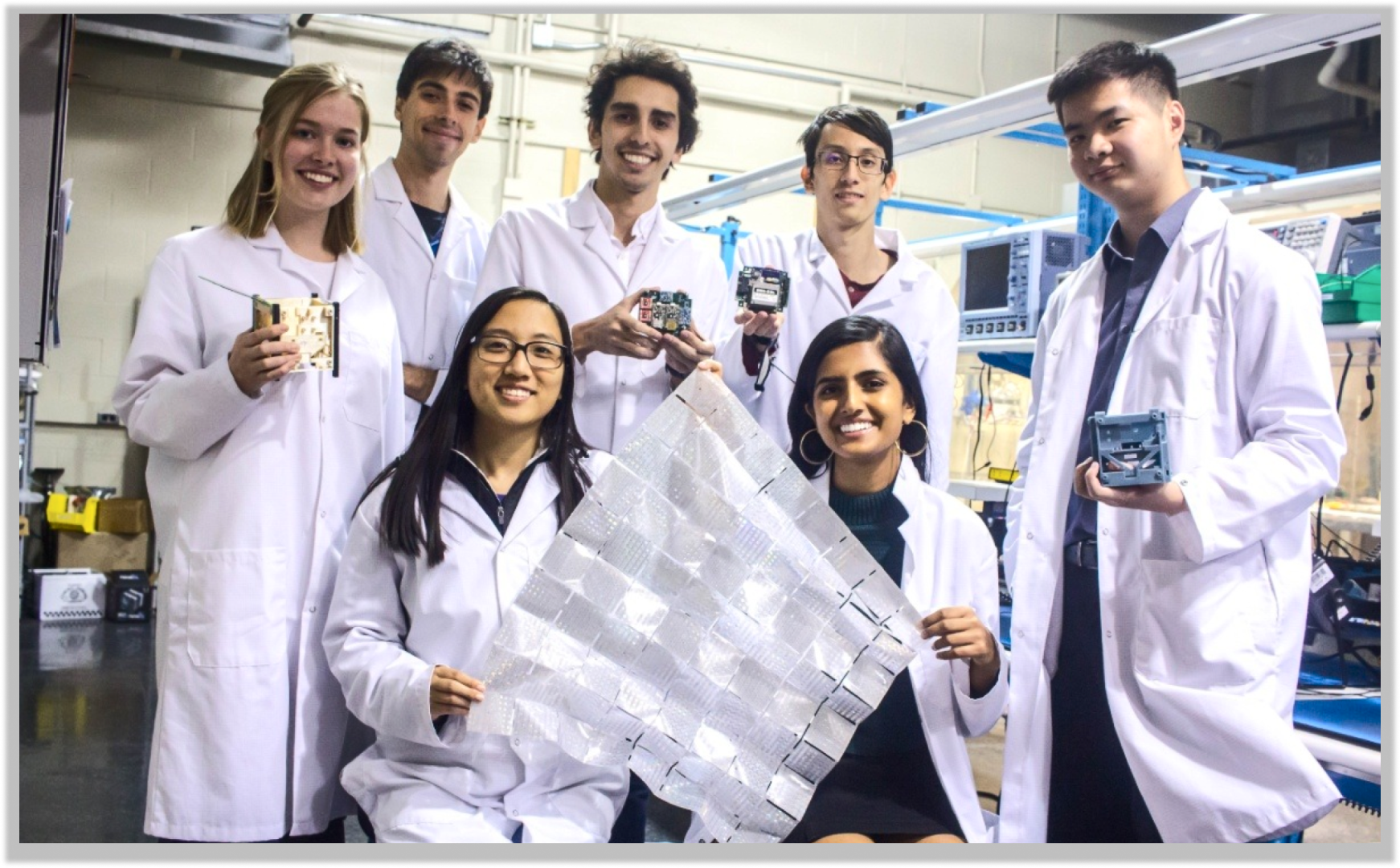 The team showing off the various components of the Alpha CubeSat light sail prior to launch. Source: Cornell University
For their light sail, the team chose a retroreflective polycarbonate material. On its dedicated website, the team explains that its CubeSat uses a “spring-loaded latch on the compartment door”. This allows the small light sail to deploy much faster. “The light sail unfolds near-instantaneously,” the team explains, while “bigger light sails often take minutes to hours.”
The light sail detaches and functions independently of the CubeSat, allowing for a smaller form factor. The light sail measures roughly half a meter across and weighs under 100 grams, including small ChipSats attached to the light sail that serve as flight computers independently of the CubeSat. The sail itself is also only 0.04 millimeters thick.
A two-day light sail mission
The Alpha CubeSat was deployed from the ISS early Tuesday morning. Astronauts used a robotic arm to release the small light sail spacecraft. Once the student-led team established contact with the satellite, they sent a command to open the spring-latched door, unfolding the light sail.
Unlike LightSail 2, the Alpha light sail detached completely from the Alpha CubeSat, meaning it became an independent, free-flying spacecraft. Its ChipSats—tiny satellites—provide solar power, computing power, sensors, and radio communication.
“[The mission] definitely has been an inspiration to so many undergrads that,” said the team’s integration and testing lead Apurva Hanwadikar, according to a report from The Cornell Daily Sun. “Most undergrads never get to touch anything going to space, so [this mission] has given so many undergrads the opportunity to do [something] they never would otherwise.”
After an initial hiccup where the team lost contact with the light sail, they are now in full operation mode. The team will now collect and analyze the light sail’s data until it is dragged back down to Earth. The team says the light sail will survive in low Earth orbit for two days at most, before being brought down to Earth by atmospheric drag.