
Rangipō is just one piece of a complex system covering 2600ha of the Central Plateau – a scheme that harnesses the power of water from in and around the Tongariro National Park.
Built just over 40 years ago, the scheme employs a mix of pipes, channels, tunnels and aqueducts to feed water to Rangipō, the nearby Tokaanu station, and the much smaller Mangaio station.
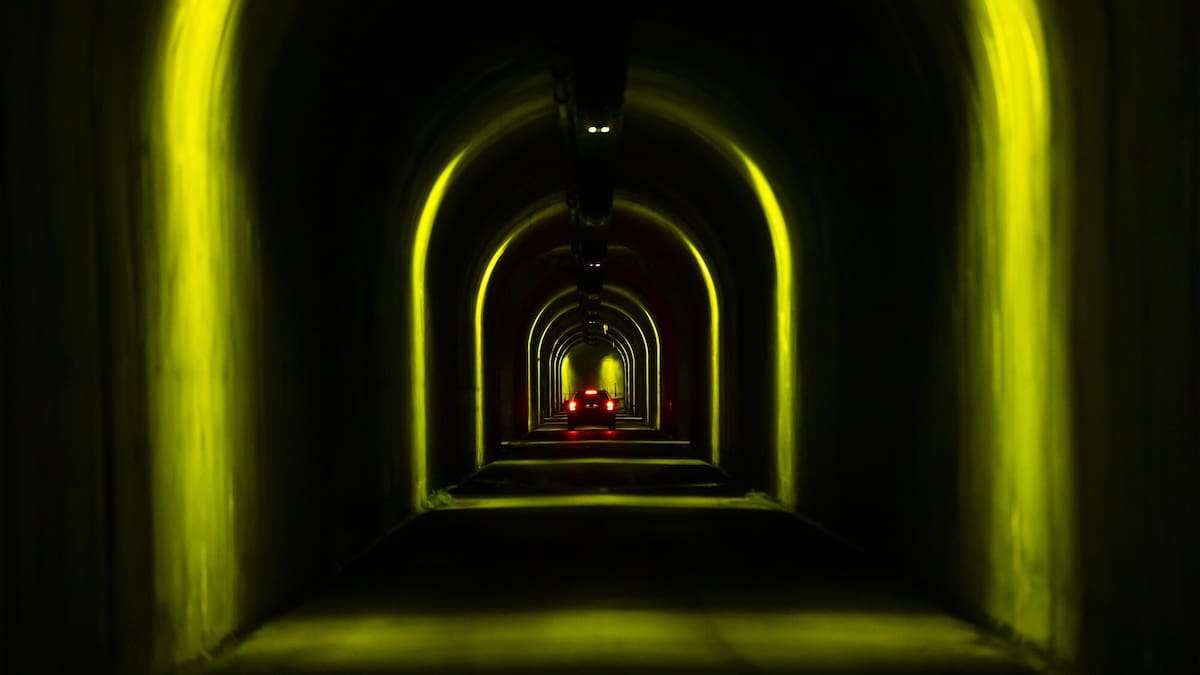
A drive down the tunnel takes us deep within the bowels of Rangipō; its now unused control centre (the station is controlled from nearby Tokaanu) looking like it’s come straight out of a 1970s sci-fi movie.
The now abandoned control room for the Rangipō Power Station, near Tūrangi. The station is now controlled remotely by Genesis Energy’s Tokaanu Power Station. Photo / Jamie Gray
There, a Rangipō old-timer tells us much of the underground facility was hewn out of volcanic rock the old-fashioned way – hand tools and dynamite.
The tour takes us to the “surge chamber” – a huge cathedral-like cavern where the water releases some of its force after running through Rangipō’s twin turbines.
To feed Rangipō, water is taken from the eastern side of Mount Ruapehu via the Wāhianoa Aqueduct, running through the small 1.8MW Mangaio Power Station before ending up in the man-made Lake Moawhango.
From there, it travels 20km along the Moawhango Tunnel, known as the Eastern Diversion, takes in water from the Waihohunu Intake, falls down a vertical drop shaft, then travels along a horizontal section before hitting Rangipō’s turbines.
Once through Rangipō, the scheme gets another bite of the cherry with water diverted from Tongariro at the Poutu Intake, ending up at Lake Rotoaira and then the Takaanu Power Station.
It’s a similar but more complex story on the western side of Ruapehu.
The Western Diversion takes in water from the Whanganui and Whakapapa Rivers, and the Mangatepōpō Stream, is channelled into man-made lakes, Te Whaiau and Ōtamangākau, before moving on to the natural Lake Rotoaira.
A tunnel through Mount Tihia takes water from Rotoaira to the 240 MW Tokaanu Power Station, the 200m drop ensuring it hits the station’s four turbines with force.
From there, a tail race takes water out into Lake Taupō before it restarts its journey down the Waikato River, through nine more hydro stations, before hitting the sea.
All New Zealand’s big hydro projects have had their challenges, but the experts say Tongariro would take the cake as the most complex.
Genesis Energy CEO Malcolm Johns. Photo / Genesis Energy
Genesis chief executive Malcolm Johns still marvels at the ingenuity involved in a project built in the 1970s and 80s without the benefit of today’s advanced technology.
“To basically walk that geography with a canvas pack on your back and to conceptualise how you’re going to build that scheme, and then to sit down in a room with a hundred people with slide rules to design it and then to go and build it, blows my mind,” Johns says.
“It’s spread over thousands of hectares, and there’s absolutely no way, in anybody’s wildest imaginings, that anything like that could be attempted today.”
During construction, official Ministry of Works film trailers, complete with jaunty voiceovers, were commonplace in the nation’s cinemas – featuring the tunnelling specialists brought in from Italy for the 13-year job.
Royce Hargreaves was following in his father Philip’s footsteps when he became part of the scheme 15 years ago.
Like his father, Royce started as a roving operator – monitoring and maintaining the scheme’s complex network of tunnels, pipelines, dams and stations.
“I can recall being on a callout with my old man going to several spots around the scheme,” says Hargreaves, who is now the scheme’s site manager.
“He would carry me up ladders and it was amazing the number of places he took me to – he was a lot fitter and stronger back then – but it really created a true appreciation for me.
“It was like a wonderland as a young kid going into these massive places.”
The Rangipō Dam. Photo / Brett Phibbs
Hargreaves says engagement with Ngāti Tūwharetoa has been important.
“We have a number of different iwi and hapū around the power scheme, which is geographically quite widespread, so we cover different territories.
“And we are always working collaboratively with iwi to bring to fruition our long-term plans and strategies for one another.”
There were some controversial moments in terms of construction of the power scheme under the Public Works Act.
“But we have definitely made a lot of headway since then.”
For Hargreaves, a bad day at the office would be seismic activity in the shaky region.
“Being the Central Plateau, we’ve had a few volcanic re-eruptions. That’s always a challenge for us, not that it’s a frequent event.
“We are always at the mercy of Mother Nature, whether it’s volcanic activity or even floods.
“It’s a big task for our civil teams and our mechanical engineers to sort of stay on top of a lot of this gear in our assets.”
Royce Hargreaves, site manager at Genesis Energy’s Tongariro Power Scheme.
Tokaanu also serves as nerve centre for Genesis Energy’s hydro schemes in the North and South Islands and as a central hub for its other renewable assets.
The station is one of just two North Island hydro stations with “black start” capability to get the power grid up and running should it suffer a big outage.
The actual power grid itself is a beast, Hargreaves says.
If for whatever reason, the system goes down, it can require some coaxing to get back up and running.
“We talk about brownouts quite a lot in the winter period when generation’s quite low and demand’s quite high, but that’s when they’re at risk of losing certain circuits and may look at load shedding to protect the national grid.
“It’s sort of like balancing plates.
“If the plates fall down, then it takes a while to get them back up and running, but it’s not that easy.”
Genesis Energy’s Tokaanu Power Scheme.
Tokaanu has an ancillary generator to start one of its bigger machines and then that bigger machine can liven a line to the nearby Whakamaru substation.
“Then we can bring on another one and then it’s just a matter of like a cascading effect,” says Hargreaves.
“You slowly bring it on bit by bit, more load, more generators, then still more load and more generators – it’s a balancing act and thankfully we haven’t actually had to experience that, but we do testing every two years.”
Hargreaves feels the scheme, and all its intricacy, is not fully appreciated.
“When you look at the manpower, the volume of soil that had to be moved and the tunnelling, and it’s just amazing.
“I’ve had a few conversations with some of the guys who were involved in the construction, and they have a lot of pride in it.
“I guess they were emotionally connected to it, but it’s not talked about anymore.
“It just exists, and they feel that there’s no real appreciation of it, which is sad in a way.
“But I love it, you know?”
Jamie Gray is an Auckland-based journalist, covering the financial markets, the primary sector and energy. He joined the Herald in 2011.
Stay ahead with the latest market moves, corporate updates, and economic insights by subscribing to our Business newsletter – your essential weekly round-up of all the business news you need.