
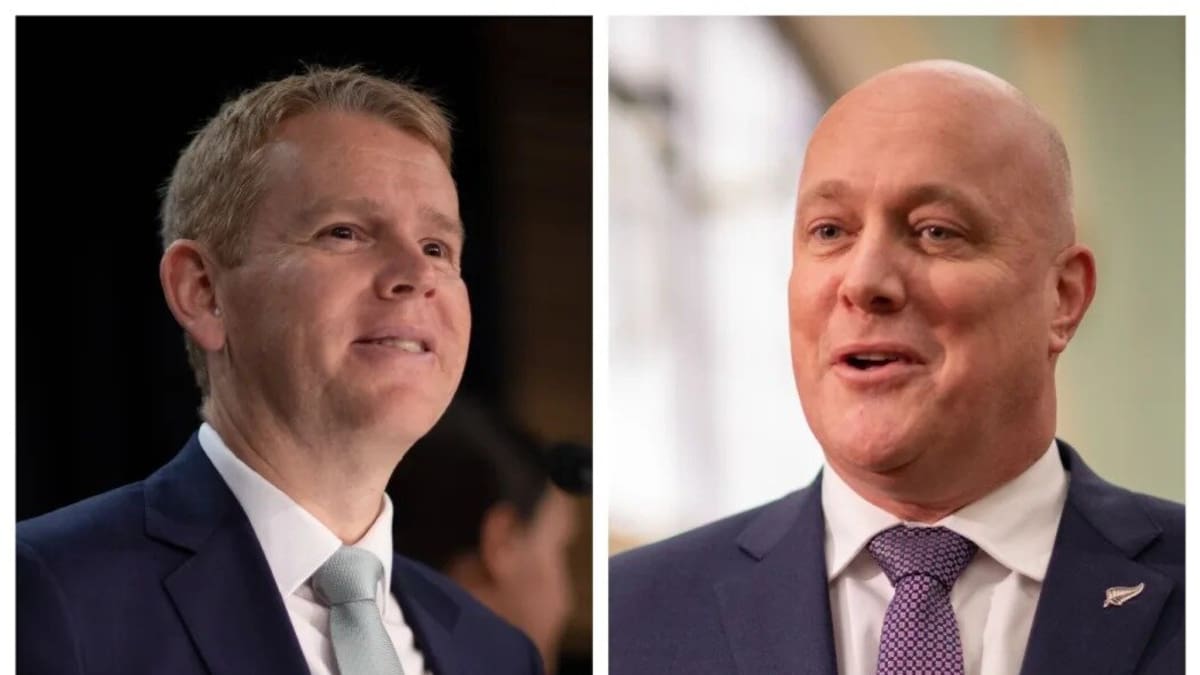
Prime Minister Christopher Luxon turned over a new leaf at the end of last year when he fled the capital on a Jetstar flight – his first with the carrier. He enjoyed the experience and was impressed by the airline’s punctuality, something that can’t always be said for its main competitor.
His break, in Waiheke and Auckland, followed a familiar pattern. Bad weather frustrated fishing plans but he still found time on the water to catch some snapper.
Hipkins isn’t the only one clearing away junk. Both leaders are contemplating reshuffles as they head into the new year.
Luxon’s is not expected next week, which begins with his State of the Nation speech in Auckland on Monday. Held at the new convention centre, a monument to the happier times of the Key-English Government, the speech is likely to focus on one of the few policy areas where voters still trust National: law and order.
He’ll talk up the coalition’s successes and draw a none-too-subtle comparison with the Opposition. Labour has tried to neutralise law and order as an issue, but its only viable path to power runs through Te Pāti Māori and the Greens, whose enlightened criticism of the carceral state is perhaps a little avant-garde for the Labour-National marginal voter for whom Foucault is a sound one makes when congested.
Luxon will then head to Christchurch for National’s caucus retreat at the Commodore Hotel, another throwback to the Key-English years. In 2011, the hotel became one of the few places outside the Beehive to host a full Cabinet meeting. Christchurch readers will know it’s also a short walk from Key’s alma mater (they’ll also know where that is) and Luxon is expected to announce the election date there: probably November 7.
A Cabinet reshuffle is expected later in the year. There’s a consensus that Chris Bishop is overworked and will need to shed something, likely his associate sport portfolio – though he could lose more.
National’s middling performance in the 2023 election leaves Luxon with few Cabinet positions to play with. Almost everyone agrees Chris Penk should move into Cabinet, but whose place he would take remains unclear. Expected retirements early in the year could provide a solution.
Hipkins’ reshuffle is simpler. As Opposition leader, unencumbered by the number of MPs he can squeeze around the Cabinet table, he has more latitude. Duncan Webb’s portfolios will be reallocated after his announcement he will retire at the election.
Labour also holds its caucus retreat next week, choosing west Auckland as part of its effort to win back the city after its 2023 rout. No policy announcements are planned. The party’s narrative-heavy, policy-light approach has worked well so far, and it has no desire to change what’s so far been a winning strategy.
Former National Cabinet minister Maurice Williamson attacked Chris Bishop’s intensification plan for Auckland. Photo / Michael Craig
The political year began dramatically with a leak about a planned U-turn on an Auckland densification change. The proposal hasn’t yet gone to Cabinet, so an announcement isn’t imminent but the details are agreed and it is coming.
This isn’t a case of Bishop being overruled by the leader.
Despite Bishop’s leadership manoeuvrings late last year, he and the Prime Minister broadly agree on knocking housing from its perch as New Zealand’s most beloved asset class. They see the change not as a backdown but as tinkering with a policy that would allow zoning for up to two million additional homes in Auckland.
The big test is whether that two-million figure – so toxic to National’s Auckland base – survives. The mix of urban, suburban and greenfields development almost certainly will change, likely to the enrichment of inner-Auckland properties. The real test of whether this is a tweak, not at all related to reflating the property market, or whether it’s a gentle operational adjustment will come from how many new houses can realistically be enabled by the change.
Luxon and Bishop still bear the scars of Act’s campaign against National over medium-density standards earlier this decade and are wary of a repeat.
But giving Auckland a bespoke fix creates further problems. Councils elsewhere have already implemented Labour’s intensification rules. Forcing them to unwind those changes amid RMA reform and amalgamation talks isn’t going to happen, so the Government is going to need to find a way to explain why Auckland home owners, already the wealthiest in the country, get a reprieve from the nationwide property crash.
The answer is the change isn’t going to be talked about with reference to prices at all. While wealthy central suburbs will benefit most, the change won’t be sold as a green light for renewed property speculation. Luxon’s critique of Key–Ardern “sugar-rush economics” still stands: house prices and immigration will not drive the recovery.
Yet some Auckland MPs want the Government to do just this and signal an end to the housing crash it has overseen to give buyers confidence that it’s safe to get back into the market.
As Matthew Hooton wrote in the Herald, the Wellington-based National brains trust had badly misunderstood the politics of housing in Auckland.
There’s a consensus Chris Bishop is overworked and will need to shed a portfolio or two this year. Photo / Mark Mitchell
In the short term of a three-year Parliament, National has little to show for its pivot from housing to productivity. Tanking home values hasn’t led to a flood of investment in “highly productive” activity. In the long term, affordable houses may mean a better, more productive New Zealand; in the short term, it has most households rushing to stash their ever-diminishing wealth under the nearest mattress.
The most “highly productive” investment most New Zealanders made in this Parliament was throwing money into the S&P 500 by way of their KiwiSavers. Sadly, in that context, “highly productive” is a euphemism for bankrolling American tech firms’ ever more innovative ways for doing most of us out of a job. That’s a problem for Labour too – in a perfect world, its capital gains tax (CGT) would frighten investment from mouldy flats into the innovators who will build the next Xero. In the real world, investment is just as likely to be frightened into the hands of Elon Musk.
Some National MPs believe the Government could improve its Auckland prospects by restoring buyer confidence. No one votes for a National Government to crash asset prices and there’s a sense it may have overshot its mandate.
Labour leader Chris Hipkins is expected to announce a reshuffle soon. Photo / Michael Craig
Bishop’s public cheerleading for falling rents has angered MPs who see landlords as part of National’s base, rewarded in 2023 with the promise to restore interest deductibility. Yet National is unlikely to replace those voters with tenants, many of whom are drifting to Act and NZ First. Cynics wonder whether Bishop’s long campaign for falling rents is part of a longue durée leadership play. The issue is less electoral than principled: MPs shouldn’t bash the base.
Luxon now sits at the intersection of a broad Venn diagram, caught between Bishop’s comfort with falling prices, Auckland MPs’ desire to recapitalise the bank of mum and dad, and his own preference for slow growth below wage inflation. Auckland MPs want symbolic reassurance the regulatory trapdoor won’t be pulled again.
Labour faces similar tensions. While it sees opportunity among renters, whose support is more fluid than home owners’, it no longer sees much upside in celebrating a collapsing housing market.
NZ First, as ever, is one to watch.
While Winston Peters shows no desire to leave Parliament, he may be less keen on another term as Foreign Minister. National MPs are wary of jockeying for the role, knowing it could strain coalition relations.
One sleeper policy to keep an eye on is tougher commercial fishing regulation. A viral video showing dead snapper near Great Barrier Island reignited calls for tougher regulation of commercial fishing. NZ First, whose deputy leader Shane Jones champions the industry, is unlikely to budge significantly this term but National may take a stronger policy to the election.
Every election is high-stakes, but with Labour and National evenly matched, this one more so than most.
If National loses, becoming the first one-term National Government – and the first to last less than three years – the recriminations will be fierce. The party’s “broad church” looks increasingly unsustainable. MPs disagree on housing, spending and the Treaty. Luxon would likely quit Parliament, leaving behind a civil war that could eclipse 2017-21. Some even think the party could split over housing (it won’t).
Labour’s outlook is hardly better. Hipkins, against the odds, kept the party disciplined after 2023. Should Labour lose, however, he’ll only have delayed Labour’s day of reckoning with deep rifts on issues such as tax. His inevitable departure would trigger Labour’s first contested leadership race in 13 years, giving unions and members their first say over the leadership since 2014. They’ve not had great form picking winners in the past. If Labour loses this election, it could well put itself on a trajectory to losing the next as well.