
[Evros Delta and Dadia National Parks Management Unit]
Wildlife authorities in the northeastern Evros region have installed an additional 15 artificial nests in an effort to support the endangered black vulture population in the fire-ravaged Dadia Forest.
Large sections of the forest, home to the only natural population of black vultures in the Balkans, were destroyed by major wildfires in 2022 and 2023, severely damaging the birds’ traditional nesting habitat.
Despite the devastation, black vultures have continued to build nests in burned trees that remain standing. However, many of these dead trunks have begun to collapse – vulture nests can weigh between seven and eight kilograms – prompting the need for human intervention.
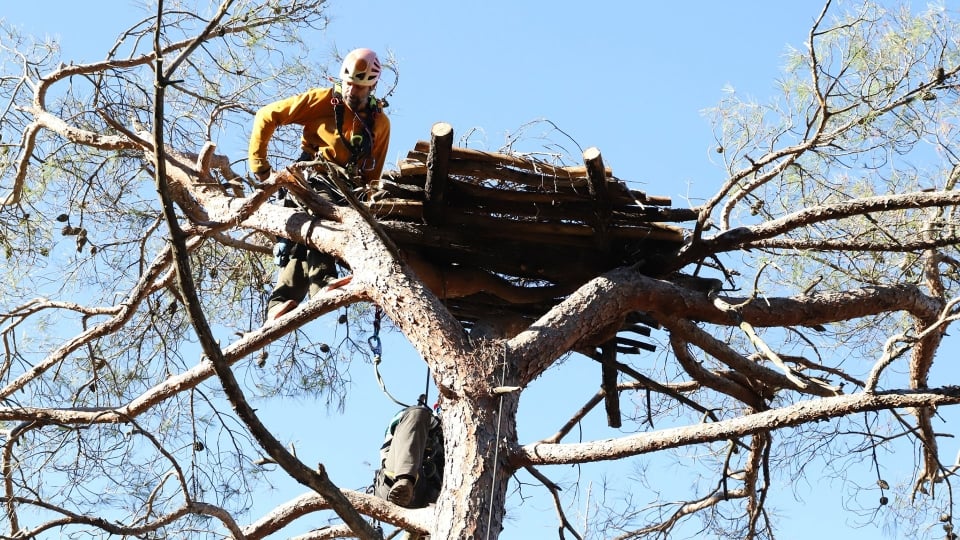
In response, the Evros Delta and Dadia National Parks Management Unit installed the first 15 artificial nests in the autumn of 2023. These were metal structures mounted on pillars. As the black vulture population has continued to grow, authorities decided to install 15 more nests, this time using wooden structures on trees.
“We are trying different approaches,” said Sylvia Zakkak, deputy head of the parks management unit, speaking to Kathimerini. “Now that we have installed wooden ones, we will see which structure [the vultures] prefer and we will adapt accordingly.”
Since the fires, the black vulture population in Dadia has increased by around 30%. Before the disasters, 36 breeding pairs were recorded in 2020. That number rose to 38 pairs shortly afterward and has now reached 47 pairs.
Zakkak cautioned that the rise in numbers may have multiple explanations. “It may be a response of the black vulture to the shock. It is possible that younger individuals have entered the breeding process. Also, our visibility may have increased due to the consequences of the fire,” she said, noting that dense vegetation in the past may have obscured some nests. “Two years is a short period of time and we cannot yet draw a definitive conclusion.”
Beyond raptors, experts are also monitoring the recovery of smaller bird populations in the area. According to Vasilis Zafeiropoulos, a forester and scientific associate of the Thrace Biodiversity Society, signs of ecological recovery are becoming increasingly evident.
“The variety of small birds is increasing and the system is entering a regeneration phase,” he told Kathimerini. “In 2025, 1,540 individuals from 62 bird species were recorded,” adding that the open spaces created by the fires have also attracted new species to the area.