
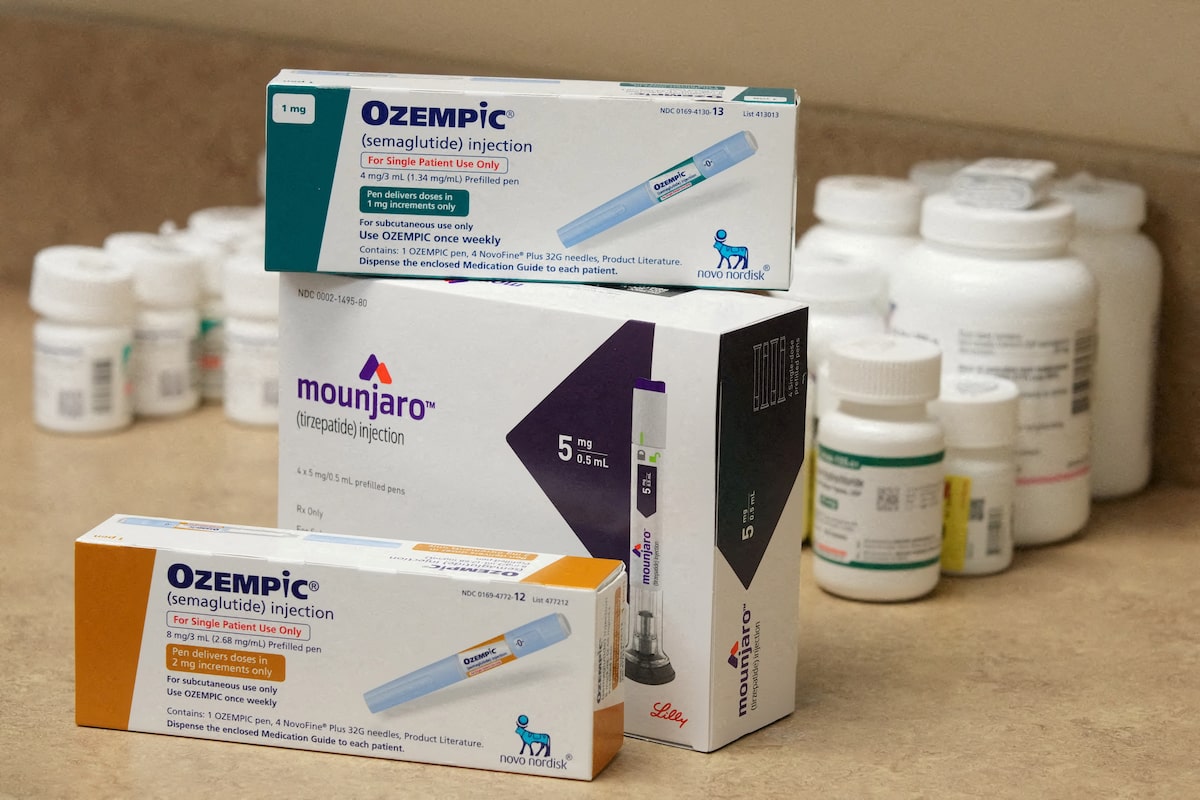
Boxes of Ozempic and Mounjaro, semaglutide and tirzepatide injection drugs used for treating weight loss and type 2 diabetes.George Frey/Reuters
If Ozempic curbs people’s appetites, do they spend less on food and could the savings offset the cost of the medication?
A new paper published in the U.S.-based Journal of Marketing Research provides some financial data to help answer that question.
Keep in mind that the decision to take weight-loss drugs is mostly a health and medical consideration. If you are contemplating the use of GLP-1 drugs (such as Ozempic), that is a conversation you need to have with a medical professional and treat a personal finance columnist’s opinion on the subject as merely tangential.
Looking at grocery and restaurant spending data from more than 22,000 households in the United States (more than 10 per cent of which had at least one GLP-1 user in the home), the study found that yes, there were savings, but those savings were unlikely to cover the cost of the medication for those paying completely out of pocket.
The list price for Ozempic in Canada in 2025 was roughly $3,000 a year and Wegovy was about $5,000 a year, before distribution costs, although Canadians may have varying levels of insurance to offset these costs.
Generics of Ozempic and Wegovy expected to lower insurance costs for employers and workers
In the first six months after taking GLP-1 drugs, the authors of the U.S. paper found that grocery spending decreased by US$390 a year for the average household. The average household in the study was spending roughly US$7,400 per year on groceries, so this translates into a savings of just over 5 per cent.
There were also savings when eating out. Looking at “limited-service” restaurants (think fast food and quick-service), there was an 8-per-cent decline in spending in those same first six months.
There were some interesting details in the nature of the reduced grocery spending. It seemed to have been driven by buying fewer items overall, not simply switching to cheaper versions of the same products. A few categories saw an increase in spending, such as nutrition bars, fresh fruit, and yogurt.
More interesting was that spending reductions were larger for higher-income households. Households earning over US$125,000 saw more than twice the spending reduction versus those earning below US$125,000. Why might that be?
The paper doesn’t settle that particular question but a plausible explanation is simply that higher-income households have more “optional” food spending to be cut, like premium add-ons, delivery fees, and impulse buys that disappear when appetite is attenuated.
Novo Nordisk prepares new cheaper version of Ozempic as generics face delays
Larger financial savings for higher-income households suggests that GLP-1s are financially regressive: Those most likely to be able to afford the medication are also the ones who see the biggest expense savings offset.
For people who continue taking GLP-1s, the continuing reduction in grocery spending and eating out could come up against another expense that could derail any potential savings, even if the drug costs were totally covered: a new wardrobe – though I doubt anyone would complain about that if their goal was to either be more healthy or lose weight.
In our thought experiment about the financial aspect of GLP-1s, we also have to consider an uncomfortable reality. Obesity is associated with lower wages, and the discrimination is most pronounced for women. That means that part of the calculus would consider higher earning potential for people using GLP-1s successfully.
Trying to figure out the “return” on a GLP-1 is harder than it sounds. You would be guessing at weight and health results, estimating food savings, budgeting for a wardrobe refresh, and even considering whether better health changes your earning power.
The paper’s message is not “take this drug as part of your financial planning.” Rather, it’s that people who adopt GLP-1s tend to buy less food, and eat less at quick-service restaurants, especially early on, but the dollar savings are not big enough to base the decision on whether to use them on money alone.
Then again, the patent for semaglutide, a key ingredient in Ozempic and Wegovy, has expired in Canada and cheaper versions of weight loss drugs may be coming soon.
A lower out-of-pocket price would shift the break-even math for some households. Even then, the sensible framing remains the same: this is a health decision first, but side effects may include lower food spending.
Preet Banerjee is a consultant to the wealth management industry with a focus on commercial applications of behavioural finance research.