
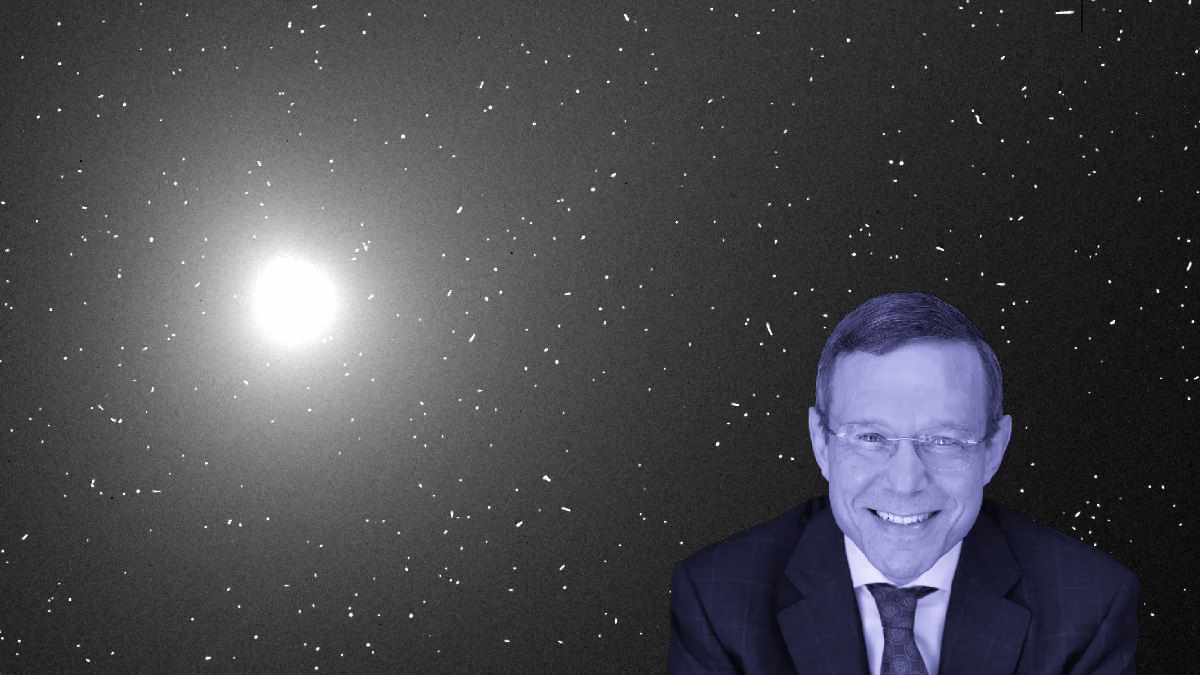
3I/ATLAS, the third-ever interstellar guest in the solar system since 1I/Oumuamua (2017) and 2I/Borisov (2019), has fascinated the lay and the experts alike with its peculiar behavior ever since its discovery by the ATLAS observatory on July 01, 2025. The exocomet became a social media sensation over NASA’s alleged silence in releasing the media related to 3I/ATLAS procured from its various probes. The agency finally released a cache of data while also asserting that, contrary to speculations, it was merely a comet during its presser on November 20, 2025 (available here). However, eminent Harvard astrophysicist Avi Loeb, who has been studying the interstellar interloper ever since, has since flagged at least 17 anomalies in the exocomet. There has been no concrete rebuttal to his arguments based on findings from various observatories. In his latest Medium blog, the scientist shared the anomaly he found in the Hubble images of 3I/ATLAS from January 14.
A new set of six images, taken by the Hubble Space Telescope on January 14, 2026, show the brightness map of the glowing halo surrounding 3I/ATLAS after perihelion. The glow extends beyond 130,000 kilometers towards the Sun, about a third of the Earth-Moon separation.
He further notes
When the image is processed through the Larson-Sekanina Rotational Gradient filter, which removes the circularly symmetric glow around the nucleus, it features a weird configuration of jets, including a prominent anti-tail outflow directed towards the Sun, supplemented by a system of three mini-jets. These mini-jets are equally separated by an angle of 120 degrees from each other, and none of them is pointing away from the Sun as expected for a standard cometary tail.
In conclusion he asks
What is the nature of the anti-tail that allows it to penetrate hundreds of thousands of kilometers through the Solar wind and radiation without being deflected away from the Sun, as often the case in familiar cometary tails? Is the anti-tail composed of fragments of ice (as suggested in a paper I co-authored with Eric Keto, published here), large dust grains (as I suggested in a research note, posted here), or massive objects (as I suggested in a paper, published here)?