
From Earth orbit to the Moon and Mars, explore the world of human spaceflight with NASA each week on the official podcast of the Johnson Space Center in Houston, Texas. Listen to in-depth conversations with the astronauts, scientists and engineers who make it possible.
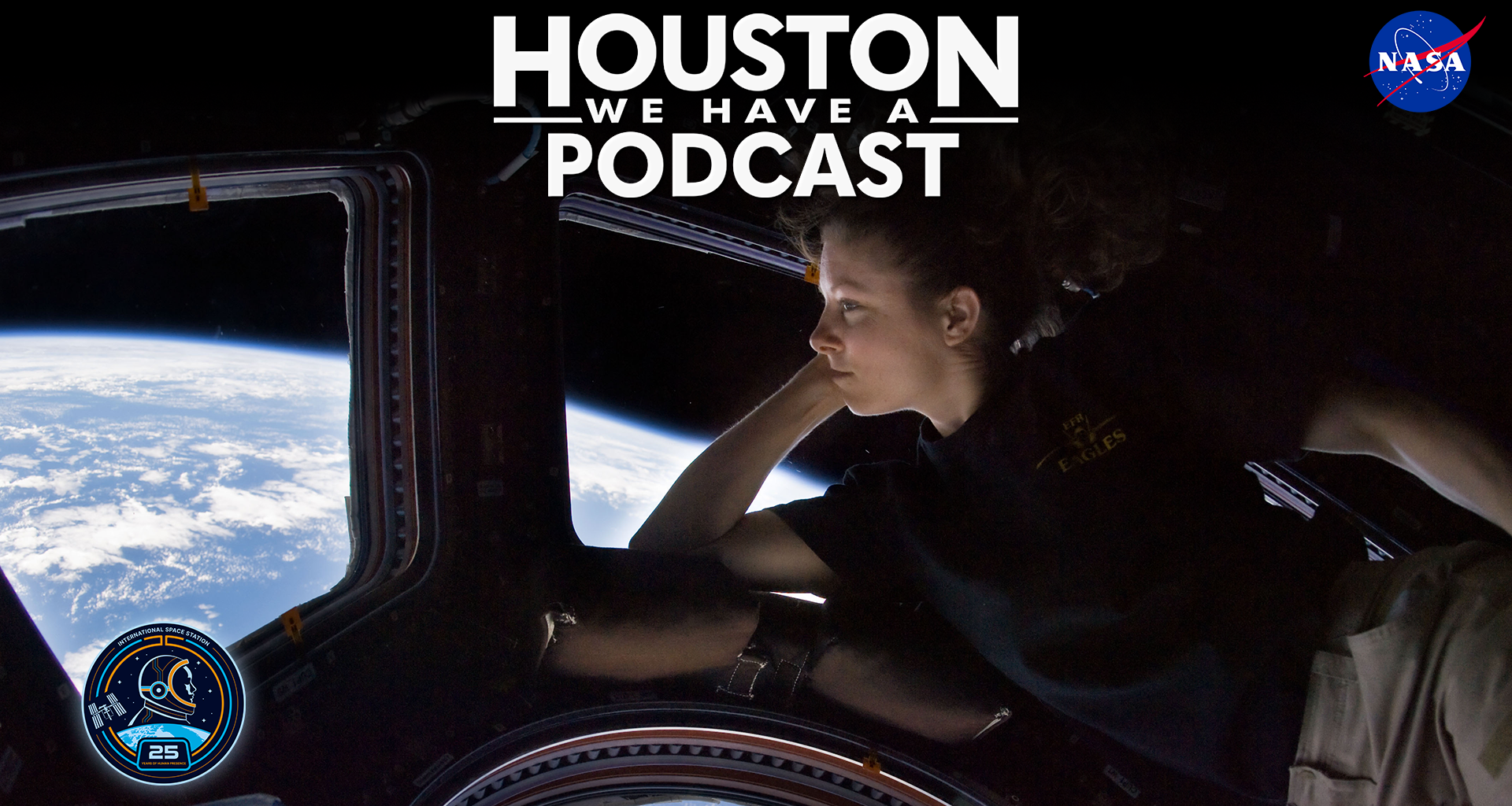
On episode 407, NASA astronaut Tracy Dyson reflects on her experiences living and working aboard the International Space Station and what 25 years of continuous human presence in space means for humanity’s future. This episode was recorded September 30, 2025.

Transcript
Nilufar Ramji
Houston We Have a Podcast. Welcome to the official podcast of the NASA Johnson Space Center, Episode 407: A Place in Space to Call Home: Part 1. I’m Nilufar Ramji, and I’ll be your host today. On this podcast, we bring in the experts, scientists, engineers, and astronauts, all to let you know what’s going on in the world of human spaceflight and more.
For the last 25 years, humans have lived and worked aboard the International Space Station… turning what was once a dream into a permanent home in space. What started as a bold idea has grown into a symbol of international cooperation, a cutting-edge orbiting laboratory and a launch pad for humanity’s future exploration of the Moon, Mars, and beyond.
For the astronauts who have lived aboard the space station for these 25 years, the experience of calling the space station home has looked a little different for each one.
As part of our ISS25 series, we had the opportunity to speak with two NASA astronauts who each have different perspectives of life on the space station. You’ll be hearing from one of them, Tracy Dyson, on this episode; and coming soon in Part 2, Mark Vande Hei will tell us about his experiences in space.
Tracy Dyson’s career is deeply tied to the history of the International Space Station, from helping to assemble it aboard the Space Shuttle Endeavor on STS-118 in 2007, to living and working there in 2010 during expeditions 23 and 24 and most recently, returning for expeditions 70 and 71 in 2024. We’ll reflect on what it means to celebrate 25 years of continuous human presence in space, what life aboard the space station is really like, and how this orbiting outpost is preparing us for the next great era of exploration. Here’s Tracy Dyson.
Nilufar Ramji
Tracy, welcome to Houston We Have a Podcast. We are so happy to have you here.
Tracy Dyson
Thank you. It’s my pleasure.
Nilufar Ramji
So before we get into the topic of the space station, I want our listeners to get to know you. So tell us a little bit about you, your background, and maybe when you joined NASA, what what things were like at that time? What was human space flight exploration looking like at that time?
Tracy Dyson
I should go back to the the year of 1997 I had finished up my PhD and submitted my dissertation in the month of June, and I think it was the next month July, when I submitted my application for the astronaut program. And then I went on and did a postdoctoral fellow fellow fellowship in Southern California at UC Irvine. And it was during that period of time that I got the notice to that I was being offered an interview. And so that start that kicked it off. And and then later on that year, I was selected in August of 1998, just prior to turning- my birthday, in fact. And so I began in 1998 with the class group 17. We were called the Penguins, and we were not the largest class, but probably the second largest class of astronauts, with or without our international partner astronauts, we were 25 altogether.
Nilufar Ramji
Wow.
Tracy Dyson
Yeah, there was big but the group before us, the sardines, as they were called, had something like 44 so it was a huge, huge astronaut corps when we arrived. And there’s, you know, depending on which astronauts you asked, there was somewhere between 110 to 140 astronauts. I mean, it wherever it fell, at any one given time, there was a lot of astronauts during that period of time. And it was also a transition time where we were flying shuttles for individual missions, but transitioning to building the International Space Station. And so we, we the class of 1998 are kind of the babies of the International Space Station, because it was only a couple months after our arrival, while we were still astronaut candidates, that we launched the first element of the International Space Station, the functional cargo block.
Nilufar Ramji
That is really exciting. No one can see me right now. I’m smiling ear to ear, just because you actually helped build the space station. You put it together. Yeah, and it’s been up there for 25 years. Tell us a little bit about what that was like.
Tracy Dyson
Oh gosh, it’s hard to put it in a nutshell, because there were so many facets of the construction of the space station. I mean, for us to have a space station, first of all, brand new idea. I mean, minus all the time it took to conceive the idea, plan it, and do all. Work to get the elements but But nevertheless, the operations of an International Space Station were in its complete infancy, and we were a long way from where we are today in terms of even knowing how we were going to operate, because each and every shuttle flight was bringing up a new element to the space station. Each and every flight meant that the configuration of the space station was changing. And so as new astronauts, here we are learning everything. We had to learn about the space shuttle, which was delivering everything, and then we had to learn about each piece of international space station all by itself, and then what it was going to be like when it joined the existing station as we were building it. And at the time- and you ask anybody who was around during that period of time, it was every every shuttle flight was a brand new schematic. Every procedure had a number associated with it, depending on what flight it was. The NBL- the NBL had different mock ups and different configurations and different space walk teams depending on what the configuration of the space station was. And so talk about flexibility and adaptability, right? It was 100% required during the assembly of the International Space Station.
Nilufar Ramji
I just what an exciting time to be at the agency! A period of change, evolution, growth, so many things happening.
Tracy Dyson
Absolutely, and you want to know that the hard truth is that when we arrived, NASA was not the brand everybody was wearing. In fact, as we transitioned into this International Space Station, the country was a bit skeptical about the money that we were spending as taxpayers on this notion of a space station, and what, what was it going to do for us, and we as astronauts, were, you know, the face out there. And we had to not only learn the technical details and the operational concepts and stuff that we were developing, but we also had to talk about the science, which we had not even done yet. I mean, we were building a laboratory. We weren’t actually functioning in one yet, right? But yet, we had to forecast what, what it was going to look like, and be able to communicate it and convince folks that this is the right thing to do. And luckily, It withstood the test of time, but it was really a hard period of time. It’s not the kind of excitement that we enjoy today. Today’s Space Station is a proven platform, and everybody’s like, wants to be a part of it from around the world. But back when we first started, it was tough.
Nilufar Ramji
It’s always hard to build that foundation for everyone to understand what the, you know, the 5, 10, 25-year plan is. So it’s exciting that you got to be there in the assembly, and then you made another trip later on where you saw it fully assembled, and it was living and working aboard that so that proven- that, that proving ground that you established in the early years, you got to live it out in the same time, right?
Tracy Dyson
Yes, yeah, I would say that my flights were placed in such a way that gave me such a view to what we have today. And my my shuttle flight was just a dear time in my life for lots of reasons. But as far as the assembly goes, we brought up an element. And even though it was, you know, by comparison to other elements quite small, was the S5, the Starboard 5 truss. And if you looked at a model of the space station today or a picture of it, you’d be hard pressed to pick out where that thing is, but it is a necessary spacer between two sets of solar arrays. So just want to get that out there. But nevertheless, we did some other things on that flight that were significant, but we were just a part of the assembly and and so that, with with that objective, we docked to the space station for a period of time. And so I got to see what life was like on board without being an Expedition crew member. I just got to live on board the shuttle, go in there, do our work, come back out, etc, for 10 glorious, docked days of a 12, almost 13 day mission.
And then when I came back as an Expedition crew member, I was right at that, that cusp of assembly complete. And, you know, full fledged utilization is what we’d say. But, but we weren’t quite full fledged yet, we were aspiring utilization, and so we were at the point where the station wasn’t going to grow anymore in terms of the number of modules and everything like that. But we were, we were starting to figure out, how are we going to be now efficient with our operations? How are we now going to focus turn our focus from building this thing to actually using it. And so it was really an interesting time, as we it was clunky, very, very clunky in in, in retrospect right now, and the time, it was just like chaos, but, you know, not really sure how it was going to take shape.
And then, most recently, I went up. You know, 14 years later, and there’s been a lot of changes, not to the structure of the space station, but to the operations, the mindset and the slick products and concepts that we have that have allowed us to do some of the most groundbreaking, sophisticated science on or off the planet.
Nilufar Ramji
I have so many questions, but I want to take a pause for a quick second and ask you one specific thing.
Tracy Dyson
Sure.
Nilufar Ramji
It’s been 25 years of the space station. Can you give us a little bit of your reflections of what the last 25 years have been like when you’re looking at the space station, and literally you did everything from assemble it, look at process improvement. You’ve gone up there in different phases of what, what is the space station today? So I want to hear a little bit about your reflections on that.
Tracy Dyson
I gotta pick…
Nilufar Ramji
Is there a certain feeling you might get? Like, are you feeling really proud because you’re smiling with us right now?
Tracy Dyson
Well, pride is one part of it. I don’t want to get emotional, but I feel like, I, you know, when I, when I joined NASA, I felt like a full fledged adult. Because, you know, by age, I really, I really was, but I really feel like, as a professional, I’ve really grown up here. This has been my home. This has been my my, you know, childhood, if you would, in terms of, you know, a professional astronaut, and being a member of this incredible community. And then looking back, you know, now 25 years, and having been here, you know, for as long as I have, I can see the other people who have been here since the day I got here and, and there’s a bit of a, you know, a smile that we a twinkle in our eye when we look at one another and go, “Yeah, we, we’ve watched this thing go through its growing pains. And we’ve, we’ve stuck with it.” And, you know, the ups and downs of station life, if you will, and what it’s taken our agency in terms of its shepherding of this notion even I mean, how audacious right to think that we could not only build this, think of it on the earth, build it in space, and invite other countries, other sovereign nations, to join us in this effort, and we’re pulling it off.
When I think back on the last 25 years, it’s, it’s, there’s some fortitude, you know, some quiet courage it takes, you know, for those moments when you’re like, you know, do we know what we’re doing and, and when you, when you look at somebody else, and, and they’ve got the same, you know, tenacity deep inside you’re like, “Heck, yeah, we know we’re doing. Because we’re doing it together.” Right? I mean, that’s when I think about the last 25 years. I just think about the the hand, the hands that have held one another across this planet and up in space. The only way we could have done it is through our partnerships.
Nilufar Ramji
Right. The international cooperation is huge, and I want to talk to you a little bit about that, but before I get there, just for our listeners sake, because you and I know this, but you’ve been up in space three times. STS-118 around August 2007. And then you had expedition 23/24 back in 2010. And then you returned just about a year ago on Expedition 70 and 71. So if there were there was a highlight from each of those three stints up in space. Could you give us a little bit of a glimpse into that?
Tracy Dyson
Oh, sure. Oh, again, it’s so hard to pick just one, because on my shuttle flight, it was, you know, my rookie flight. And the time the bonds that you form with your crew on a shuttle flight is intense because, you know, you don’t pick who you fly with, right?
Nilufar Ramji
These are your new best friends.
Tracy Dyson
Yeah, these are your new brothers and sisters. And so it takes a little while on the ground to get, you know, established in in our roles, in both the Assigned Roles and then the, you know, the dynamic roles that we have as members of a crew, but it’s beautiful how that works out, and we have the time on the ground to work it out. And so by the time you you know the solids light, and you’re on your way, you’re you’re you’re flying into space with six really close people, and you’re looking forward to executing this mission together, because you’ve worked so hard. And so there’s so many aspects of those missions, however short they were, that are, are just just precious in in just the way humans develop with one another.
And you know, everything from- I’ve celebrated, I’ve celebrated my birthday on. All three missions, believe it or not, and it’s like threading the needle to do it on a shuttle flight, because with the delays and everything that can and we are on our launch, actually did get delayed by a day, but I was in space for my birthday. And our pilot, Charlie Hobart, we call Scorch, tough marine guy, he took out one of his brownies from his own because we all had our own lockers full of food, like personal stash. And he took one of his brownies on whatever flight day it was that my birthday landed on, and he took one of those mag lights, and he took the mini mag lights, and he took the the top off of it, and so it and so it was just the bulb sticking up, and he squashed in the middle of the brownie.
Nilufar Ramji
That’s so sweet!
Tracy Dyson
He’s like, ATC, and he floats the brownie at me with this, you know, big candle glowing. And it was one of the best moments of that entire flight. And then Scott Kelly, our commander, I think it was flight day 10, when we had done a lot of the the work up to that point, or it was close to the end of our mission, docked with the station, and he coordinated with the ground. And he and he said, asked if they could take off, turn off all of the external lights to make it as dark as possible. Because, believe it or not, up in space, it’s hard to see the stars like it is here in Houston for all the lights and stuff, and so made it as dark as possible. And then he looked at me, and Barbara, and B. Alvin Drew, and said, I want you three rookies in that, you know, on the flight deck, in those windows for an whole orbit. And don’t you come down until you’re done.
And what he what he did for us, the time that he carved was so precious to me because, and I’m sure it was to Barbara and and B. Alvin, because for that, for that moment, we got to breathe. Up until that point, it was highly choreographed, constantly moving, constantly getting into different procedures and different activities. And, you know, just crazy trying to keep up with everything. And then we got this moment, and this the tablecloth here is black, but space is blacker. And it’s blacker, is blacker than any black you’ve ever seen, because it’s like infinite, black infinity or infinity. Black is is, is the richest, darkest, mysterious black you’ve ever seen, and that’s what the universe looks like. And when you look at all the stars, it’s like, I’ve got to really make this this story short, but it really deserves so much time, but, but when I looked out at the at the the universe, and I’m looking at all the stars, you know we’re above the atmosphere, I know you know that, we’re above the atmosphere, but here’s, here’s, here’s what that does for you. The stars don’t blink, they don’t twinkle, because you don’t have this light diffracting off of an atmosphere between you and the star, right? And so that was the first thing I noticed, was that these stars are like, solid color, solid light, and then that draws you in like it just hypnotizes you, and then all of a sudden, your eyes kind of make out this, this depth of stars, almost like those graphic art designs that it takes your focal point to be beyond the plane of the picture in order to see this 3d image pop out. Same thing with the stars. I was like, like, wow. So there you could tell the distance. There’s distance between stars, not just one’s bigger than the other and one’s smaller, but distance. And then, and then you start to look at the horizon of the earth, and the earth going by super fast, and the wherever the sun is, it’s casting this beautiful shadow and sun glints and colors in the in the bodies of water like you’ve never seen- pearlescent corals and yellows. They’re just so, so yummy, to use a term that I know interior designers like.
But then you turn around and you look at the shiny metal Space Station and solar rays and radiators that are turning and antennas and boxes, and then you think about the people on Mission Control who are sitting at consoles, sending commands to these things and looking at telemetry. And having spent time in Mission Control, I’m picturing everybody in their attentive to their systems, and it’s just like, This is amazing. This is so amazing. And the people there on the earth don’t even know we’re going over them. And then all of a sudden, things got super blurry, and I was like, what’s going on? And then I realized I was crying. But because you’re in microgravity. Tears don’t fall. They just keep forming bubbles.
Nilufar Ramji
You’re gonna make me cry!
Tracy Dyson
So yeah, there I am with these, like, frog bubble tears. And I didn’t realize it until I took my fingers and I tried to move it away from my eye, because, like, oh, that’s why I can’t see, because I’m being so moved. And. And and then water. The way it reacts with your skin, it has a lot of surface tension. So it’s like, just, it’s just like, this moving around my face. It’s like, I can’t get it off my face. But anyway, so there’s like, this total emotional reverie going on, and that’s just my shuttle flight.
Nilufar Ramji
Oh, my goodness, this visual you just gave us. I felt like I was there with you. I know that. You know, just being an earthling down here, just looking up at the sky, looking up at the stars, looking at the moon, for that matter- just since I’ve joined NASA, you look at it from a different perspective. Even if you haven’t been to space, your vision or your, the grandeur of what it is out there in our universe, it’s just like you have this innate need that you want to explore. You want to tell those stories. You want to bring that home to the public that doesn’t necessarily feel that same way, but you want to bring that excitement to them. So you’re bringing that to our listeners, and I really appreciate you for that. So thank you for talking about your first mission. So now, let’s spend maybe half the time-
Tracy Dyson
Narrow down a little bit. Well, my second mission, I can say real quickly that it was the EVAs, and not just because it’s a space walk, but because of the nature of these space walks. I mean, I was, we had an EVA planned for that increment. It was one Eva, and it was to install a PDGF, a grapple fixture for the arm on the Russian segment. And it wasn’t very far into the Russian segment. Was like just behind node one on on the low, the forward part of the FGB, and we had practiced it in the poll. Not a big deal. It wasn’t a high priority thing, but it was just, let’s get it done on this increment. And then the Pump Module failed. It was first time that we had a critical component fail on board the space station. And we didn’t have a, you know, heroic shuttle crew to come up with their well trained, very proficient spacewalkers to to get the job done. It had to be done by the crew that was on board. And it was the first time something like this had ever happened, and so what I thought was very beautiful about that time, not just that we fixed the problem. It took three EVAs to do it, but we learned a lot through that. It took tremendous teamwork, because when a pump module fails, it’s just like the radiator going out on your car, and if the radiator isn’t working, then your engine’s not going to run much longer before it It seizes, and that’s the same with the space station. And we only had one other pump, but it had its own cooling channel, and so we spent the night the very night that it happened inside the space station, and we actually had to immediately start sleep shifting. So we had two shifts of crews doing this, but we had to jumper. We had to get out jumpers and jumper, everything from the failed power channel to the good power channel. Meanwhile, people on the ground are making all these decisions around the world about the science that we have to move now from one Melfi to another Melfi, which is our deep freezer, to save the science. I mean, there were so many decisions and compromises and coordination that had to happen on the ground, not to mention our whole space walk community who were like, Okay, what just happened? And now we’ve got to go out there without, you know, procedures. We got to develop these procedures. People were getting into the pool last minute to exercise these procedures. I mean, it was an amazing amount of teamwork to get this thing done, and it was incredible to be a part of that.
When you’re up on the Space Station, it may seem like you’re in the mix, you know, like, like, you, you’re, you’re part of what’s going on, but, but you can feel up there, very isolated, because the bulk of the community is here. This is where all the action’s happening, and people don’t necessarily want to bother the crew with, you know, minute details, but so you’re missing out on a lot of what’s going on. But up there, we had, we had plenty to do, but we, we were isolated until we returned to Earth to find out, to meet the people, to shake the hands of everybody that played a role in that. And, I mean, when you’re up there, it’s not lost on you that there’s a, you know, a community of dedicated professionals down here getting the job done, but you don’t get to see it until you get back. And so anyway, those space walks were, were a real defining moment.
Nilufar Ramji
As you’re talking with me, I’m picturing scenes from Apollo 13. Yeah, that’s, that’s what I was imagining. You know, the back room to the back room, if you wanted a visual of what, what things were like, it’s, you know, there’s one person up there, but for every one person, there are dozens, if not 50 to 100 people that are helping you be successful up there. And it takes that game of telephone for you to get the right message and then execute on that which, no pressure.
Tracy Dyson
That was perfect description, though, of the Apollo 13-ness of it. Because, yeah, if we could have recreated, you know, in a video, what folks were doing on the ground. I mean, the sacrifices people were making, like our lead EVA officer, was actually getting ready to go on vacation. So it’s not just the people here. It’s our families too, right, right? Whether they want to be a part of the program or not.
Nilufar Ramji
They are. They’re collateral damage.
Tracy Dyson
I know your listeners are probably laughing right now because they they’ve all had an experience where their family has become, you know, part of…
Nilufar Ramji
Part of the company, right?
Tracy Dyson
Yeah, exactly. They’re part of it.
Nilufar Ramji
Okay, so as you talk about Expedition 70/71, when you talk about the highlights on that, let’s go into a little bit about life aboard station. Let’s talk a little bit about some of the daily routines you had, or balancing, sort of the you know, you mentioned, every single minute of your time is scheduled and everything is planned in advance. It takes years of training to get there. So tell us a little bit about how you balanced all of all of the things that are going on at when you’re, you know, several years into the space station, decades, and what life was like.
Tracy Dyson
Oh, wow. Well, first I want to say that it was such a, it was such a privilege, obviously, to go up and to get another mission to see the space station at this, at this state that we were in, and in terms of full throttle utilization. And being a, you know, my background in research science, it was, it was really something to see the space station become a laboratory, multiple laboratories, a conglomeration of laboratories and facilities. And so there were, there were a lot of moments, you know, like, Oh, this is, this is amazing that we’ve come this far, plus just operating in space. I mean, like I said earlier, it was clunky, and then we’ve refined it so much that that things- I know that there’s newer astronauts that go up that that have a lot to say when they come back about how we need to improve things, but there’s people like me. You have no idea. You should just embrace what is, what is not the suck now, but it’s hard to convince. Folks if they don’t know the history. But suffice it to say, things definitely got better, which they should, right? And and the fact that we are an international, global space station is even more impressive. And then on top of that, we’ve got this fantastic science. But what’s it like every day? You know, I hate to burst the bubble, but it is very similar to what your life is like here on Earth.
Nilufar Ramji
It’s not glamorous like you would envision.
Tracy Dyson
Well, you know, for astronauts, the things that we do on the ground we basically do up there. We just don’t have gravity to help us. And so you name it. From, you know, getting getting yourself ready in the mornings, to trying to figure out how to do this complex task. There’s negotiating all day long of forces that don’t, don’t exist up there. And gravity is the one, the one major one that we notice and so but our days are like you said, they’re pretty structured. And we used to say that where the shuttle was a sprint station is going to be a marathon. So pace yourself, because you know, you got to go the distance you got. You got not just a two week mission, but you got six months. It’s not true. It’s it’s just a long sprint being on the station, station, because there’s so much to do, and especially if you had, like we had the SpaceX cargo missions that would bring up science, and they were only up there for 30 days, and some of that science was extremely time critical, not to mention the volume that we had to transfer back and forth and get things done. And then there’s people, you know, experts on the ground that you have to coordinate. With, and they guide you, in most cases, remotely, through through the work that you’re doing. And so just just a high level of coordination that makes the pace super, super persistent.
And so Monday through Friday, you’re going at a pretty good clip all day long, and it’s Saturdays and Sundays, you know, traditionally are the days off, but Saturday we’re cleaning the station. Every Saturday is house keeping day, and it’s not as regimented as a work day is. But nevertheless, there’s there’s, there’s things that need to get done. And so as a crew, each crew decides, you know the specifics of how you want to approach that. But for the most part, everybody picks a module or two, and we’re cleaning handrails. I mean, it’s, imagine if you crawled on the floor at home, you’d want that floor to be pretty clean, true, yeah. And so on board. I don’t want to get too graphic, but there’s, there’s, there’s a fair amount of cleaning that you want. It Yeah, you want, yeah, toilets, obviously, but, but just surfaces alone that you, you know, the same, the same hands that you know, you eat with, are the ones that you move around with, and everybody’s, you know, touching the same handrails. And so you want to make sure those handrails are clean on a weekly basis.
And so really, you get one full day. Sunday is pretty much your, your day, yeah, the next day, it’s kind of your, your decompress day, where you don’t have to be anywhere in particular for the for the entirety of the day. Sometimes you have conferences, sometimes you have other activities, but it’s really kind of the decompress day. And then with each day, there’s, you know, we all wake up with the morning DPC, the Daily Planning Conference, where we talk to everybody around the world and the control centers, and kind of kick off our day if there’s any changes. And then, bam, we get right into our scheduled activities. And we do get two and a half total hours a day dedicated to exercise. And that may sound like like we’re like in the gym all the time, but a portion of that is set up and and, you know, changing clothes and getting into the workout, but for an hour and a half you’re doing exercise. And that exercise isn’t just for your mental well being. This is so that you can, it’s insurance so that you can walk when you land on the planet like the way you stated that, trust me, you don’t want to be the one that can’t stay on their own two feet. And just for the longevity of your health, you definitely are committed to exercise, if for no other reason, just for understanding the effects of microgravity on the human body and the bone loss, the muscle loss, and all the other ways that your body has to adapt to be in that environment. And so we’re pretty dedicated to exercise every day.
And then we work pretty long days. It’s it’s basically, for the most part, 12 hours you’re on and and you get a few hours in the evening to eat, whatever free time you want to do, and then it’s bedtime. And so that that period of time between the evening DPC and when you go to bed is called pre-sleep. That’s where a lot of people, that’s when you reach out to family, because mostly your family’s in Houston, at least, if you’re a US astronaut, and you’re calling, you’re calling family, because it’s, you know, their afternoon and and you can, you can see a lot of people in pre-sleep and then talk with family and things like that.
Nilufar Ramji
What were some of the small things you were able to do? Like, did you bring something up with you? Or what basically made space station feel more like home?
Tracy Dyson
Oh, I brought, I brought my Bible, first of all, and I brought my journal, this journal I had with me on my previous flight, and I had filled it up between flights with all the reminders of things that I wanted to that I’d learned from my first flight, my first long duration flight, I should say, and it still had all the patches and everything that I’d written from my first flight in there. And then, yeah, while I was on the ground, I was like, “You know what? I want to remember this.” And you know, close friends and family would give me words of wisdom and that know me best. And so I’d write those things in there, and they’re just favorite verses, things that I’d learned and all that. So anyway, was chock full of reminders. And so that was that was definitely up in my my CQ, or my Crew Quarter. Pictures of family and things like that, made it kind of like home and and then my makeshift dresser drawer, which was really just the corner of my CQ, and some bungees, and that’s where I shoved all my clothes. So kind of looked like a bedroom in a weird sense, but trying to relate, relate to everyday life at home.
You know, we get care packages and in those our family and friends and in cards and things like that. So every now and then I’d get something and I’d stick it up, just so I would remember folks at home. So…
Nilufar Ramji
That’s really nice. While you were up there, you said you celebrated all three birthdays three times that you were up there. So anything different from the birthdays that followed?
Tracy Dyson
Oh, it was really tough to beat my first birthday with scorch giving me his very own, probably only brownie. Yeah, I mean, like they pack you full of brownies on a shuttle. So what a sacrifice. Oh, I can tell you this birthday each birthday I’ve had. So when I was on in 2010 Shannon and Wheels, and our Russian crew mates gave me, you know, a birthday gift of some crew provision items that it was kind of a joke, because crew provisioning was hard to keep track of on board, because we had a different system at that time. And I was required to audit a lot of things, and one of the things that we kept running short on were dry wipes, just like Kleenexes, but we use them for a number of things, not just to blow your nose. And they took a Thera band, um that they found in one of the exercise ctbs, and they wrapped it around a package of dry wipes and gave it to me, and it was really the thoughtfulness of how kind it was so kind.
But then on my my recent flight, we started this tradition because we had about six birthdays on board during during our increment, mine being one of them, Suni, Mike, I’m trying to remember who else said, Oh, three of our Russian crew mates. And so we had a number of birthdays, and we started the tradition of making birthday cakes for each other. Oh, and each birthday cake was different. We we got gradually better as the increment went on on how to make these birthday cakes out of whatever we had available. We started out with with cake, uh, making supplies, not cake making, but cake decorating supplies. Okay, so the first birthdays had, like regular icing, but then when we ran out of that, then we had to start getting clever with the materials that we had and, but we managed and and I had a beautiful birthday cake, and nice birthday celebration. It was a little bit of a surprise. We always try to make it a little bit of surprise for everybody. Yeah, and we all congregate in in either the Node One or the SM, depending on whose birthday it is. And then the Russian the Russian colleagues, they, they made these cute gifts, Suni’s, Suni’s was this orange, like there was an apple, an orange and a lemon, or something like that, with toothpicks sticking out. And then, then the Russians have these ribbons that that are an orange fabric. So they made that as hair coming out. Anyway, it’s really cute. And for me, they made a bouquet that was, was a bouquet of flowers, but was actually “tvorog,” which is this cottage cheese… I’m going totally into it. Going in a reverie here. But so, so birthdays in space were a really fun thing. And the whole the whole crew, had a good time celebrating just regardless of whose birthday it was.
Nilufar Ramji
You talked a little bit about your journal and that, that to me, just sung a little bit more about how you keep your mindset to be so far away from family, to be far away from friends, all of your sort of creature comforts, your daily routine here on Earth. So tell me how you managed stress, or how you dealt with mental health.
Tracy Dyson
Wow. Well, certainly my Bible and my journal were a big part of it, but just the preparation for my heart going up there, I would say that my, you know, my, my walk with God, my and all of my family, friends, my my my beloved, my husband, George Dyson, just they knew that the most important part about this mission was not that I do something I’d never done before, But that I love like I never loved before. Yeah, and you have to, you have to, you have to make that a priority when you go into space, because there is so much that is out of your control. Yes, so much so that when the unexpected hits you, and it can hit you more than once you you have to be able to cage yourself on on the things that you can control. And when I read a quote I thought was pretty cool, sometimes we talk about, you know, your your heart being a tea bag, and the situation being the hot water. And when that gets poured on a tea bag, what kind of aroma does that tea bag give off? And I’ve also heard, you know, when you get cut by a knife, you know, what comes out? If the, if the situation is the knife cutting your heart, what comes out? You know, how do you respond to these things?
And so coming up, I think, going on a mission, a long duration mission in particular, requires not just technical preparation, but mental preparation, because you are going to face these things, and you’re not going to have all of your comforts that you’re used to having on the earth. You’re not going to have all of your support system readily available to you. And so yeah, I had had lots of reminders, but just lots of good. I had a good heart posture getting up there. And it’s good too, because I had some real life challenges, not just the, you know, from our launch abort at T-minus 20 seconds, and which required our crew to download the next day to a from a two orbit rendezvous to a 34 orbit rendezvous. How fun. How fun. And thank goodness I had two extraordinary people to spend in free flight with getting to the station, so it wasn’t as uncomfortable as it could have been, but it was still two and a half days in a small Soyuz capsule when we were really hoping to get there in two, you know, two orbits a couple hours.
But turning around from that, about three weeks into my mission, I received a call from the ground, and it was during our pre sleep period of time, and I was in node one, eating my dinner, along with my crew mates, when the Capcom called and said, TC, we’re putting in a phone patch on space to ground two and let us know when, when you’re ready. So they told me that there was a problem going on, and I, and they needed to give me some privacy. And so the crew responded, and we moved operational content to the space ground one loop. And when my crew mates, Matt Dominick, went flying around the whole space station to turn off the at us and every other module, and I went to the furthest module that I could, and I waited for the Capcom to put a phone patch through, because I knew some bad news was coming, and thank goodness it wasn’t too long before I found out that the phone patch was not about my husband, but with my husband, but it was the next bit of news that it was my mother. She had just suffered a hemorrhagic stroke, and we were having to make some pretty tough decisions on her behalf.
And so that started a different emphasis on my mission for me, not just, you know, it was, it was a given that the work needed to get done, but how I was going to deal with my mom’s now new situation. She was, she was just in Mission Control with my launch, and then my docking, in fact, Drew Feustel was with her during my my launch, and Reid Wiseman was there, along with all family and friends that were in Mission Control. And Suni, believe it or not, was with her when I docked, and mom was upright and mobile and and full of spirit. And now she’s she’s half a body struggling for her life, and I’m the one that is required to make the decisions on her behalf. And so the entire rest of my mission, and even to this day, has been spent in appointments with neurosurgeons, neurologists, hospital staff, lawyers, every every aspect of healthcare to make decisions on my mom’s behalf and to just uphold her quality of life. And it was a- it was a situation that you just we prepared as much as we could, in fact, for anything to happen, but we didn’t, we didn’t… My husband and I and my mother didn’t plan for this gray area. You know, it was like if we actually moved my mom from our house just before I launched into her own apartment, so that regardless of where we were, she was around people that could help her. And she had lived with us for about 10 years before this moment and then and now that she’s she’s in this new place, and it was by the grace of God that she was with her sister the night that this happened, because she was able to get her to the hospital.
But this whole experience didn’t just change my mother’s life. She went from ambulatory one one, but when she went to bed and paralyzed the next morning, and then all the support that’s been required for her, her well being. But my husband’s life took on a completely different direction. It was bad enough that his wife was going to be gone for, you know, the near eight months when you fly on a Soyuz, you leave several weeks before your launch. But his life had to be rearranged, because now he had to help his mother in law, which he did joyfully, but it still took its toll. And so… but there was a point at which my husband had to leave, because of his navy commitments, he had to leave for two months to Rhode Island for some training, and so we had to develop a support system on the ground to to help get the word to me on board, if, if something were required, you know, time critical with my mother’s care.
And then there was my. Our behavioral health our behavioral health team. We call them, our psych Support is made up of our psych docs that we meet with every, you know, two weeks or so, just to make sure that we’re, you know, cared for and in our, you know, in our emotional mental states up there. But also, we have psych support leads who, you know, the fun part of their job is to coordinate these crew choice events where we get to meet people that we wouldn’t normally meet, you know, if we weren’t astronauts floating around in space. And so these are meant to be, you know, just real spirit lifters and motivational visits and things with other people, but my psych support leads Brooke Loughborough and and then Allison, they both were instead in hospital rooms with my mother and conducting these conferences between me and and the healthcare team on a day, on a on a daily basis, and especially when my husband was out of town.
And so there was just a lot of a lot of living on board that was a challenge because of that. And I wanted my my crewmates, when this happened, really rallied behind me. They were supportive and and knew very well what I was going through. And then when Suni arrived, Suni and I are close friends, because we we not only were class, our classmates, but we interviewed together. And so we go way back and and she knows my mom really well. And having been with my mom, it was really important to to hear everything from her in her last visit with my mom. And so my crew mates were really supportive and understood, you know, in these pre-sleep period of time when I was, you know, everybody else is on floating around fun, doing tours of the station with their family, and all that kind of stuff. I was, for many times, inside my crew quarter with appointments that my husband set up, or Brooke would, she’d run down the hallway to get a nurse because we’d been waiting to ask some questions and so, so there I was, you know, dealing with the kind of things that do you think don’t happen in space.
Nilufar Ramji
But they do happen.
Tracy Dyson
They do happen, and so…
Nilufar Ramji
Thank you for sharing that with us.
Tracy Dyson
Yeah, yeah, you’re welcome.
Nilufar Ramji
That’s a tough spot to be in being so far away, and the fact that you had folks rallying behind you, you had your village that was there supporting you to be able to, you know, make those decisions, have those conversations, ask the questions, I bet you that was some solace given the difficulty of the situation.
Tracy Dyson
Absolutely and talk about situations being out of your control, yeah, having a support system, folks that you trust and and you know are there for you is, is vital. For anybody going on a trip, not to mention going to space,
Nilufar Ramji
you’re just going on a different kind of work trip.
Tracy Dyson
Yeah.
Nilufar Ramji
I thank you again. I really appreciate you sharing that with us. I have a couple more questions, and I kind of want to go back to a topic really quickly, if you would let me you talked about flying on these vehicles, being on station. Talk to us about coming back from space, because you came back from space on a space shuttle and a Soyuz,
Tracy Dyson
Yeah, yeah, wow. Those couldn’t be any more different than if you, like, deliberately tried to be at different ends of the spectrum of space vehicles. Yeah, so the both launch and landing of those two vehicles are vastly different, even though it takes the same amount of time to get to space, but coming home, in particular, you know, the shuttle, as you know, you know, is a glider, a pretty heavy, heavy doesn’t seem like it should be flying in space, kind of brick. I think Eileen Collins once called it like a refrigerator. You know that, like the aerodynamics of a refrigerator coming into the atmosphere, but it does. It glides rather smoothly at the prowess of the commander and pilot and the team on the flight deck to this beautiful soft landing on the runway, and you just roll to a stop, and then the hatches open up, and people come and get you, and you’re you’re basically sitting upright. And if you, if you are up to it, you can just walk out and plus, it’s the shuttle flight. So you’re, you’re not in space for months at a time, it’s weeks, and you still- the the environment that you just came from, does take a little while for the body to adapt. It’s not, it’s not a matter of minutes. It’s it’s. It’s hours and days.
But when you’re on the Soyuz both, both, both vehicles land on Earth. So unlike, unlike a Dragon that splashes down or an Apollo capsule, it splashes down the ocean, both are on earth. But the but the talk about the aerodynamics of a ball, basically, which is the Soyuz capsule shaped like a bell. And you wonder, how in the world, does that thing steer itself to the right spot? It doesn’t just, you know, you don’t just fire engines and then hope that you land in the right place. It’s, it’s actually doing some steering, some some rotating with its jets to to to dissipate energy at the right times and and to control coming in. But, boy, I tell you what. When you are like, right next to the window and you’re watching parts of your capsule ablate, you just for a moment, are thinking, Oh, wait, no, that’s right, that’s supposed to happen. Like, it’s okay that I smell, I smell my capsule burning. That’s, that’s the the heat shield ablating. It’s supposed to do that. And then in all of the bells and the whistles, the pyro is firing, the spinning, the the analog nature that feels like the Soyuz. It’s, it’s, it’s robust.
Nilufar Ramji
Sounds fun!
Tracy Dyson
Oh, it’s, it’s, Mr. Toad’s Wild Ride there! There’s hardly anything funner than a Soyuz re entry. When the when the parachutes release, it’s, it’s the greatest shock of your life. I mean, if you think about how fast you’re screaming, you’re like, going several mock numbers, and this parachute gets released a series of them, but still, it’s, it’s one big, you know, yank, and it’s and then it’s as soon as, as soon as that Yank happens, then the whole capsule starts spinning and swaying underneath as this chutes, that just chute starts to unfurl, and all of that. And then the as the G’s are building prior to that, it’s like this gorilla sitting on your chest. And I listened to my commander on this last one. I don’t think I noticed it as much on my first Soyuz flight, but listening to him make the calls on, on the gravity, sorry, the acceleration and our range, I think he was recalling, but he was you’d hear his voice get heavier and heavier, and I would not want to be him right now. I mean, I’m having to do this, this maneuver that we do to overcome the G forces, but he’s having to talk at the same time. So it was like, it’s a very physical process, I guess is a way to encapsulate a Soyuz.
And then, then, and then, what’s beautiful is that these, quote, unquote, the air quotes, soft landing jets fire like a meter, a meter before you land on the ground. And when people are watching video of a Soyuz landing and you see all this dust kick up, it’s like, oh, like, like, you think that that’s the plunk of the capsule on terra firma, but it’s actually the soft landing jets are firing, and it’s supposed to cushion your fall along with your seat, seat cushion. Yeah, it cocks up on these shock absorbers.
Nilufar Ramji
So I have two follow up questions: That was very visual. It’s just reminding me of bungee jumping.
Tracy Dyson
Have you bungee jumped?
Nilufar Ramji
I have bungee jumped.
Tracy Dyson
Wow!
Nilufar Ramji
That is scary.
Tracy Dyson
Yeah.
Nilufar Ramji
It reminds me of being on some kind of a thrill ride. Insert your favorite amusement park. But it is scary. It’s not for the weak.
Tracy Dyson
Yeah, yeah.
Nilufar Ramji
So I’ve heard being in a Soyuz is like being in the back seat of a bug, a Volkswagen Bug.
Tracy Dyson
Oh yeah, yeah.
Nilufar Ramji
It’s very crammed quarters.
Tracy Dyson
It sure is, oh for three people in there. Yeah, you’re basically on your back, especially when, when the G’s Come on, that’s the sensation you have when you’re in space, getting in your seat, you just feel like you need a seat belt to suck you into the into the chair. But, yeah, in a 1g environment, you’re basically laying down, and your knees are propped up, and so you’re basically kind of hunkered in.
Nilufar Ramji
Like a little bit of a fetal position, almost?
Tracy Dyson
Yeah, pretty much. And then you’ve got these knee pads that that hold your knees in place, and then the harness and everything like that. So you’re you’re tucked in pretty good. Plus your suit is tailored to your body, and the seat liner is molded literally to your your tush. And so it’s that you, you are never going to fit in a seat quite like you fit in a Soyuz.
Nilufar Ramji
Talk about customization. That’s it, right there.
Tracy Dyson
Yeah, and that’s really the crux of how you’re safe in that seat, so you’re not jostling around all that.
Nilufar Ramji
So okay, so now you’re back on Earth. Now you’re back on Earth, and you’ve had three flights. You’ve racked up over 300 days in space. So let’s reflect a little bit. So what’s it like, or what does it feel like to be part of a program that is, you know, it’s spanned decades, generations, legacies. What- Tell me about your feelings?
Tracy Dyson
Oh, well, when I I’ve said this before, when I think about the fraction of the human race that has been to space. It stops me in my tracks, and I think about that, and what that, what that means, and what it should mean, and and all the thoughts I imagine any anybody would have wondering, how do, how does one get to be a part of something as unique and also meaningful as what we’ve done with our space program from the beginning of it to where we are today? And I, you know, I, think, Did I, did I make good did I make good use of that? Did the NASA make good use of that? And you start to think about the involvement, just on a personal level, of the kind of responsibility now that you have with that experience, and wanting to make sure that you don’t just chalk that up as another great adventure, because so much resource has gone into me being here and doing what I’ve done. Especially with having three flights, and these flights being where they’ve been in the development of just the station and the shuttle program alone, not to mention the whole of where we started from as a nation, wanting to go into space and just feeling a tremendous amount of responsibility to put that to good use. But when I think about where we’re headed, and, you know, away from low earth orbit, but not really leaving low earth orbit, because we’ve learned so much. And I’m, I’m here to tell you that I think, I think it’s important that we go beyond how far we go is really just a matter of human imagination and ingenuity. So I’m not gonna put any boundaries on that, but I will venture to say that regardless of how far we go, we’re going to find out that where we are is pretty special.
Nilufar Ramji
Yes, I love that.
Tracy Dyson
Yeah. And everything we do to this point forward, and what we have done is just, I think, going to strengthen that, which is a good thing.
Nilufar Ramji
We go together
Tracy Dyson
And we go together, yes, right? Because we’re, I mean, if nothing else, the unity of what we’re doing, it just, it just highlights where we’re, like a planet. We’re truly a planet. We are. I mean, we’re not just the United States, we’re not just a group of sovereign nations. We’re, we’re a planet and and we should go together.
Nilufar Ramji
You answered my next question about the next your hopes for the next phase of human spaceflight. So perfect way to wrap our conversation. Tracy, it was an absolute pleasure. Thank you for being here.
Tracy Dyson
My pleasure. My pleasure as well. Thank you so much for having me.
Nilufar Ramji
Of course.
[Music]
Well, thanks for sticking around. I hope you learned something new today.
This episode is the third of our International Space Station 25 series, where we’re celebrating a quarter century of continuous human presence in space with the people who made it possible.
If you want to hear more from Tracy, we spoke with her ahead of her latest flight on episode 327. And stay tuned for A Place in Space to Call Home: Part 2, coming soon, where we will talk with astronaut Mark Vande Hei.
You can check out the latest from around the agency at nasa.gov, and you can find more about our astronaut corps at nasa.gov/astronauts. You can also learn more about the International Space station at nasa.gov/iss.
Our full collection of episodes and all of the other wonderful NASA Podcasts can be found at nasa.gov/podcasts.
On social media we are on the NASA Johnson Space Center pages of Facebook, X, and Instagram. If you have any questions for us or suggestions for future episodes, email us at nasa-houstonpodcast@mail.nasa.gov.
This interview was recorded September 30, 2025.
Our producer is Dane Turner. Audio engineers are Will Flato, Daniel Tohill and Greg Wiseman. And our social media is managed by Kelsey Howren. Houston We Have a Podcast was created and is supervised by Gary Jordan. Special thanks to Kara Slaughter, Mary Pfister, and Courtney Beasley for helping us to set up this interview, and of course, thanks again to Tracy Dyson for taking the time to come on the show.
Give us a rating and feedback on whatever platform you’re listening to us on and tell us what you think of our podcast.
We’ll see you next week.
3… 2… 1… This is an official NASA podcast.