
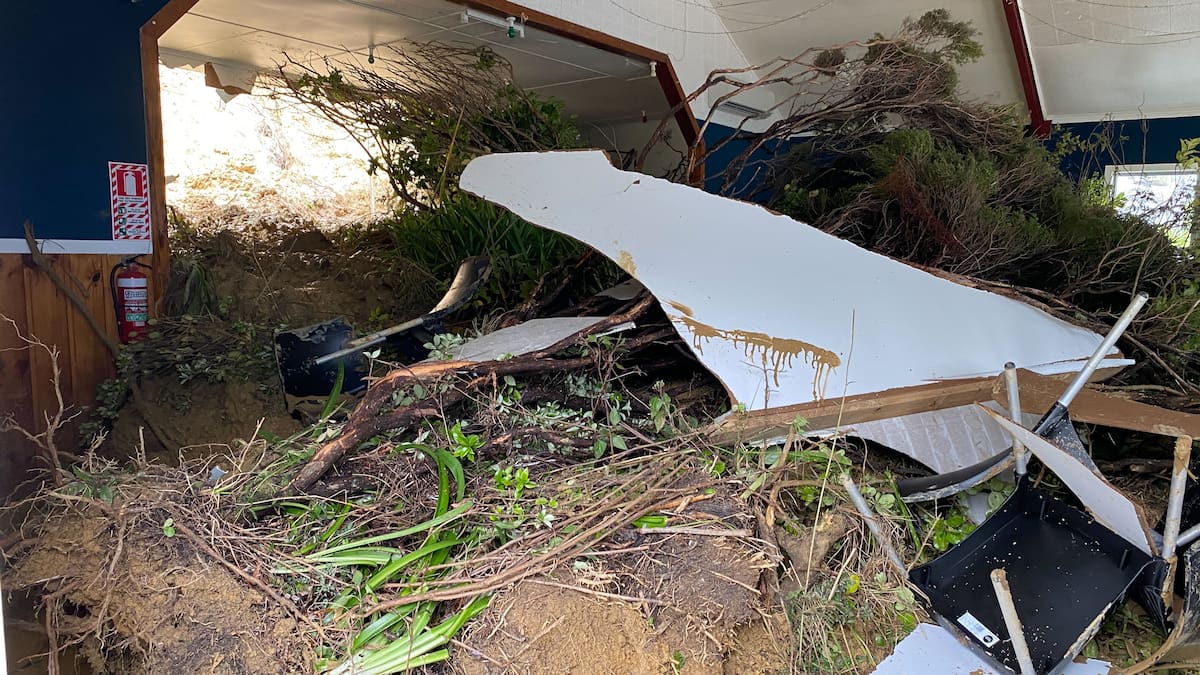
His cattle had got out due to the fences being down.
Floodwaters in Ōakura Bay Rd rose to the height of letterboxes. Photos / Ayla Hawkins
Liv Patu was visiting the coastal area with about 13 others when the bad weather struck, saying “everyone was up around 5.30am moving cars and valuables to higher ground”.
“The whole bay had become one with the creek.”
Further north near Russell, campers at Elliot Bay Campground were trapped by slips at both exits of the site.
Elliot Bay Campground manager Ursula Lambert said there had been about seven slips on the way into Russell.
A visiting couple’s hopes of a fun Northland camping holiday were washed away as torrential rain and strong winds battered Elliot Bay overnight.
Fortunately, their 5‑year‑old son Theo somehow slept soundly through the entire ordeal, his mother Julia Czerwonatis said.
Julia Czerwonatis and son Theo, 5, at their favourite Northland camping spot Elliots Bay before the bad weather hit.
The former Whangārei woman and her husband Sam McLeod, now based in Germany, were hoping for an enjoyable stay at their favourite Northland camping ground, which is about 100km northeast of Whangārei.
Already accustomed to Northland’s tropical weather habits from having lived here previously, they knew rain might come but they weren’t expecting weather anywhere near the intensity that hit at about 1am on Sunday, causing at least one nearby tent to rip.
Czerwonatis said the rain arrived suddenly, hours earlier than forecast predictions, and intensified far beyond what campers or even the campground operators had anticipated.
“It felt a bit like there was a river running under the tent,” she said.
A Helena Bay farmer said it’s the worst flooding he’s seen in 60 years. Photo / Denise Piper
As conditions rapidly worsened, McLeod got up every half hour to check the conditions and for any damage to their gear.
By 3am, they decided to partially pack up so they could move quickly if needed.
Around them, the wind and rain built to a peak between 5am and dawn, pushing more water across the sloping beachside campgrounds.
Helena Bay was swamped by floodwaters overnight. Photo / Liv Patu
Other families on flatter ground got waterlogged more quickly and were forced to wade through rising water to reach an old woolshed on the site, which served as a dry gathering place for children to wait and eat breakfast while their parents tried to pack up.
When daylight broke, the campground’s caretaker checked the access roads.
A slip blocked the route south toward Rāwhiti, but the northern road toward Ōkiato was open, with only smaller slips partly cleared by locals, including one man using a small digger.
Just after 10.30am, the family joined others evacuating and made their way to the Ōpua–Ōkiato car ferry, which was still operating despite the weather.
A local resident said up to 100 people had been staying across two campgrounds when heavy rain began about 2am – an iwi‑owned campground near the marae and a Department of Conservation (DoC) site at the end of the peninsula, which remains isolated.
Only four carloads made it out of the DoC site before a slip blocked the road.
One camper managed to get through by negotiating the slip on a motorbike, but for others the only remaining safe exit was on foot via a farm track.
Ngaiotonga Bridge was washed out on Rāwhiti Rd, just south of Whangaruru North Rd.
Local operators and volunteers opened the campground shop to provide food, hot showers and hot drinks for those still in the area.
About 50–60 people sheltered at Tuparehuia Marae in Whangaruru, northeast of Whangārei.
The marae had solar power installed after Cyclone Gabrielle, specifically for civil defence use.
The system has been used a couple of times since, but this is the biggest weather event yet to put it to the test.
Civil Defence Centres were activated at the marae as well as Ngaotonga in Punaruku, Oteto and Mōkau.
Civil Defence Northland reported three houses were evacuated because of landslides. Occupants of the homes, believed to be Ōakura, were able to safely relocate to local marae.
Floodwaters, downed trees and slips blocked many roads in Whangārei and the Far North.
The Ngaiotonga Bridge was washed out on Rāwhiti Rd, just south of Whangaruru North Rd, and was expected to be closed for some time.
Back in Whangārei, Parua Bay resident Kathy Wallace said the floodwaters covering her Ross Rd driveway were worse yesterday morning than when Cyclone Gabrielle hit.
“The neighbour’s dog kennel has bent the bridge railing,” she said.
Power was cut to 750 Northpower customers in Ōakura, Punaruku and Whangaruru, part of which was caused by lightning. The outages occurred before 7am and by 3pm had not yet been remedied.
Civil Defence Northland, Whangārei District Council, Far North District Council, Fire and Emergency New Zealand, Northpower and the National Emergency Management Agency (Nema) were co-ordinating a response to restore access to affected communities.
Wet weather is expected to continue for Northland this week following the weekend’s torrential rain and flooding.
MetService meteorologist Devlin Lynden said Northland was likely to get showers through today and tomorrow.
“The hope is that things will be a bit drier as people clean up, but unfortunately it’s looking like, particularly for Northland and other eastern areas of the North Island, there’s a general easterly flow that’s pushing moisture into those areas.”
On Wednesday, heavy rain and strong northeasterly winds are expected to hit the top of the North Island as a system moves south from the tropics.
The MetService severe weather outlook said the forecaster is 30-60% confident that “warning amounts of rain” will fall in northern and eastern Northland.